• → European Space Agency

      • Space for Europe
      • Space News
      • Space in Images
      • Space in Videos
    • About Us

      • Welcome to ESA
      • DG's News and Views
      • For Member State Delegations
      • Business with ESA
      • ESA Exhibitions
      • ESA Publications
      • Careers at ESA
    • Our Activities

      • Space News
      • Observing the Earth
      • Human Spaceflight
      • Launchers
      • Navigation
      • Space Science
      • Space Engineering
      • Operations
      • Technology
      • Telecommunications & Integrated Applications
    • For Public

    • For Media

      • Media
      • ESA TV
      • Videos for professionals
      • Photos
    • For Educators

    • For Kids

    • ESA

    • Space Science

    • Our Universe
    • About Space Science
    • ESA's 'Cosmic Vision'
    • Science missions
    • Mission navigator
    • Target groups
    • For Media
    • For Scientists
    • For Kids
    • Multimedia
    • Science images
    • Science videos
    • Animations
    • Downloads
    • Sounds from space
    • Resources
    • Reference section
    • Services
    • FAQs
    • Glossary
    • Help
    • Portal terms of use
    • Comments
    • Follow us
    • RSS feeds
    • ESA Sci on Twitter
    • ESA Space Science Images on Flickr
    • ESA 3D on Flickr

    ESA > Our Activities > Space Science

    Hubble finds double Einstein ring, and other results

    Hubble finds double Einstein ring
    10 January 2008

    The NASA/ESA Hubble Space Telescope has revealed a never-before-seen optical alignment in space: a pair of glowing rings, one nestled inside the other like a bull's-eye pattern. The double-ring pattern is caused by the complex bending of light from two distant galaxies strung directly behind a foreground massive galaxy, like three beads on a string.

    More in depth information can be found here.

    We also present two additional results from Hubble:

    The violent lives of galaxies: caught in the cosmic matter web
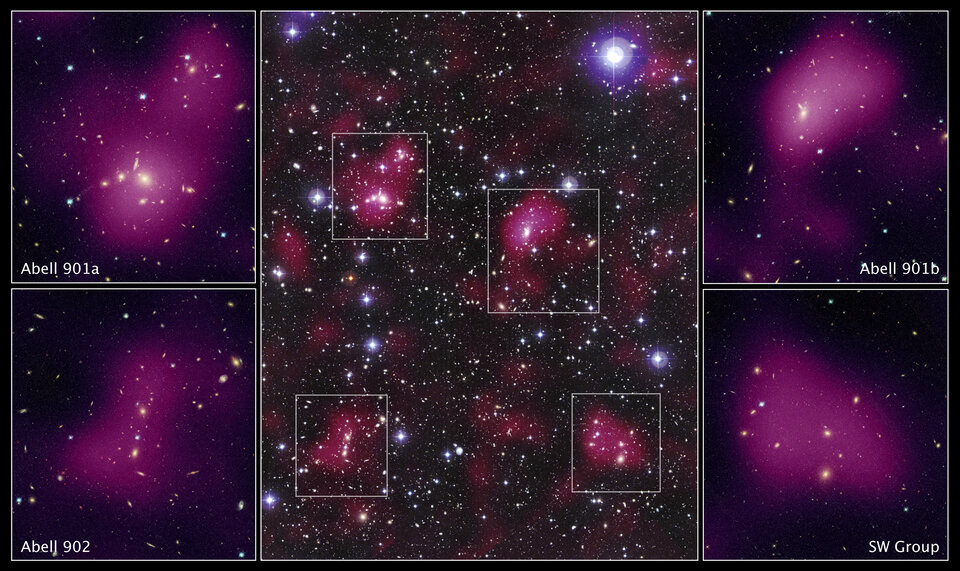
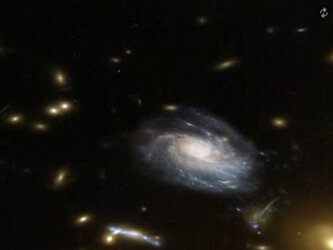
    Hubble maps dark matter web in a large galaxy cluster

    Astronomers are using the NASA/ESA Hubble Space Telescope to dissect one of the largest structures in the Universe as part of a quest to understand the violent lives of galaxies. Hubble is providing indirect evidence of unseen dark matter tugging on galaxies in the crowded, rough-and-tumble environment of a massive supercluster of hundreds of galaxies.

    More in depth information can be found here.


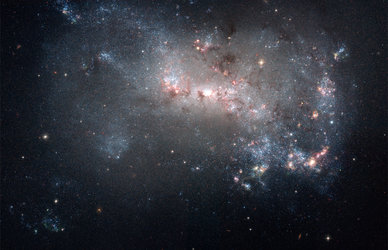
    Hubble finds that 'blue blobs' in space are orphaned clusters of stars
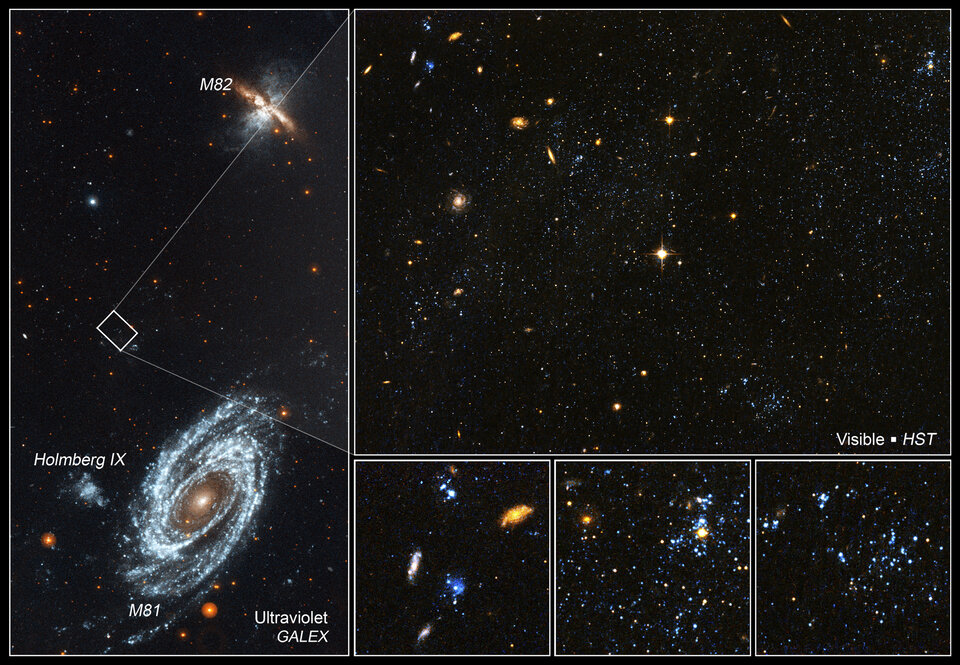
    Location of the blue blobs in galaxy group

    Hubble has revealed that mysterious ‘blue blobs’ in a structure called Arp’s Loop between M81 and M82 are blue clusters of stars less than 200 million years old with many stars as young as, and even younger than, 10 million years.

    More in depth information can be found here.

    Notes for editors:

    The Hubble Space Telescope is a project of international cooperation between ESA and NASA.

    For more information:

    Lars Lindberg Christensen, Hubble/ESA, Garching, Germany
    E-mail: lars@eso.org

    Rate this

    Views

    Share

    • Currently 0 out of 5 Stars.
    • 1
    • 2
    • 3
    • 4
    • 5
    Rating: 0/5 (0 votes cast)

    Thank you for rating!

    You have already rated this page, you can only rate it once!

    Your rating has been changed, thanks for rating!

    75
    Tweet
    • More about...
    • Hubble overview
    • Hubblecast
    • Related articles
      • Hubble - graceful dance of interacting galaxies
        • Extreme star cluster in new Hubble images
          • Hubble and Spitzer find 'Lego-block' galaxies in early Universe
            • Hubble uncovers the Veil Nebula
              • Stellar fireworks through Hubble’s eyes
                • Hubble sees dark matter ring in a galaxy cluster
                  • Hubble sees multiple star generations in a globular cluster
                  • Hubble rescue story
                    • Spectacular star birth pictures on Hubble’s 17th birthday
                      • Hubble’s view of barred spiral galaxy NGC 1672
                        • Hubble sees ‘Comet Galaxy’ being ripped apart by galaxy cluster
                          • The colourful demise of a Sun-like star
                            • New stars shed light on the past
                              • First 3D map of the Universe’s dark matter scaffolding
                              • Unfolding the Universe’s Dark Matter
                              • Related Links
                              • Hubble European Information Centre

    Connect with us

    • RSS
    • Youtube
    • Twitter
    • Flickr
    • G+
    • Facebook
    • Livestream
    • Subscribe
    • App Store
    • ESA Science Twitter

    Follow ESA science

    • LATEST ARTICLES
    • · Rare merger reveals secrets of gal…
    • · Watching for hazards: ESA opens as…
    • · ESA astronaut Timothy Peake set fo…
    • · Space drives e-mobility
    • · Proba-V opens its eyes
    • FAQ

    • Jobs at ESA

    • Site Map

    • Contacts

    • Terms and conditions