Light and dark in the Phoenix Lake
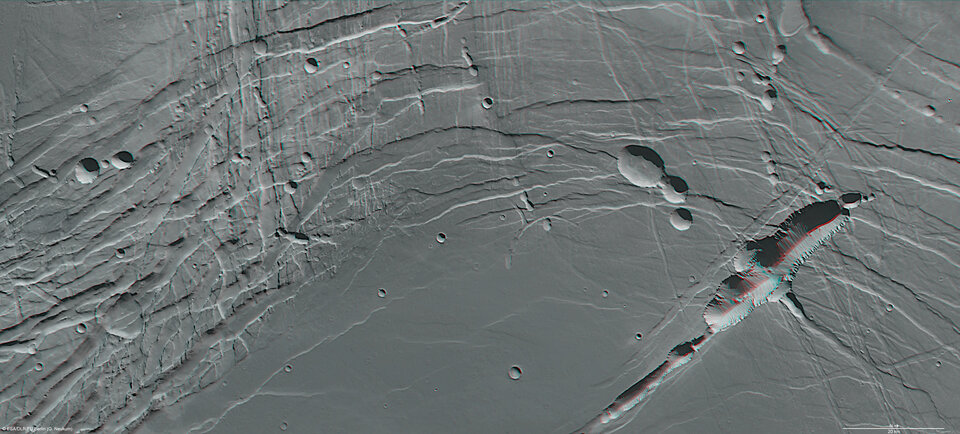
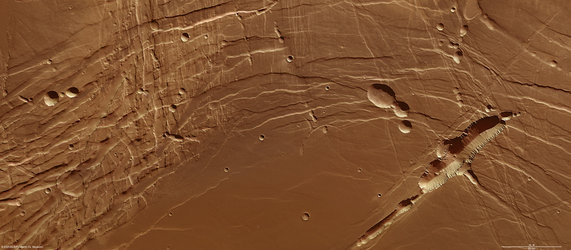
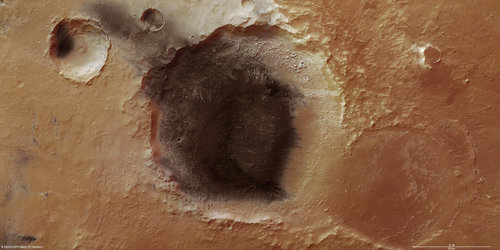
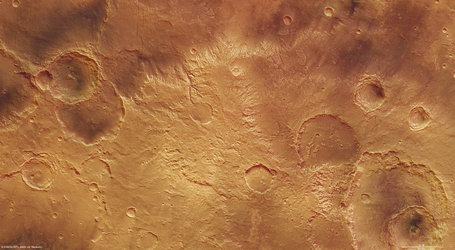
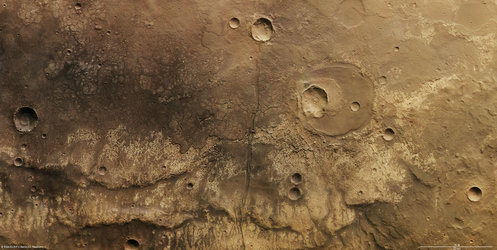
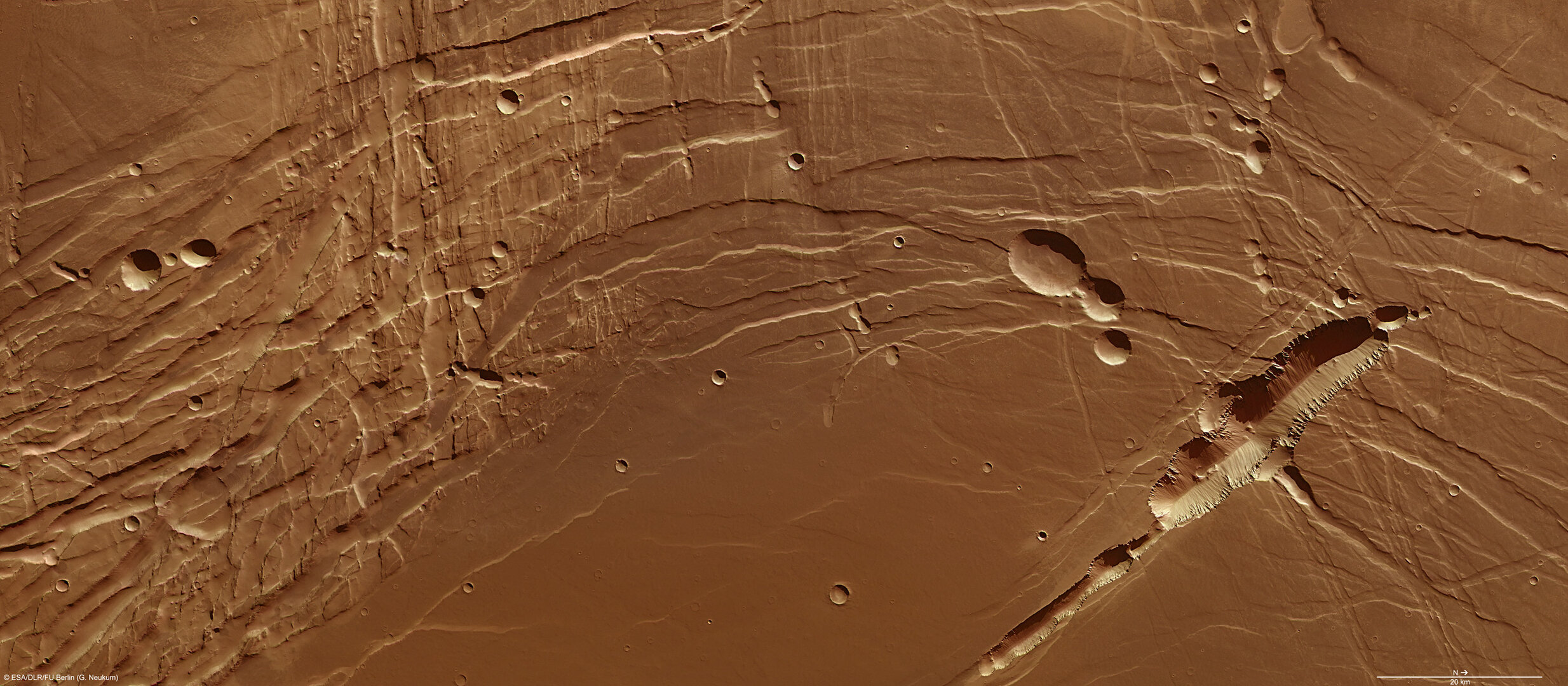
They say you can’t judge a book by its cover but, with planets, first impressions do count. New images show where complex fault lines in Mars’ Phoenicis Lacus region have resulted in terrain with a distinctly contrasting appearance.
Nineteenth-century astronomers were the first to see Phoenicis Lacus on Mars. They identified it as a dark spot, and thought that it resembled a sea. Now we know that it is not a body of water but the southwestern extension of the complex Noctis Labyrinthus system, which stretches away from the giant volcanoes of Mars’s Tharsis region.
The brightness of a surface feature is still the first thing planetary astronomers notice. It is known as the albedo and is partly determined by the composition of the surface material. For example, ice is more reflective than rock. The texture of the surface also plays a part, with rough surfaces reflecting less sunlight and so appearing darker than smooth surfaces.
Phoenicis Lacus has an area of 8100 sq km (59.5 x 136 km), which corresponds to the size of Corsica. Only a small portion of it appears in this image, which was obtained on 31 July 2010 using the High-Resolution Stereo Camera (HRSC) on ESA’s Mars Express spacecraft.
Phoenicis Lacus was formed by the uplift of the Tharsis plateau. The continual episodes of strong volcanic activity in Tharsis not only lifted the plateau, but also deformed Phoenicis Lacus, creating blocks and multiple fault lines at different orientations. Extension has taken place here, resulting in this characteristic ‘horst-and-graben’ (cliffs and valleys) landscape.
A prominent collapse feature in this region is also visible. It shows as a long pit and sinks to a depth of about 3 km below the surrounding plains. Its walls give a glimpse of extensive basalt layers and a small field of sand dunes covers the floor.
An impact crater can be seen on the left of the image. It was elongated during the spreading of the graben and evolved from a circular to an ellipsoidal form.
The other large bowl-shaped structures in this image do not have distinct rims like impact craters, so they are most likely collapsed structures.
http://www.esa.int/Our_Activities/Space_Science/Mars_Express/Mars_Express_image_browser
Traces of Martian life
http://www.youtube.com/watch?v=McdmMMoy730- Mars Express close flybys of martian moon Phobos
http://www.esa.int/Our_Activities/Space_Science/Mars_Express/Mars_Express_close_flybys_of_martian_moon_Phobos - Wind and water have shaped Schiaparelli on Mars
http://www.esa.int/Our_Activities/Space_Science/Mars_Express/Wind_and_water_have_shaped_Schiaparelli_on_Mars - Light and dark in the Phoenix Lake
http://www.esa.int/Our_Activities/Space_Science/Mars_Express/Light_and_dark_in_the_Phoenix_Lake - Mars: how low can you go?
http://www.esa.int/Our_Activities/Space_Science/Mars_Express/Mars_how_low_can_you_go - Mars’s mysterious elongated crater
http://www.esa.int/Our_Activities/Space_Science/Mars_Express/Mars_s_mysterious_elongated_crater - Rocky mounds and a plateau on Mars
http://www.esa.int/Our_Activities/Space_Science/Mars_Express/Rocky_mounds_and_a_plateau_on_Mars - Wet era on early Mars was global
http://www.esa.int/Our_Activities/Space_Science/Mars_Express/Wet_era_on_early_Mars_was_global - Volcanic ash in Meridiani Planum
http://www.esa.int/Our_Activities/Space_Science/Mars_Express/Volcanic_ash_in_Meridiani_Planum - Craters young and old in Sirenum Fossae
http://www.esa.int/Our_Activities/Space_Science/Mars_Express/Craters_young_and_old_in_Sirenum_Fossae - Craters, lava flows and tectonic features near Ma'adim Vallis
http://www.esa.int/Our_Activities/Space_Science/Mars_Express/Craters_lava_flows_and_tectonic_features_near_Ma_adim_Vallis - Craters and channels in Hephaestus Fossae
http://www.esa.int/Our_Activities/Space_Science/Mars_Express/Craters_and_channels_in_Hephaestus_Fossae - Chaotic terrain in Ariadnes Colles
http://www.esa.int/Our_Activities/Space_Science/Mars_Express/Chaotic_terrain_in_Ariadnes_Colles - Ice-covered martian North Pole
http://www.esa.int/Our_Activities/Space_Science/Mars_Express/Ice-covered_martian_North_Pole - The Euminedes Dorsum mountains on Mars
http://www.esa.int/Our_Activities/Space_Science/Mars_Express/The_Euminedes_Dorsum_mountains_on_Mars - Lava deposits in Mangala Fossae
http://www.esa.int/Our_Activities/Space_Science/Mars_Express/Lava_deposits_in_Mangala_Fossae - High Resolution Stereo Camera
http://berlinadmin.dlr.de/Missions/express/indexeng.shtml - Behind the lens...
http://www.esa.int/Our_Activities/Space_Science/Mars_Express/Behind_the_lens - Frequently asked questions
http://www.esa.int/Our_Activities/Space_Science/Mars_Express/Frequently_asked_questions - ESA Planetary Science archive (PSA)
http://www.rssd.esa.int/PSA - NASA Planetary Data System
http://pds-geosciences.wustl.edu/missions/mars_express/hrsc.htm - HRSC data viewer
http://hrscview.fu-berlin.de