• → European Space Agency

      • Space for Europe
      • Space News
      • Space in Images
      • Space in Videos
    • About Us

      • Welcome to ESA
      • DG's News and Views
      • For Member State Delegations
      • Business with ESA
      • ESA Exhibitions
      • ESA Publications
      • Careers at ESA
    • Our Activities

      • Space News
      • Observing the Earth
      • Human Spaceflight
      • Launchers
      • Navigation
      • Space Science
      • Space Engineering
      • Operations
      • Technology
      • Telecommunications & Integrated Applications
    • For Public

    • For Media

    • For Educators

    • For Kids

    • ESA

    • ESA Science

    • Mars Express

    • Europe goes to Mars

      • Europe reclaims a stake in Mars exploration
      • Space age transforms our knowledge about Mars
    • About Mars Express

      • Mars Express mission facts
      • Mars Express instruments
      • The mission
      • The spacecraft
      • The launcher
    • About Mars

      • Geography of Mars
      • Water on early Mars?
      • Signatures of life
      • Facts about Mars
    • Meet the team

      • International collaboration
      • Project Manager
      • Project Scientist
      • Mars Lead Scientist
      • Principal Investigators
      • Operations
      • Industry
    • Multimedia
    • VideoTalk
    • Mars Express images
    • Mars Express videos
    • HRSC videos
    • Animation in 11 languages
    • Download wallpapers
    • Download screensavers
    • 3D Flash 'model'
    • Make a model
    • Services
    • Comments

    ESA > Our Activities > Space Science > Mars Express

    Pack-ice on Mars?

    ESA’s Mars Express sees signs of a ‘frozen sea’

    23 February 2005

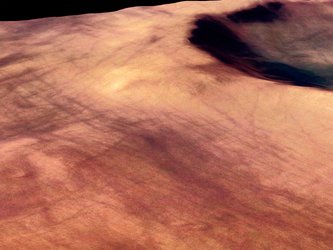
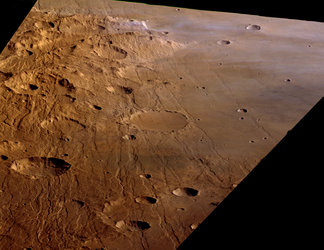
    This image, taken by the High Resolution Stereo Camera (HRSC) on board ESA’s Mars Express spacecraft, shows what appears to be a dust-covered frozen sea near the Martian equator.

    It shows a flat plain, part of the Elysium Planitia, that is covered with irregular blocky shapes. They look just like the rafts of fragmented sea ice that lie off the coast of Antarctica on Earth. This scene, taken during orbit 32, is a few tens of kilometres across, and is centred on latitude 5º North and longitude 150º East.
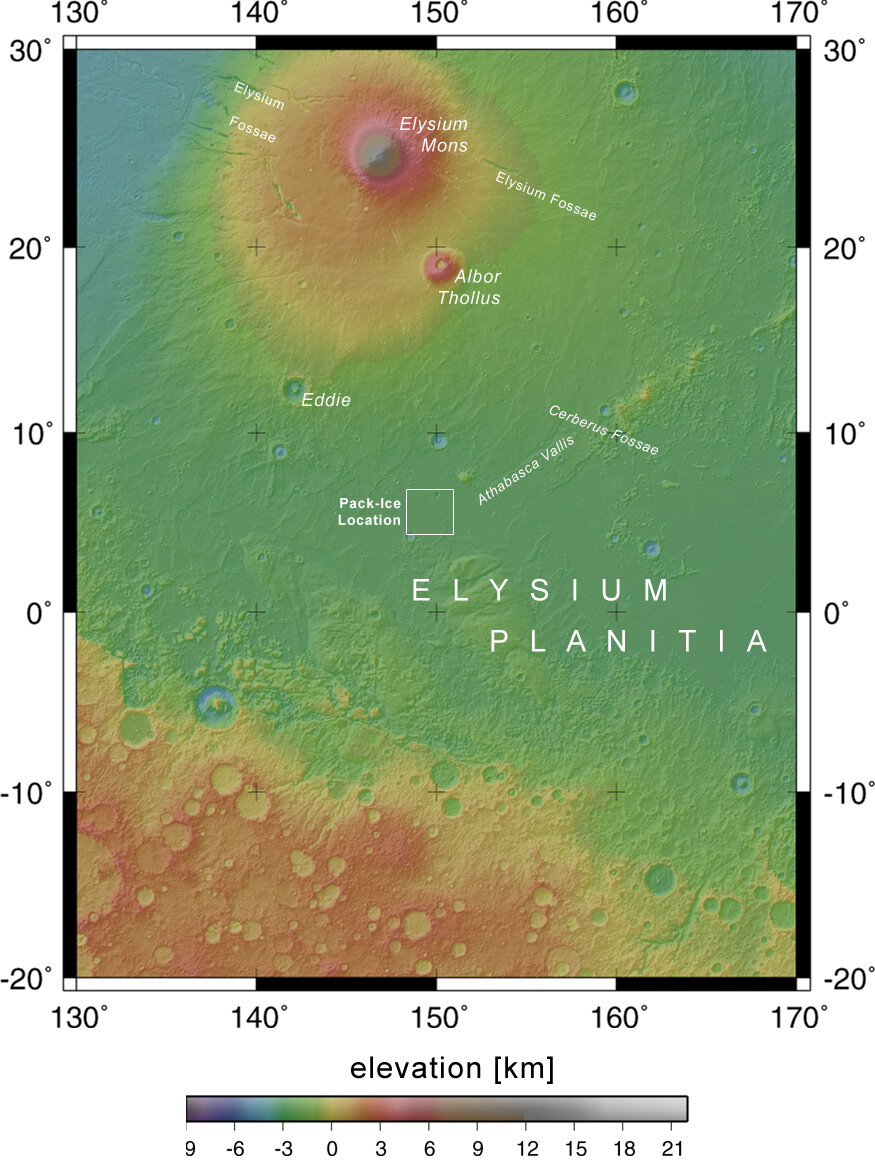
    Map showing location of the 'frozen sea' in context

    The water that formed the sea appears to have originated beneath the surface of Mars, and to have come out through a series of fractures known as the Cerberus Fossae, from where it flowed in a catastrophic flood.

    It collected in a vast area about 800 kilometres long and 900 kilometres wide with a depth of about 45 metres. As the water started to freeze, floating pack ice broke up into rafts. These became later covered in ash and dust from volcanic eruptions in the region.


    Ice is unstable at the surface of Mars because of the low atmospheric pressure, and sublimates away (changes straight from ice to vapour without passing through the liquid state) into the atmosphere, but some of the ice rafts appear to have been protected by layers of volcanic dust. While the entire sea froze solid, the unprotected ice between the rafts sublimated to leave 'ice plateaus' surrounded by bare rock.

    The sparse cratering of this region shows that it cannot have formed more than about five million years ago, meaning this is a relatively young feature.

    The question remains as to whether the frozen body of water is still there, or whether the visible floes are just the remains of the sublimation process. Two observations suggest that the ice is still there: first, the submerged craters are too shallow, indicating most of the ice is still in the craters; and second, the surface is too horizontal – if the ice had been lost, there would be a greater height variation.

    These findings were presented on 21 February at ESA's Mars Express Science Conference at ESTEC in Noordwijk, the Netherlands, where about 250 scientists from all over the world are discussing the first year of scientific results from Mars Express. The complete scientific paper by Dr J. Murray et al. describing the frozen sea results will be published by the journal Nature in March 2005.

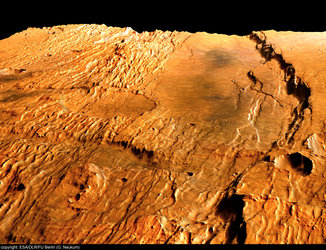
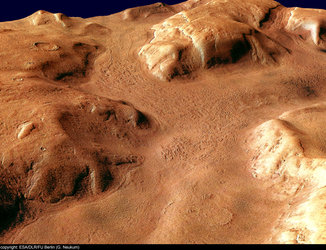
    The colour images were processed using the HRSC nadir (vertical view) and three colour channels. The perspective views were calculated from the digital terrain model derived from the stereo channels.

    For more information on Mars Express HRSC images, you might like to read our updated 'Frequently Asked Questions'.

    Rate this

    Views

    Share

    • Currently 5 out of 5 Stars.
    • 1
    • 2
    • 3
    • 4
    • 5
    Rating: 5/5 (1 votes cast)

    Thank you for rating!

    You have already rated this page, you can only rate it once!

    Your rating has been changed, thanks for rating!

    328
    Tweet
    • Watch the 3D animation
    • QuickTime hi-res
    • QuickTime lo-res
    • Windows Media hi-res
    • Windows Media lo-res
    • Mars Express image browser
    • Recent images
      • ESA’s Mars Express sees signs of a ‘frozen sea’
        • Melas, Candor and Ophir Chasmas: centre of Valles Marineris
          • Fractures of Claritas Fossae
            • Walls of Candor Chasma
              • The channels of Reull Vallis
                • Crater Hale in Argyre basin
                  • Coprates Catena’s ‘collapsed’ structures
                    • Martian moon Phobos in detail
                      • Tithonium Chasma, Valles Marineris, on Mars
                        • Rim of Crater Huygens on Mars
                          • Promethei Terra, southern highlands of Mars
                            • The grabens of Claritas Fossae
                            • High Resolution Stereo Camera
                              • Behind the lens...

    Connect with us

    • RSS
    • Youtube
    • Twitter
    • Flickr
    • G+
    • Facebook
    • Livestream
    • Subscribe
    • App Store
    • LATEST ARTICLES
    • · Rare merger reveals secrets of gal…
    • · Watching for hazards: ESA opens as…
    • · ESA astronaut Timothy Peake set fo…
    • · Space drives e-mobility
    • · Proba-V opens its eyes
    • FAQ

    • Jobs at ESA

    • Site Map

    • Contacts

    • Terms and conditions