• → European Space Agency

      • Space for Europe
      • Space News
      • Space in Images
      • Space in Videos
    • About Us

      • Welcome to ESA
      • DG's News and Views
      • For Member State Delegations
      • Business with ESA
      • ESA Exhibitions
      • ESA Publications
      • Careers at ESA
    • Our Activities

      • Space News
      • Observing the Earth
      • Human Spaceflight
      • Launchers
      • Navigation
      • Space Science
      • Space Engineering
      • Operations
      • Technology
      • Telecommunications & Integrated Applications
    • For Public

    • For Media

      • Media
      • ESA TV
      • Videos for professionals
      • Photos
    • For Educators

    • For Kids

    • ESA

    • ESA Science

    • Mars Express

    • Europe goes to Mars

      • Europe reclaims a stake in Mars exploration
      • Space age transforms our knowledge about Mars
    • About Mars Express

      • Mars Express mission facts
      • Mars Express instruments
      • The mission
      • The spacecraft
      • The launcher
    • About Mars

      • Geography of Mars
      • Water on early Mars?
      • Signatures of life
      • Facts about Mars
    • Meet the team

      • International collaboration
      • Project Manager
      • Project Scientist
      • Mars Lead Scientist
      • Principal Investigators
      • Operations
      • Industry
    • Multimedia
    • VideoTalk
    • Mars Express images
    • Mars Express videos
    • HRSC videos
    • Animation in 11 languages
    • Download wallpapers
    • Download screensavers
    • 3D Flash 'model'
    • Make a model
    • Services
    • Comments

    ESA > Our Activities > Space Science > Mars Express

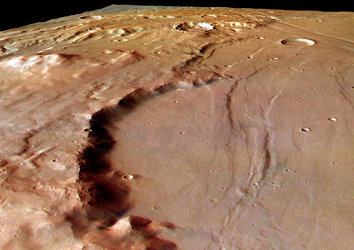
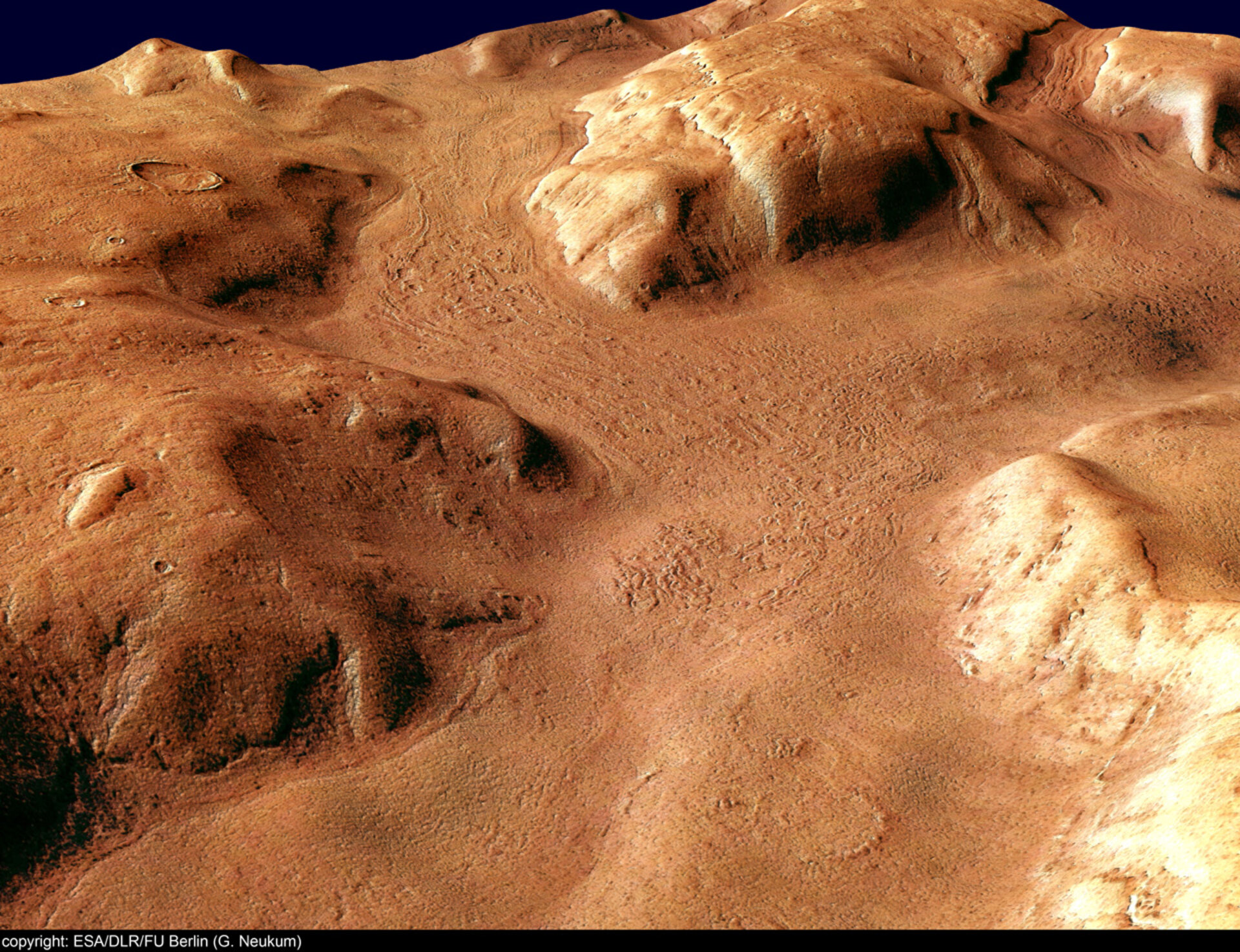
    Perspective view of Reull Vallis, looking south-east

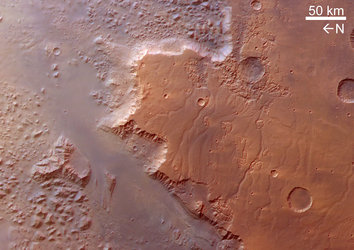
    The channels of Reull Vallis

    7 December 2004

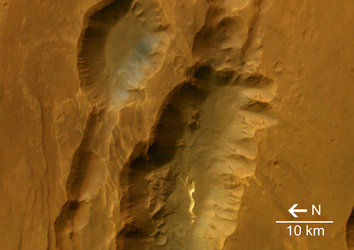
    These images, taken by the High Resolution Stereo Camera (HRSC) on board ESA’s Mars Express spacecraft, show a region of Reull Vallis in the southern hemisphere of Mars.

    Map showing Reull Vallis in context

    The images show an area located at about latitude 42° South and longitude 102° East. The image was taken with a ground resolution of about 21 metres per pixel during Mars Express orbit 451 in May 2004.

    Reull Vallis is an outflow channel that extends 1500 kilometres across Promethei Terra in the direction of Hellas Basin. It is approximately 20 kilometres wide and has cut into the surrounding plain to a depth of 1800 metres. It is the major outflow channel in the region and exhibits a high degree of surface modification, suggesting a complex evolution.


    Reull Vallis in colour

    In these images, Reull Vallis extends from the east to the north-west and is connected to a tributary in the south (Teviot Vallis). Distinct parallel structures are visible in the channels, possibly caused by glacial flow of loose debris mixed with ice. Small depressions, located on the flow features, are probably caused by the sublimation of ice.

    Numerous impact craters, visible on the flanks of the valley, have been filled with material from these flows. Distinct flow features can be recognised within impact craters, for example, the 15-kilometre wide crater in the west (bottom) of the image.

    3D anaglyph of Reull Vallis

    There is a clear morphological distinction between the heavily eroded south-west and the plains of the north-east, which have experienced much less erosion. While most landforms throughout the image have a rounded, softened appearance, younger structures have a distinctly sharp and raised morphology.

    Reull Vallis detail 1

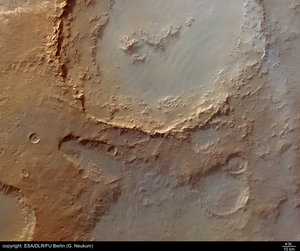
    On the southern and western edges of the colour image, large impact craters are visible. Their diameters range from 15 to 35 kilometres. These craters have heavily eroded rims and are partly filled with material. Erosion has left distinct, branched gully systems at the edge of the large crater that is located on the southern edge of the image.

    Perspective view of Reull Vallis, looking west

    Image resolution has been decreased for use on the internet. The colour images were processed using the HRSC nadir (vertical view) and three colour channels. The perspective views were calculated from the digital terrain model derived from the stereo channels.

    The 3D anaglyph image was created from the nadir channel and one of the stereo channels. Stereoscopic glasses are needed to view the 3D image.

    For more information on Mars Express HRSC images, you might like to read our updated 'Frequently Asked Questions'.
    Rate this

    Views

    Share

    • Currently 0 out of 5 Stars.
    • 1
    • 2
    • 3
    • 4
    • 5
    Rating: 0/5 (0 votes cast)

    Thank you for rating!

    You have already rated this page, you can only rate it once!

    Your rating has been changed, thanks for rating!

    173
    Tweet
    • Looking at Mars
    • Mars Express image browser
    • Recent images
      • Crater Hale in Argyre basin
        • Coprates Catena’s ‘collapsed’ structures
          • Martian moon Phobos in detail
            • Tithonium Chasma, Valles Marineris, on Mars
              • Rim of Crater Huygens on Mars
                • Promethei Terra, southern highlands of Mars
                  • Ophir Chasma, part of Valles Marineris
                    • Solis Planum, Thaumasia region
                      • Eos Chasma, part of Valles Marineris
                        • Crater dunes in Argyre Planitia
                          • The eroded valleys of Dao and Niger Valles
                            • Olympus Mons caldera in perspective
                              • Escarpment and landslides of Olympus Mons
                                • View of deposits in Melas Chasma on Mars
                                • High Resolution Stereo Camera
                                  • Behind the lens...

    Connect with us

    • RSS
    • Youtube
    • Twitter
    • Flickr
    • G+
    • Facebook
    • Livestream
    • Subscribe
    • App Store
    • LATEST ARTICLES
    • · Earth Explorers take centre stage …
    • · The fast winds of Venus are gettin…
    • · ExoMars 2016 set to complete const…
    • · Herschel ends operations as orbiti…
    • · Europe’s largest spaceship reache…
    • FAQ

    • Jobs at ESA

    • Site Map

    • Contacts

    • Terms and conditions