• → European Space Agency

      • Space for Europe
      • Space News
      • Space in Images
      • Space in Videos
    • About Us

      • Welcome to ESA
      • DG's News and Views
      • For Member State Delegations
      • Business with ESA
      • ESA Exhibitions
      • ESA Publications
      • Careers at ESA
    • Our Activities

      • Space News
      • Observing the Earth
      • Human Spaceflight
      • Launchers
      • Navigation
      • Space Science
      • Space Engineering
      • Operations
      • Technology
      • Telecommunications & Integrated Applications
    • For Public

    • For Media

      • Media
      • ESA TV
      • Videos for professionals
      • Photos
    • For Educators

    • For Kids

    • ESA

    • Space Science

    • Our Universe
    • About Space Science
    • ESA's 'Cosmic Vision'
    • Science missions
    • Mission navigator
    • Target groups
    • For Media
    • For Scientists
    • For Kids
    • Multimedia
    • Science images
    • Science videos
    • Animations
    • Downloads
    • Sounds from space
    • Resources
    • Reference section
    • Services
    • FAQs
    • Glossary
    • Help
    • Portal terms of use
    • Comments
    • Follow us
    • RSS feeds
    • ESA Sci on Twitter
    • ESA Space Science Images on Flickr
    • ESA 3D on Flickr

    ESA > Our Activities > Space Science

    Notes for Editors

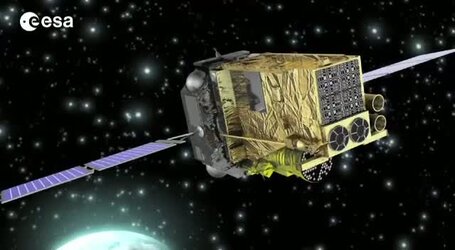
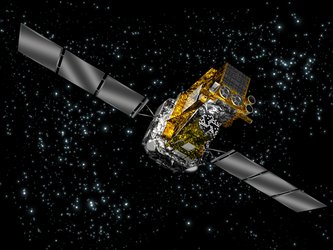
    Integral was launched on 17 October 2002 by a Proton/Blok-DM rocket from Baikonur, Kazakhstan. It operates in an elliptical 72-hour orbit around Earth.

    Equipped with two gamma-ray telescopes, an X-ray monitor and an optical camera, all four of Integral’s instruments point simultaneously at the same region of the sky to make complementary observations of high-energy sources.

    With an initial mission duration of two years, it continues to operate very successfully after ten years and a further extension beyond 31 December 2014 is under consideration.

    Animation captions

    Galactic Centre through Integral’s eyes:
    Download movie
    The central region of our Milky Way, the Galactic Bulge, is a rich host of variable high-energy X-ray and gamma-ray sources.

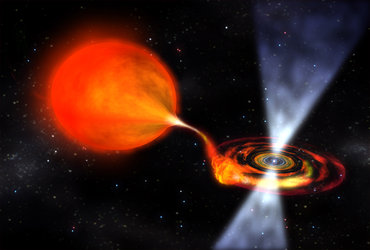
    After a short introduction illustrating Integral’s place in ESA’s fleet of astronomy and astrophysics satellites, the movie looks inside the central bulge to reveal these dynamic sources, which include X-ray binary systems with either a black hole or a neutron star, pulsars and remnants of supernova explosions.

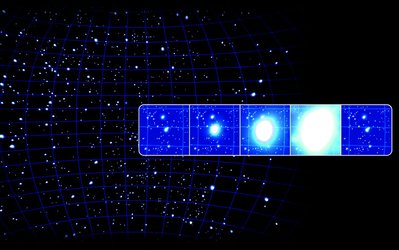
    A number of these sources only shine brightly for a limited period of time – in some cases, they appear as a sudden bright flash and disappear shortly afterwards, whereas others are more persistent. The effect of this constantly changing environment gives the Galactic Bulge the appearance of a dramatic cosmic light show.

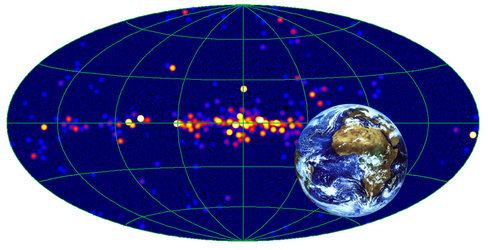
    Zooming back out of the Milky Way shows a bird’s eye view of the known gamma and hard X-ray sources in our Milky Way.

    The movie concludes with a stunning fly-through of the central part of the Galactic Bulge before returning to our Solar System and the orbit of Integral around Earth.

    Credits: ESA–C. Carreau & E. Kuulkers

    Integral science highlights:
    Download movie
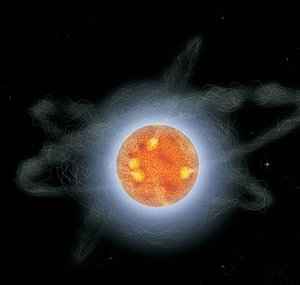
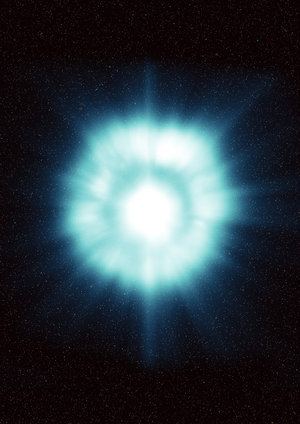
    A journey through some of Integral’s key science highlights. From rare breeds of binary stars and pulsars with extraordinary magnetic fields, to the annihilation of matter with antimatter and the feeding habits of black holes, Integral has been uncovering the secrets of the most energetic phenomena in the Universe.

    This slideshow of artist impressions was first released on Monday as our Space Science Image of the Week.

    Credits: ESA–C. Carreau.

    For further information, please contact:

    Markus Bauer 

    ESA Science and Robotic Exploration Communication Officer


    Tel: +31 71 565 6799


    Mob: +31 61 594 3 954


    Email: markus.bauer@esa.int


    Christoph Winkler
    ESA Integral Project Scientist

    Email: Christoph.Winkler@esa.int

    Rate this

    Views

    Share

    • Currently 0 out of 5 Stars.
    • 1
    • 2
    • 3
    • 4
    • 5
    Rating: 0/5 (0 votes cast)

    Thank you for rating!

    You have already rated this page, you can only rate it once!

    Your rating has been changed, thanks for rating!

    25
    Tweet
    • Related articles
      • Integral: a decade revealing the high-energy sky
        • Celebrating ten years of Integral science
          • Integral disproves dark matter origin for mystery radiation
            • Integral spots matter a millisecond from doom
              • Integral discovers the galaxy’s antimatter cloud is lopsided
                • Giant eruption reveals 'dead' star
                  • Dissecting a stellar explosion
                    • XMM-Newton and Integral clues on magnetic powerhouses
                      • Faint gamma-ray bursts do actually exist
                        • Integral locates origin of high-energy emission from Crab Nebula
                          • X-rays betray giant particle accelerator in the sky
                            • Integral catches a new erupting black hole
                              • ESA steps towards a great black hole census
                                • Star eats companion
                                  • ESA's Integral detects closest cosmic gamma-ray burst
                                  • In depth
                                  • This article in depth
                                  • Integral in depth
                                  • Related ESA publications
                                    • ESA BR-308 Integral: A Decade Revealing the High-Energy Sky
                                    • Integral results leaflet (pdf)
                                    • Integral mission brochure (pdf)
                                    • Integral movies
                                    • Follow us
                                    • ESA Sci on Twitter
                                    • ESA on Flickr

    Connect with us

    • RSS
    • Youtube
    • Twitter
    • Flickr
    • G+
    • Facebook
    • Livestream
    • Subscribe
    • App Store
    • ESA Science Twitter

    Follow ESA science

    • LATEST ARTICLES
    • · Rare merger reveals secrets of gal…
    • · Watching for hazards: ESA opens as…
    • · ESA astronaut Timothy Peake set fo…
    • · Space drives e-mobility
    • · Proba-V opens its eyes
    • FAQ

    • Jobs at ESA

    • Site Map

    • Contacts

    • Terms and conditions