Call for Media: briefing on first results from ESA’s Planck mission
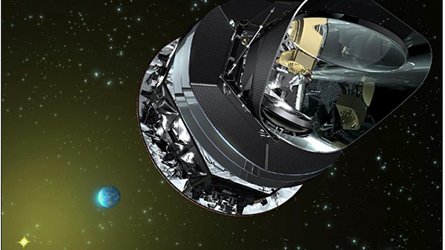
ESA PR 01-2011 Media representatives are invited to a briefing on the occasion of the release of the first data and scientific results from ESA’s Planck mission.
The media briefing will take place at the Planétarium, Cité des Sciences, Paris, France on 11 January from 12:00 to 13:30 CET. Doors open at 11:45 CET.
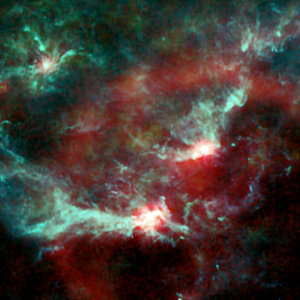
Scientists from ESA and several European astronomy institutes will present the first data and results from ESA’s Planck mission. The Early Release Compact Source Catalogue contains thousands of sources detected by Planck from radio to far-infrared wavelengths, ranging from dense, cold clouds embedded in nearby star-forming regions to distant, supermassive clusters of galaxies.
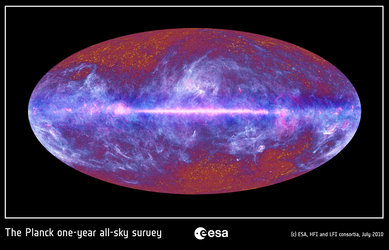
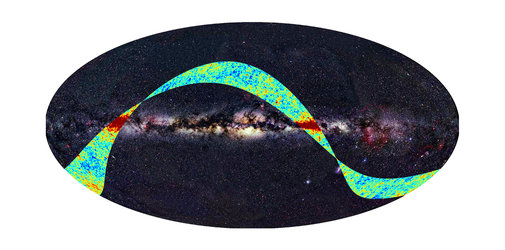
Planck’s goal is to make the most accurate measurements to date of the ‘cosmic microwave background radiation’, a rippling glow covering the whole sky, left over from a time just 380 000 years after the Big Bang created the expanding Universe. With these measurements, we expect to be able to learn much about the birth, early evolution and ultimate fate of the Universe.
However, there are many other objects in the Universe giving out light at the same wavelengths, including cold dust, hot gas and electrons swirling in magnetic fields. All of this emission must be identified and removed before Planck can achieve its ultimate goal of measuring the cosmic microwave background with unprecedented sensitivity and sharpness. The 11 January release of the catalogue is an important step by the Planck scientists in this direction.
Fortunately, this ‘contamination’ is not just thrown away: it is a scientific treasure trove for astronomers across the world to uncover in the coming years, as we shall learn at this media briefing.
Early results gleaned from the catalogue include the first imaging of galaxies clustering in the distant Universe, seen through subtle variations in the cosmic infrared background; the detection of the coldest objects in our Milky Way; and the identification and quantification of sources of microwave emission spread across our own Milky Way – so far only suspected.
For more detailed information on the Planck mission:
http://www.esa.int/planck
http://sci.esa.int/planck
Media representatives wishing to attend the event are requested to complete the online form at:
http://www.esa.int/esaCP/SEMA09TRJHG_index_0.html
For further information, please contact:
ESA Media Relations Office
Tel: +33 1 53 69 72 99
Fax: +33 1 53 69 76 90
Email: media@esa.int
Planck First Data and Results Media Briefing, 11 January 2011
Planétarium, Cité des Sciences, 26 avenue Corentin Cariou, 75019 Paris
Programme
| 11:45 | Doors open |
| 12:00 | Welcome |
| Mark McCaughrean, Head, Research & Scientific Support Department ESA Directorate of Science and Robotic Exploration | |
| 12:05 | Planck and space research in France |
| Fabienne Casoli, Head of Study and Exploration of the Universe, CNES (French space agency) | |
| 12:10 | Planck’s first data product: the Early Release Compact Source Catalogue |
| Jan Tauber, ESA Planck Project Scientist | |
| 12:20 | Planck observations of galaxy clusters, building blocks of the Universe |
| Nabila Aghanim, Université Paris Sud & CNRS | |
| 12:30 | Planck observes the integrated light from the most distant galaxies |
| Jean-Loup Puget, Université Paris Sud & CNRS | |
| 12:40 | Planck sheds new light on mysterious components of the Milky Way |
| Clive Dickinson, University of Manchester | |
| 12:50 | Questions & Answers |
| Opportunity for individual interviews | |
| 13:30 | End of programme |
Moderator: Markus Bauer (ESA)