• → European Space Agency

      • Space for Europe
      • Space News
      • Space in Images
      • Space in Videos
    • About Us

      • Welcome to ESA
      • DG's News and Views
      • For Member State Delegations
      • Business with ESA
      • ESA Exhibitions
      • ESA Publications
      • Careers at ESA
    • Our Activities

      • Space News
      • Observing the Earth
      • Human Spaceflight
      • Launchers
      • Navigation
      • Space Science
      • Space Engineering
      • Operations
      • Technology
      • Telecommunications & Integrated Applications
    • For Public

    • For Media

    • For Educators

    • For Kids

    • ESA

    • Launch Special

    • Planck

    • Herschel

    • ESA Science

    • About Planck

      • Planck at a glance
      • Science objectives
      • Planck highlights
      • History of microwave astronomy
    • The Microwave Universe

      • Why the microwave
      • Key questions
    • The spacecraft

      • Vital stats
      • Telescope
      • Instruments
      • Sophisticated spacecraft
    • The mission

      • Journey
      • Launch and early operations
      • Operating Planck
    • Meet the team

      • Planck Project Scientist: An interview with Jan Tauber
      • Herschel and Planck Programme Manager: An interview with Thomas Passvogel
    • Multimedia
    • Planck images
    • Planck videos
    • Science@ESA vodcast

    ESA > Our Activities > Space Science > Planck

    Key questions

    3D distribution of dark matter in the Universe

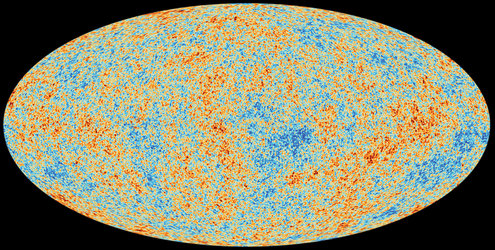
    The anisotropies, i.e. the uneven temperature distribution in the cosmic background hold answers to many key questions in cosmology. Some refer to the past of the Universe, such as what triggered the Big Bang, and how long ago it happened.

    But some other questions look deep into the future. For instance, what is the density of matter in the Universe and what is the true nature of this matter? These parameters could tell us if the Universe will continue its expansion forever or if, on the contrary, it will end up collapsing on itself in an inverse process to the Big Bang, which one might call the 'Big Crunch'.

    Now, thanks to NASA’s Wilkinson Microwave Anisotropy Probe, we know that our Universe will most likely not crunch; however, new insights are telling us that the future fate of the Universe is even less predictable than we thought.

    Some of the new uncertainties are related to the existence of ‘dark energy’ which may exist in large quantities in our Universe, as indicated by recent observations that measure the light from distant exploding stars. Is it really there? And, if so, what are its effects?

    The most powerful tool to analyse the anisotropies is the CMB, and ESA's Planck satellite will shed light on these issues.

    The birth of the Universe

    Map of CMB Anisotropy
    COBE - DMR Map of CMB Anisotropy

    The period up to a millionth of a second after the birth of the Universe is full of uncertainties: there are no solid observations or speculation-free arguments to confirm or disprove theories covering this period.

    According to the most accepted hypothesis, at the beginning of this epoch a process called 'inflation' occurred. During inflation, the Universe expanded extremely quickly, after which it expanded and cooled much more slowly. If this is what actually happened, the inhomogeneities in the CMB will reflect some of the details of the event, and Planck will provide us with the most reliable information about it.
    Rate this

    Views

    Share

    • Currently 0 out of 5 Stars.
    • 1
    • 2
    • 3
    • 4
    • 5
    Rating: 0/5 (0 votes cast)

    Thank you for rating!

    You have already rated this page, you can only rate it once!

    Your rating has been changed, thanks for rating!

    68
    facebook
    twitter
    reddit
    google plus
    digg
    tumbler
    digg
    blogger
    myspace
    • Planck: looking back at the dawn of time
    • Read more
      • Cosmic Microwave Background (CMB) radiation
        • Travelling back in time
          • Observations: Seeing in microwave wavelengths
            • So, how did everything start?
            • In depth
            • Planck in depth
            • Science Talks via Slideshare

    Connect with us

    • RSS
    • Youtube
    • Twitter
    • Flickr
    • Google Buzz
    • Subscribe
    • App Store
    • LATEST ARTICLES
    • · CryoSat hits land
    • · Ariane 5 completes seven launches …
    • · Measuring skull pressure without t…
    • · Malargüe station inauguration
    • · The solar wind is swirly
    • FAQ

    • Jobs at ESA

    • Site Map

    • Contacts

    • Terms and conditions