• → European Space Agency

      • Space for Europe
      • Space News
      • Space in Images
      • Space in Videos
    • About Us

      • Welcome to ESA
      • DG's News and Views
      • For Member State Delegations
      • Business with ESA
      • ESA Exhibitions
      • ESA Publications
      • Careers at ESA
    • Our Activities

      • Space News
      • Observing the Earth
      • Human Spaceflight
      • Launchers
      • Navigation
      • Space Science
      • Space Engineering
      • Operations
      • Technology
      • Telecommunications & Integrated Applications
    • For Public

    • For Media

    • For Educators

    • For Kids

    • ESA

    • Rosetta

    • ESA Science

    • About Rosetta

      • Europe's comet chaser
      • Why 'Rosetta'?
    • About the spacecraft

      • The Rosetta orbiter
      • Orbiter: Instruments
      • The Rosetta lander
      • Lander: Instruments
    • About the journey

      • The long trek
      • Debris of the Solar System: Asteroids
      • Asteroid (2867) Steins: a portrait
      • Life and survival in deep space
      • Long-distance communication
      • The Rosetta ground segment
    • About the arrival

      • Comets - an introduction
      • Comet 67P/Churyumov- Gerasimenko
      • Comet rendezvous
      • Giotto - ESA's first comet mission
    • Meet the team
    • Mission Manager
    • Project Scientist
    • Multimedia
    • VideoTalk
    • 3D Flash 'model'
    • Rosetta images
    • Rosetta videos
    • Rosetta Animations
    • Rosetta wallpaper
    • Life of a comet
    • Services
    • Frequently asked questions
    • Comments

    ESA > Our Activities > Space Science > Rosetta

    ESA’s new camera follows disintegration of a comet

    ESA observes Comet 73P/Schwassmann-Wachmann 3 breaking apart
    19 May 2006

    The continuing disintegration of Comet 73P/Schwassmann-Wachmann 3 has allowed ESA scientists to see into the interior of the comet. Using a revolutionary camera attached to the ESA Optical Ground Station on Tenerife, they have followed the detailed twists and turns of various comet fragments.

    The superconducting camera, SCAM, is an ultra fast photon counting camera, developed by ESA. It is cooled to just 300 thousandths of a degree above absolute zero. This enables its sensitive electronic detectors, known as superconducting tunnel detectors, to register almost every single photon of light that falls into it. As such, it is the perfect instrument with which to detect fast and faint changes in the fragments of the comet.

    Comet 73P/Schwassmann-Wachmann 3 is a short-period comet that approaches the Sun every 5.4 years. Two apparitions ago, in 1996, the comet nucleus split into five pieces (Fragments A, B, C, D, E) of which 3 (B, C, E) were still visible at its 2001 return.

    When it approached the Sun again this year, seven fragments were initially observed, indicating that the comet was breaking apart again. Indeed, as astronomers watched, further fragments broke off. Fragment B alone produced at least seven new pieces. At present, about 40 fragments are visible, most of which are likely to be very small and with irregular and short-lived activity.

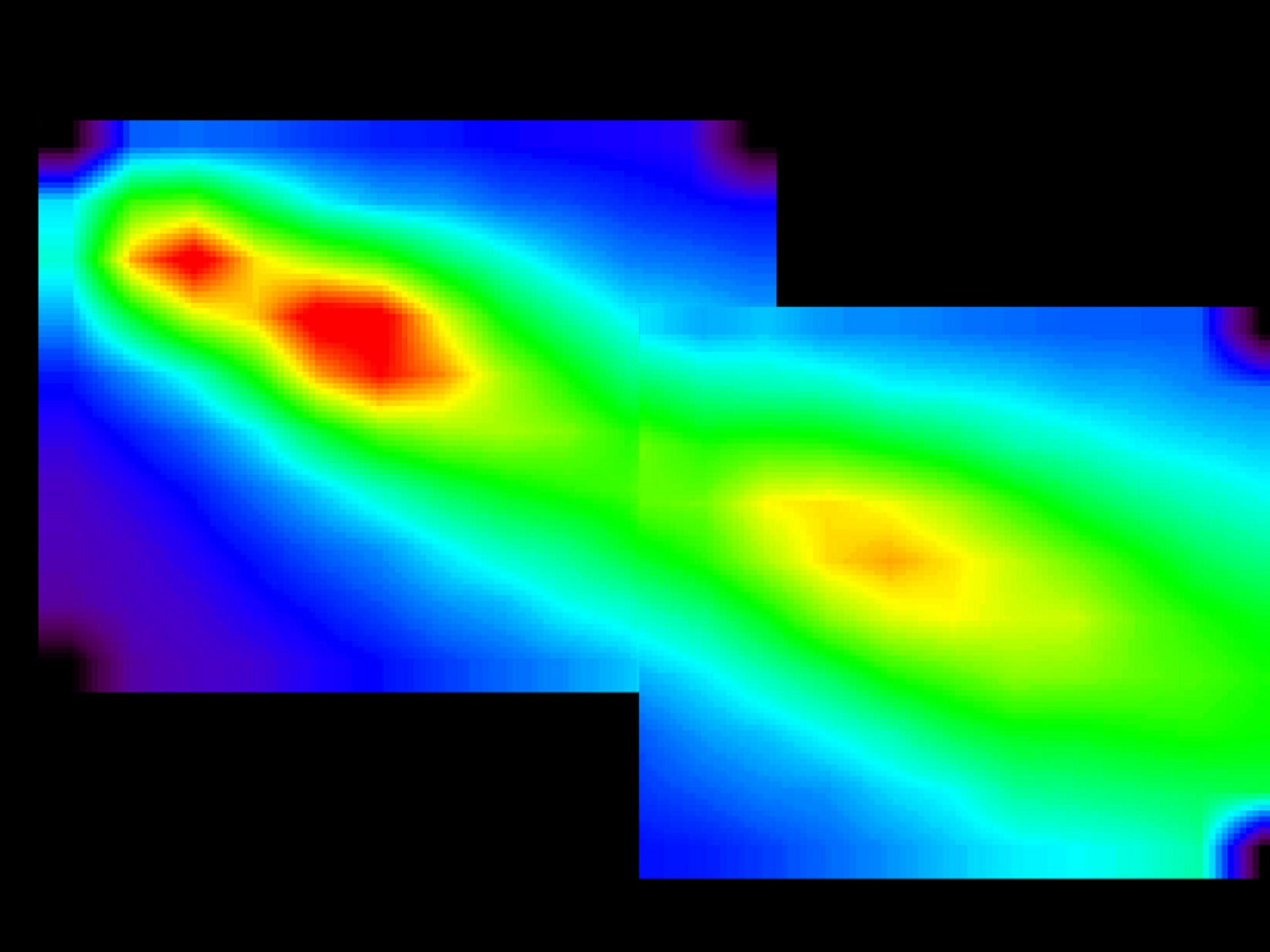
    SCAM was attached to the one-metre ESA Optical Ground Station telescope on 7 May 2006, when the disintegrating comet was observed . Every few microseconds, the camera reads out the number of photons that have touched it and their colour. Using the unprecedented accuracy of the camera, ESA scientists charted the evolution of the dust and gas envelopes associated with each fragment for two hours. Now they must analyse the results.

    In particular they will be looking for differences in the size and shape of the fragments and also any colour differences between them that might indicate compositional differences. Other studies are made possible by SCAM’s unrivalled time resolution. Outbursts and activity from each fragment can be traced down to changes that occur on a timescale of one minute. In addition, as the dust and gas particles released from the fragments move with velocities between 0.5 and 1 kilometres per second, the observations will allow the interaction of the gas and dust flow to be studied for the two fragments closest to one another.

    Comet 73P/Schwassmann-Wachmann 3 is one of the comets that was considered as a potential target for ESA’s Rosetta mission. In 1995 even before its initial splitting, it was abandoned in favour of comet 46P/Wirtanen. After the launch delay of 2003, ESA decided not to re-select 73P/Schwassmann-Wachmann 3 as the replacement Rosetta target, because of the comet’s volatile behaviour. In 2014, Rosetta will rendezvous and land on the Jupiter-family comet 67P/Churyumov-Gerasimenko.


    For more information:

    Rita Schulz, ESA – for questions on the comet
    Email: Rita.Schulz @ esa.int

    Didier Martin, ESA - for questions on the SCAM camera
    Email: Didier.Martin @ esa.int

    Zoran Sodnik and Christian Erd, ESA - for questions on the OGS optical station
    Email: Zoran.Sodnik @ esa.int, Christian.Erd @ esa.int
    Rate this

    Views

    Share

    • Currently 0 out of 5 Stars.
    • 1
    • 2
    • 3
    • 4
    • 5
    Rating: 0/5 (0 votes cast)

    Thank you for rating!

    You have already rated this page, you can only rate it once!

    Your rating has been changed, thanks for rating!

    26
    Tweet
    • ESA's comet chaser: Rosetta
    • More about...
      • Rosetta factsheet
      • Related articles
        • Comet dust brought back to Earth: paving the way for Rosetta
          • Evidence for more dust than ice in comets
            • Life of a comet
              • Tempel 1: Biography of a comet
                • Rosetta monitors Deep Impact
                  • XMM-Newton to observe Deep Impact
                    • Hubble sees outburst from Deep Impact comet
                      • ESA observes Deep Impact from Earth
                        • Dust and gas from Comet 9P/Tempel 1 seen by ESA OGS
                          • Tempel 1 is weak X-ray source, XMM-Newton confirms
                          • Related links
                          • SCAM ultra fast photon counting camera
                          • NASA Stardust

    Connect with us

    • RSS
    • Youtube
    • Twitter
    • Flickr
    • G+
    • Facebook
    • Livestream
    • Subscribe
    • App Store
    • LATEST ARTICLES
    • · ESA astronaut Timothy Peake set fo…
    • · Space drives e-mobility
    • · Proba-V opens its eyes
    • · First new Galileo satellite arrive…
    • · Next destination: space
    • FAQ

    • Jobs at ESA

    • Site Map

    • Contacts

    • Terms and conditions