• → European Space Agency

      • Space for Europe
      • Space News
      • Space in Images
      • Space in Videos
    • About Us

      • Welcome to ESA
      • DG's News and Views
      • For Member State Delegations
      • Business with ESA
      • ESA Exhibitions
      • ESA Publications
      • Careers at ESA
    • Our Activities

      • Space News
      • Observing the Earth
      • Human Spaceflight
      • Launchers
      • Navigation
      • Space Science
      • Space Engineering
      • Operations
      • Technology
      • Telecommunications & Integrated Applications
    • For Public

    • For Media

    • For Educators

    • For Kids

    • ESA

    • Rosetta

    • ESA Science

    • About Rosetta

      • Europe's comet chaser
      • Why 'Rosetta'?
    • About the spacecraft

      • The Rosetta orbiter
      • Orbiter: Instruments
      • The Rosetta lander
      • Lander: Instruments
    • About the journey

      • The long trek
      • Debris of the Solar System: Asteroids
      • Asteroid (2867) Steins: a portrait
      • Life and survival in deep space
      • Long-distance communication
      • The Rosetta ground segment
    • About the arrival

      • Comets - an introduction
      • Comet 67P/Churyumov- Gerasimenko
      • Comet rendezvous
      • Giotto - ESA's first comet mission
    • Meet the team
    • Mission Manager
    • Project Scientist
    • Multimedia
    • VideoTalk
    • 3D Flash 'model'
    • Rosetta images
    • Rosetta videos
    • Rosetta Animations
    • Rosetta wallpaper
    • Life of a comet
    • Services
    • Frequently asked questions
    • Comments

    ESA > Our Activities > Space Science > Rosetta

    When is a comet not a comet? Rosetta finds out

    The debris trail of asteroid P/2010 A2
    13 October 2010

    It was a case of celestial hit and run. Two asteroids, both in the wrong place at the wrong time. The result: one big trail of debris and a case of mistaken identity. Now, however, ESA’s comet-chaser Rosetta has unravelled the truth.

    Using its OSIRIS camera, Rosetta made the breakthrough because it is far from Earth and so it could look at mystery object ‘P/2010 A2’ from a unique perspective. This showed that instead of being a comet, as first suspected, we are seeing the debris from a pair of colliding asteroids.

    An automated survey telescope on Earth discovered P/2010 A2 in January 2010. It was immediately designated a comet because it has a tail – but calling it a comet never felt comfortable. It was located in the inner asteroid belt on a nearly circular orbit, whereas most comets move on giant elliptical paths that sweep them from the outer reaches of the Solar System down towards the Sun and out again.

    Colliding asteroid P/2010 A2 as seen by Rosetta

    Also, P/2010 A2 did not appear to possess a central condensation from which the tail grew – it was just a tail.

    “We knew that we needed to look at P/2010 A2 from a different angle and Rosetta provided exactly that,” says Colin Snodgrass of the Max Planck Institute for Solar System Research in Germany.

    Comparing the Rosetta images with those taken from Earth, computer modelling has now shown that the tail is not a continuous stream of ejected material, as would be the case for a comet. Instead, it was thrown into space in a single eruption.

    The most likely cause would be a collision between two asteroids. If so, when did it happen?

    Dr Snodgrass and colleagues found that the shape and size of the trail, as seen more clearly by Rosetta, allowed them to make a remarkably precise estimate for when the collision must have occurred.

    They nailed down the date of the impact to within a ten-day window, centred around 10 February 2009, almost a year before its discovery.

    “We are really quite confident about that date because of the quality of the data we used,” says Dr Snodgrass.
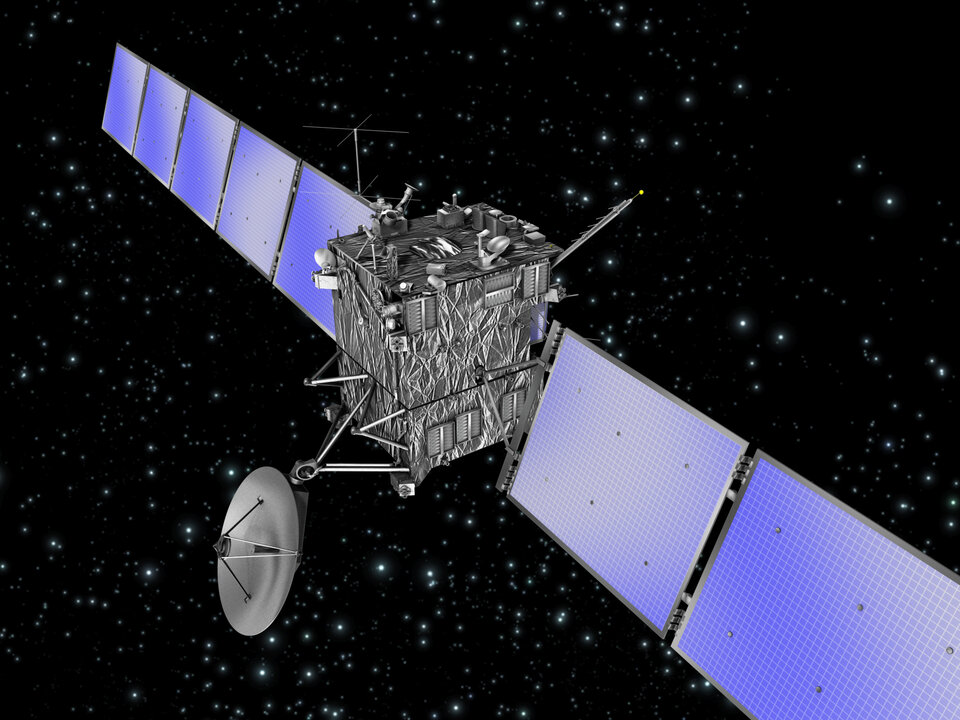

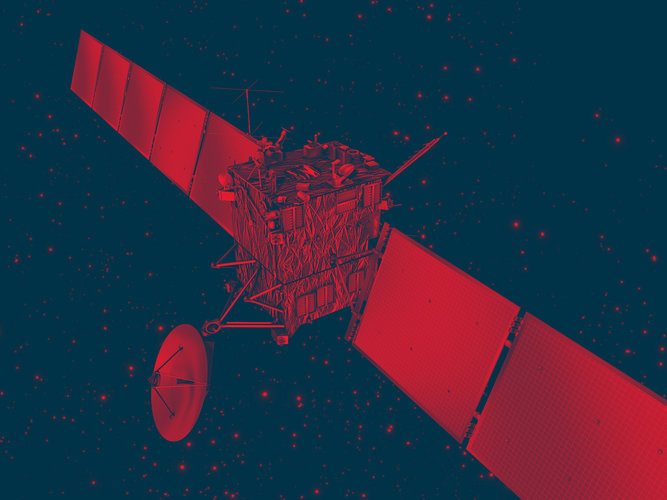
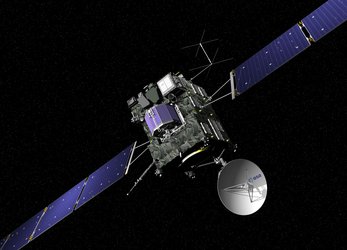
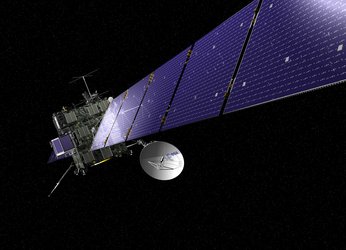
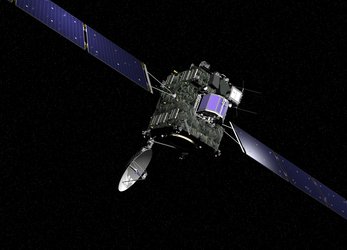
    The Rosetta Spacecraft

    An international team, including Jessica Agarwal, a former ESA research fellow used the Hubble Space Telescope to resolve a single remaining asteroid, about 120 m across, at the head of the trail.

    Using this in their computer modelling of the collision, Dr Snodgrass and colleagues found that the other asteroid was probably tiny, originally just a few metres across, and so was destroyed in the event.

    “It is truly exciting to see an object that has been in a collision so recently,” says Rita Schulz, ESA Rosetta Project Scientist.

    Such impacts are estimated to take place just once every billion years for each asteroid. But, as there are so many asteroids, there is likely to be a collision of this type every dozen years or so throughout the asteroid belt.

    As technology improves, so surveys become more sensitive, and Dr Snodgrass expects the next generation of sky surveys to pick up collisions between even smaller asteroids every year.

    “Asteroid P/2010 A2 could be a taste of things to come,” he says.
    Rate this

    Views

    Share

    • Currently 0 out of 5 Stars.
    • 1
    • 2
    • 3
    • 4
    • 5
    Rating: 0/5 (0 votes cast)

    Thank you for rating!

    You have already rated this page, you can only rate it once!

    Your rating has been changed, thanks for rating!

    134
    Tweet
    • ESA's ATV blog direct from ATV mission control
      ESA's ATV blog direct from ATV mission control
      Rosetta Blog
    • ESA's comet chaser: Rosetta
    • For the media
      • Notes for editors
      • Rosetta Earth swingby media presentation
      • Media Press Kit
      • Rosetta factsheet (pdf)
      • Rosetta on YouTube
      • ESA's comet chaser revisits Earth
      • Related articles
        • When is a comet not a comet? Rosetta finds out
          • ESA’s Rosetta comet-chaser goes LEGO®
            • Rosetta’s blind date with asteroid Lutetia
              • Swirling clouds over the South Pacific
                • Rosetta sees a living planet
                  • Rosetta bound for outer Solar System after final Earth swingby
                    • Rosetta darting across the night
                      • First view of Earth as Rosetta approaches home
                        • ESA spacecraft may help unravel cosmic mystery
                          • Rosetta approach on schedule
                            • Follow Rosetta’s final Earth boost
                              • Rosetta lined up nicely for Earth approach
                                • Last visit home for ESA’s comet chaser
                                • In depth
                                • Rosetta in depth
                                • Hubble in depth
                                • Max Planck Institute for Solar System Research
                                • Project LINEAR

    Connect with us

    • RSS
    • Youtube
    • Twitter
    • Flickr
    • G+
    • Facebook
    • Livestream
    • Subscribe
    • App Store
    • LATEST ARTICLES
    • · ESA astronaut Timothy Peake set fo…
    • · Space drives e-mobility
    • · Proba-V opens its eyes
    • · First new Galileo satellite arrive…
    • · Next destination: space
    • FAQ

    • Jobs at ESA

    • Site Map

    • Contacts

    • Terms and conditions