• → European Space Agency

      • Space for Europe
      • Space News
      • Space in Images
      • Space in Videos
    • About Us

      • Welcome to ESA
      • DG's News and Views
      • For Member State Delegations
      • Business with ESA
      • ESA Exhibitions
      • ESA Publications
      • Careers at ESA
    • Our Activities

      • Space News
      • Observing the Earth
      • Human Spaceflight
      • Launchers
      • Navigation
      • Space Science
      • Space Engineering
      • Operations
      • Technology
      • Telecommunications & Integrated Applications
    • For Public

    • For Media

      • Media
      • ESA TV
      • Videos for professionals
      • Photos
    • For Educators

    • For Kids

    • ESA

    • SMART-1

    • ESA Science

    • About SMART-1
    • SMART-1 factsheet
    • Towards final impact
    • Approaching the mission end
    • Frequently Asked Questions
    • Ask about the SMART-1 impact
    • Join the SMART-1 impact observation campaign
    • About the journey

      • The magic of ion engines
      • The SMART way to travel
      • A spiral pathway to the Moon
    • About the mission

      • Masterpieces of miniaturisation
      • What do all the instruments do?
    • About the Moon

      • Welcome to the double planet
      • Lunar science - still plenty left to do!
      • Where did the Moon come from?
    • Multimedia
    • SMART-1 images
    • SMART-1 videos
    • SMART-1 animations
    • 3D Flash 'model'
    • SMART-1 wallpaper
    • Launch replay
    • Services
    • Comments

    ESA > Our Activities > Space Science > SMART-1

    SMART-1 impact simulated in a laboratory sand-box

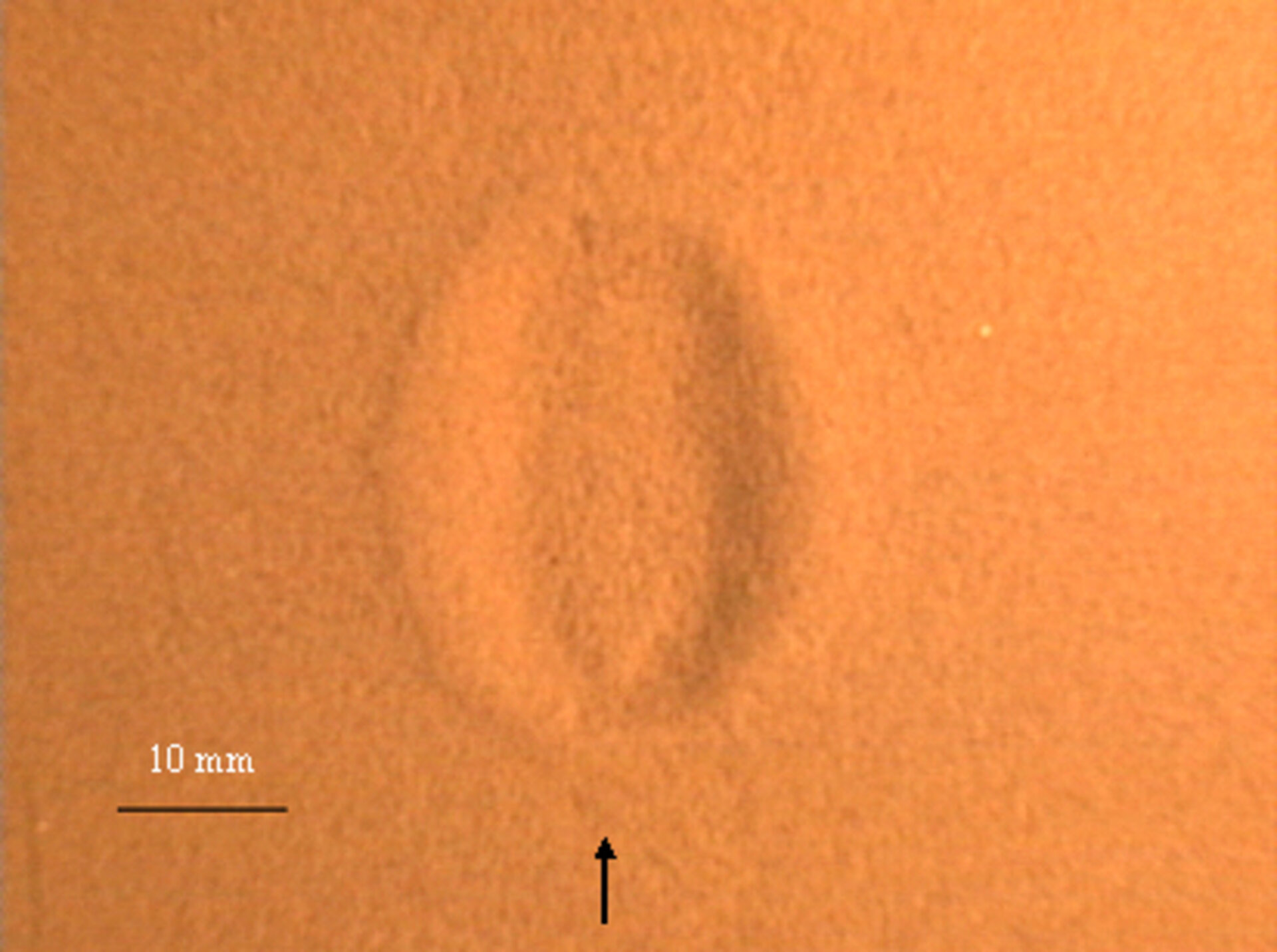
    Simulation of SMART-1's impact crater
    11 September 2006

    Laboratory simulations of the SMART-1 impact performed at the University of Kent, United Kingdom, suggest that the impact may have caused a clearly elongated lunar crater, and produced a high-speed rebounding for the spacecraft.

    This may help explain some properties of the dust cloud observed just after the actual impact of SMART-1 on the Moon.

    The simulations were performed by M.J. Burchell and M.J.Cole at the University of Kent. For the test, they used a high-speed, two-stage light gas gun to shoot at 2 kilometres per second a 2-millimitre aluminium sphere that simulated the SMART-1 spacecraft. The target was a tray of sand, similar to lunar soil.
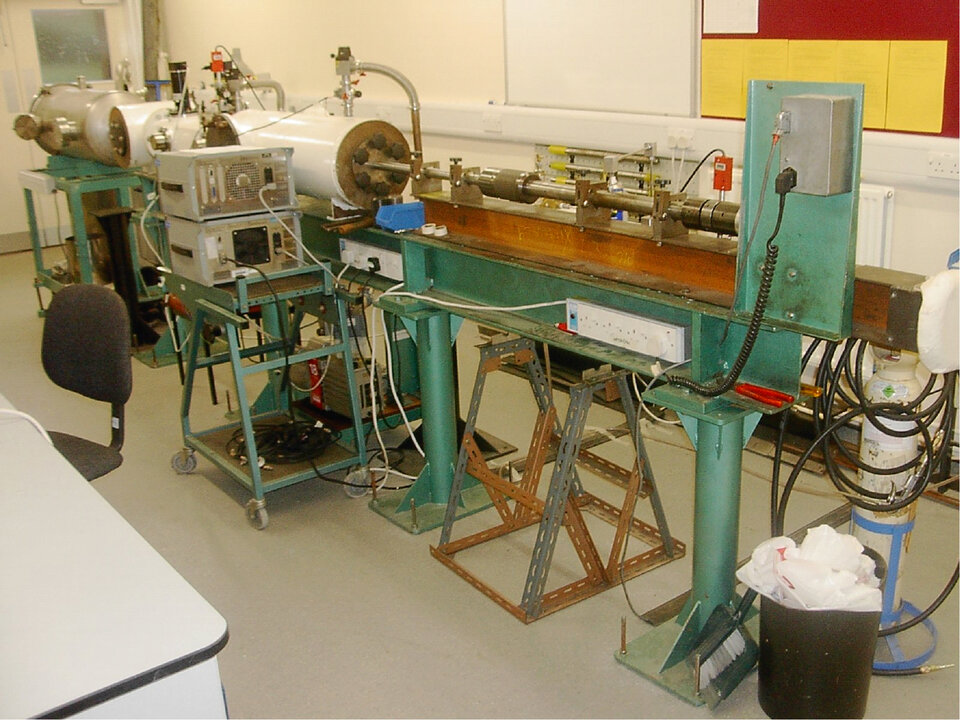
    Light gas gun simulated SMART-1 impact

    "We called for such laboratory simulations and numerical modelling of the SMART-1 impact as a crucial test to understand the processes at work in space-bound and artificial impacts," said Bernard Foing, ESA SMART-1 Project Scientist.

    Data from a previous project, in which Burchell and Cole made use of coarse grained sand, had shown that for an impact at a 10-degree incidence the fastest ejected material travelled forward (within about plus or minus 5 degree angle with respect to the impact direction) at 120 percent of the impact speed – a higher value than the impacting projectile had.

    However, at that 10-degree incidence angle only one percent of the material excavated by the impact went forwards and the percentage decreased as the angle got shallower. Out of that one percent, about 75 percent was at an angle to the surface greater than 10 degrees.
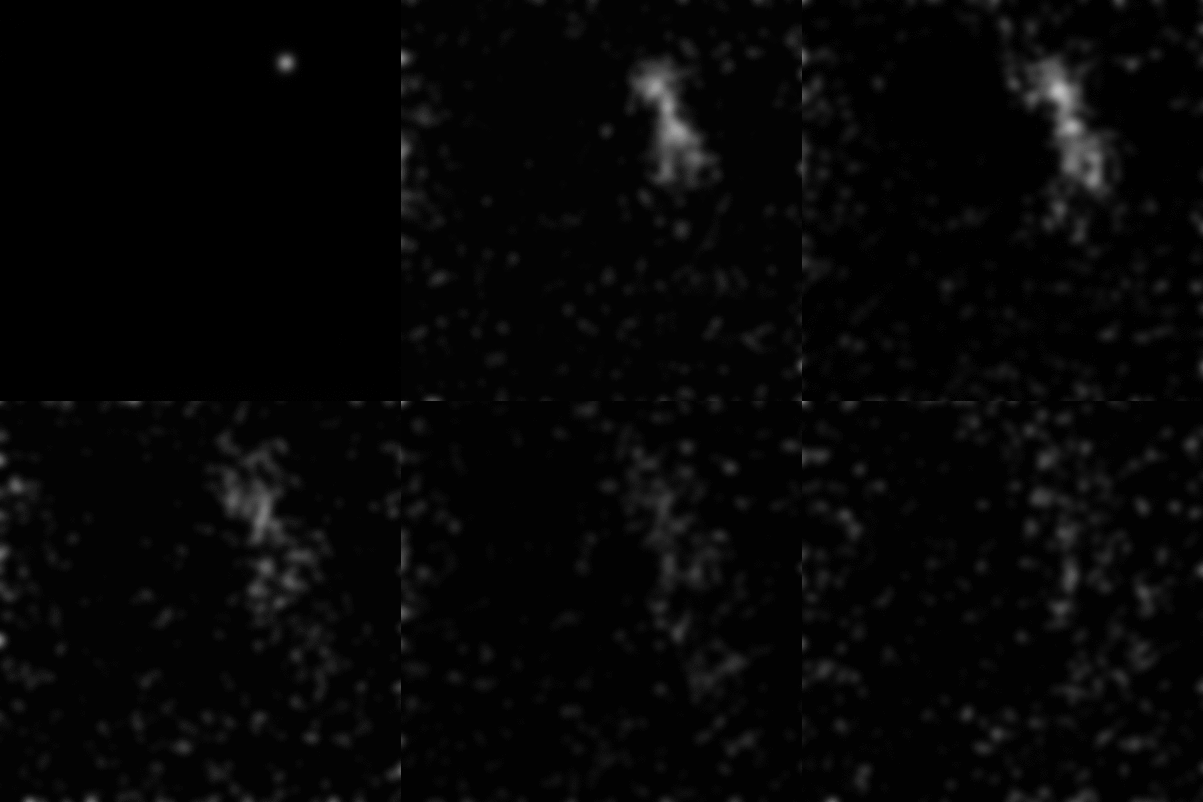

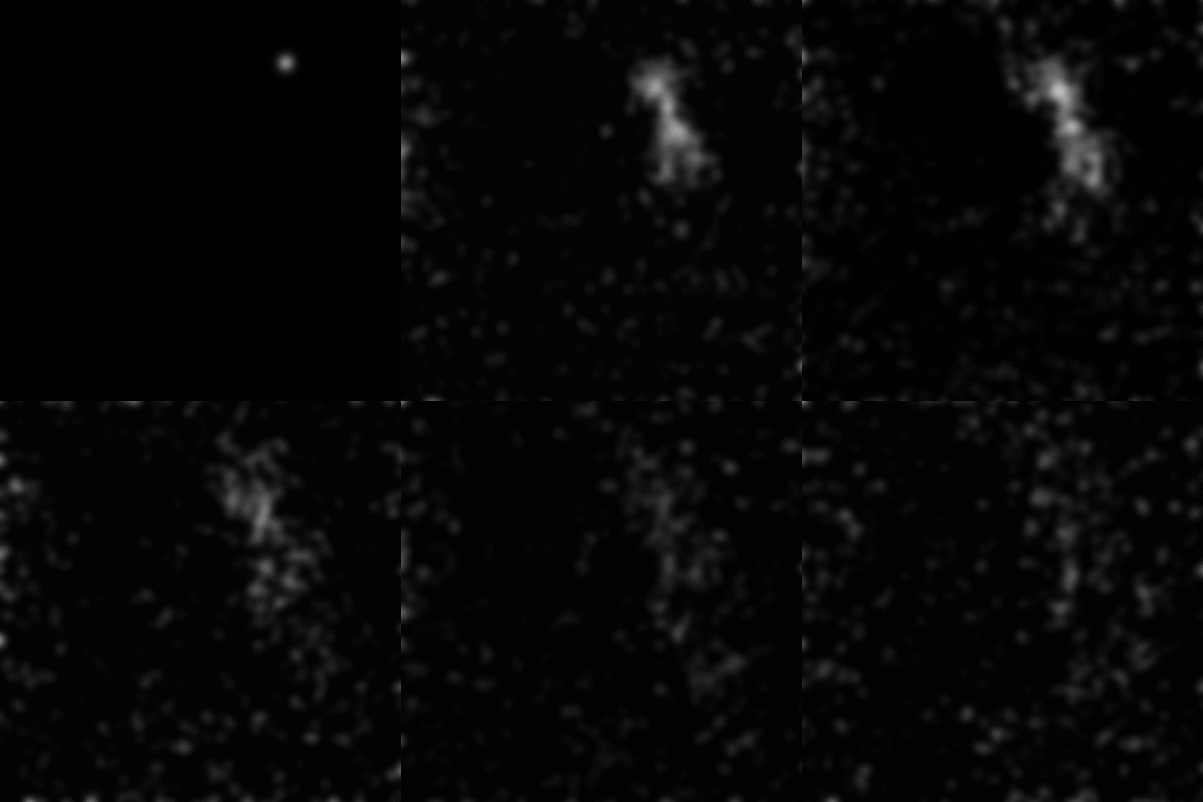
    SMART-1 impact sequence by CFHT – the movie

    "To reproduce the SMART-1 scenario we simulated an impact at two degrees incidence. The result was a nice non-circular crater," said Mark Burchell. "According to the test's results, the fine grained dust of the lunar surface was to raise a cloud of ejected material, which would have spread out sideways, as well as in a forward direction."

    Based solely on the results and ignoring scaling issues, Burchell and Cole predicted the size for the SMART-1 impact crater, expected to be 7 metres long and 4.5 metres wide. This was compatible with ESA’s scaling-law predictions on the size of the SMART-1 crater.

    Burchell and Cole also observed a 'ricochet-projectile' phenomenon, suggesting a bounce like that of a single object that had undergone some deformation, with a slight 20 percent loss of speed during the impact.
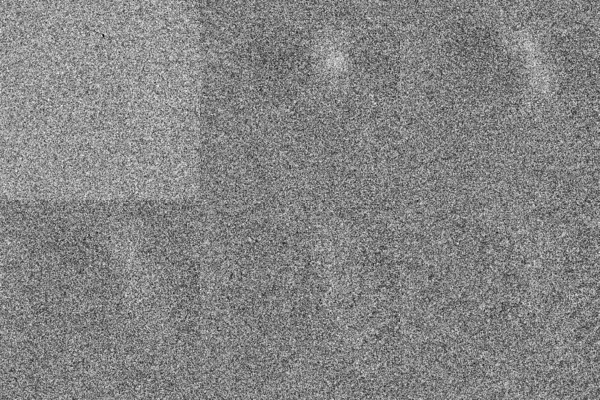
    Impact flash and dust cloud seen by CFHT

    "Based on the latest topography analysis, SMART-1 touched down with a very grazing incidence not higher than a few degrees," said Foing. "Therefore it might have bounced in a similar way to the flying bullet in the sand box, like a stone skipping on water."

    "The result of these simulations may explain some of the properties of the clouds detected by the Canada-France-Hawaii telescope (CFHT) up to 100 seconds after the flash," added Pascale Ehrenfreund, coordinator of the SMART-1 impact ground-based observation campaign. "These were spread at some tens of kilometres downstream from impact," she concluded.

    For more information

    Bernard Foing, ESA SMART-1 Project Scientist
    Email: bernard.foing @ esa.int

    Mark Burchell, University of Kent, United Kingdom
    Email: M.J.Burchell @ kent.ac.uk

    Pascale Ehrenfreund, SMART-1 ground-based impact campaign coordinator, Leiden University, The Netherlands
    Email: pascale @ strw.leidenuniv.nl
    Rate this

    Views

    Share

    • Currently 0 out of 5 Stars.
    • 1
    • 2
    • 3
    • 4
    • 5
    Rating: 0/5 (0 votes cast)

    Thank you for rating!

    You have already rated this page, you can only rate it once!

    Your rating has been changed, thanks for rating!

    89
    Tweet
    • SMART-1
    • Related articles
      • SMART-1 impact flash and debris: crash scene investigation
        • SMART-1 swan song: valuable data until final moments
          • SMART-1 impact update
            • SMART-1 impacts Moon
              • Impact landing ends SMART-1 mission to the Moon
                • SMART-1 star tracker views the Moon in earthshine (UPDATED)
                  • Amateur observers prepare to watch SMART-1 impact
                    • Intense final hours for SMART-1
                      • Low altitude flying with coarse maps – determining the time of SMART-1 impact
                        • Last weekend chance to observe SMART-1 impact site in sunlight
                          • SMART-1 impact: last call for ground based observations
                            • SMART-1 towards final impact
                              • European and worldwide radio telescopes listen to SMART-1
                                • SMART-1 manoeuvres bring Moon impact to nearside
                                  • The SMART-1 way - giving the Moon some great new looks
                                    • SMART-1 manoeuvres prepare for mission end
                                    • Related links
                                    • Space-X
                                    • Advanced Moon micro-Imager Experiment (AMIE)
                                    • More about SMART-1 impact ground observations
                                    • Virtual Moon Atlas
                                    • Amateur astronomy at Sternwarte Stuttgart (in German)
                                    • Amateur astronomy by Silvia Kowollik (in German)

    Connect with us

    • RSS
    • Youtube
    • Twitter
    • Flickr
    • G+
    • Facebook
    • Livestream
    • Subscribe
    • App Store
    • LATEST ARTICLES
    • · Rare merger reveals secrets of gal…
    • · Watching for hazards: ESA opens as…
    • · ESA astronaut Timothy Peake set fo…
    • · Space drives e-mobility
    • · Proba-V opens its eyes
    • FAQ

    • Jobs at ESA

    • Site Map

    • Contacts

    • Terms and conditions