• → European Space Agency

      • Space for Europe
      • Space News
      • Space in Images
      • Space in Videos
    • About Us

      • Welcome to ESA
      • DG's News and Views
      • For Member State Delegations
      • Business with ESA
      • ESA Exhibitions
      • ESA Publications
      • Careers at ESA
    • Our Activities

      • Space News
      • Observing the Earth
      • Human Spaceflight
      • Launchers
      • Navigation
      • Space Science
      • Space Engineering
      • Operations
      • Technology
      • Telecommunications & Integrated Applications
    • For Public

    • For Media

      • Media
      • ESA TV
      • Videos for professionals
      • Photos
    • For Educators

    • For Kids

    • ESA

    • Space Science

    • Our Universe
    • About Space Science
    • ESA's 'Cosmic Vision'
    • Science missions
    • Mission navigator
    • Target groups
    • For Media
    • For Scientists
    • For Kids
    • Multimedia
    • Science images
    • Science videos
    • Animations
    • Downloads
    • Sounds from space
    • Resources
    • Reference section
    • Services
    • FAQs
    • Glossary
    • Help
    • Portal terms of use
    • Comments
    • Follow us
    • RSS feeds
    • ESA Sci on Twitter
    • ESA Space Science Images on Flickr
    • ESA 3D on Flickr

    ESA > Our Activities > Space Science

    The lunar north pole - SMART-1 mosaic

    SMART-1: Travel maps of the lunar north pole

    5 December 2007

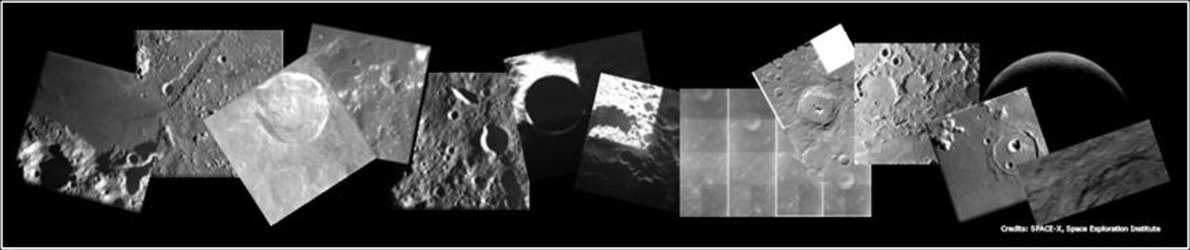
    A new map obtained with SMART-1 data shows the geography and illumination of the lunar north pole. Such maps will be of great use for future lunar explorers.

    The lunar poles are very interesting for future science and exploration of the Moon mainly because of their exposure to sunlight. They display areas of quasi-eternal light, have a stable thermal environment and are close to dark areas that could host water ice – potential future lunar base sites.

    The SMART-1 north pole map, covering an area of about 800 by 600 km, shows geographical locations of some craters of interest. Peary is a large impact crater closest to the north pole. At this latitude the interior of the crater receives little sunlight, but SMART-1 was able to observe it during phases when the crater floor was sufficiently illuminated for imaging.

    A previous lunar mission, the U.S. Clementine, observed the Peary crater during the north summer, and identified some areas particularly illuminated by the sun in that season. With its Advanced Moon Imaging Experiment (AMIE) micro-camera, SMART-1 has complemented this data set by identifying the areas that are also well-illuminated during northern winter.

    SMART-1 north pole travel map

    “Solar illumination makes these areas ideal for robotic outposts or lunar bases making use of solar power,” says ESA's SMART-1 Project Scientist, Bernard Foing.

    Hermite is another lunar impact crater located along the northern lunar limb, close to the north pole of the Moon. Looking from Earth, it is viewed nearly from the side, illuminated by oblique sunlight.

    Crater Plaskett is located on the northern far-side of the Moon, about 200 km from the north pole. It receives sunlight at a low angle. Because of the isolation of this crater and its location near the lunar limb, it has been suggested as a possible additional site of a future lunar base that could be used to simulate isolated conditions during a manned mission to Mars.

    “From the crater rim, rovers could be sent out to explore nearby craters which are permanently in shadow and may contain water ice. If the layers of ice come from the volatiles deposited by comets and water-rich asteroids, we could better understand how, and how much, water and organic material was delivered to Earth over its history,” said Foing.


    Notes for editors:

    These images were analysed in the framework of a study project for the design and operations of lunar polar robotic landers and rovers, by Marina Ellouzi, a Master’s student in space engineering at the Paris-Meudon Observatory. The polar mosaics were presented and discussed at the 9th ILEWG International lunar conference in October 2007.

    For more information:

    Bernard Foing, ESA SMART-1 Project Scientist
    Email: Bernard.Foing @ esa.int

    Jean - Luc Josset, SMART-1 AMIE Principal Investigator, Space-X Space Exploration Institute
    Email : Jean-Luc.Josset @ space-x.ch
    Rate this

    Views

    Share

    • Currently 0 out of 5 Stars.
    • 1
    • 2
    • 3
    • 4
    • 5
    Rating: 0/5 (0 votes cast)

    Thank you for rating!

    You have already rated this page, you can only rate it once!

    Your rating has been changed, thanks for rating!

    176
    Tweet
    • SMART-1
    • Related articles
      • SMART-1: Europe on the Moon, one year on
        • SMART-1 diagnoses wrinkles and excess weight on the Moon
          • How SMART-1 has made European space exploration smarter
            • SMART-1 impact simulated in a laboratory sand-box
              • SMART-1 impact flash and debris: crash scene investigation
                • SMART-1 swan song: valuable data until final moments
                  • SMART-1 impact update
                    • SMART-1 impacts Moon
                      • Impact landing ends SMART-1 mission to the Moon
                        • SMART-1 star tracker views the Moon in earthshine (UPDATED)
                        • ESA Bulletin
                        • SMART-1
                        • In depth
                        • SMART-1 in-depth
                        • Related links
                        • ILEWG International Lunar Exploration Working Group
                        • Space-X
                        • Advanced Moon micro-Imager Experiment (AMIE)

    Connect with us

    • RSS
    • Youtube
    • Twitter
    • Flickr
    • G+
    • Facebook
    • Livestream
    • Subscribe
    • App Store
    • ESA Science Twitter

    Follow ESA science

    • LATEST ARTICLES
    • · Rare merger reveals secrets of gal…
    • · Watching for hazards: ESA opens as…
    • · ESA astronaut Timothy Peake set fo…
    • · Space drives e-mobility
    • · Proba-V opens its eyes
    • FAQ

    • Jobs at ESA

    • Site Map

    • Contacts

    • Terms and conditions