• → European Space Agency

      • Space for Europe
      • Space News
      • Space in Images
      • Space in Videos
    • About Us

      • Welcome to ESA
      • DG's News and Views
      • For Member State Delegations
      • Business with ESA
      • ESA Exhibitions
      • ESA Publications
      • Careers at ESA
    • Our Activities

      • Space News
      • Observing the Earth
      • Human Spaceflight
      • Launchers
      • Navigation
      • Space Science
      • Space Engineering
      • Operations
      • Technology
      • Telecommunications & Integrated Applications
    • For Public

    • For Media

    • For Educators

    • For Kids

    • ESA

    • Space Science

    • Our Universe
    • About Space Science
    • ESA's 'Cosmic Vision'
    • Science missions
    • Mission navigator
    • Target groups
    • For Media
    • For Scientists
    • For Kids
    • Multimedia
    • Science images
    • Science videos
    • Animations
    • Downloads
    • Sounds from space
    • Resources
    • Reference section
    • Services
    • FAQs
    • Glossary
    • Help
    • Portal terms of use
    • Comments
    • Follow us
    • RSS feeds
    • ESA Sci on Twitter
    • ESA Space Science Images on Flickr
    • ESA 3D on Flickr

    ESA > Our Activities > Space Science

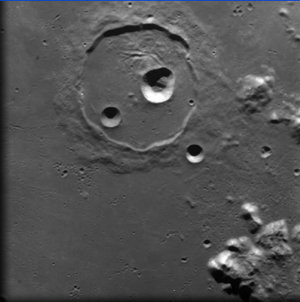
    SMART-1’s view of Crater Hopmann: on the shoulder of a giant

    SMART-1’s view of Crater Hopmann
    3 May 2006

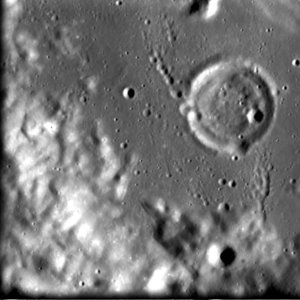
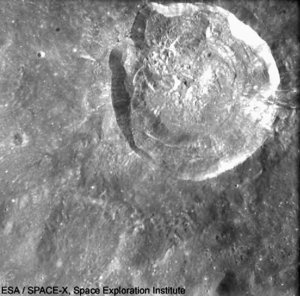
    This image, taken by the advanced Moon Imaging Experiment (AMIE) on board ESA’s SMART-1 spacecraft, shows one quarter of crater Hopmann - an impact structure about 88 kilometres in diameter.

    AMIE obtained this image on 25 January 2006 from a distance of about 840 kilometres from the surface, with a ground resolution of 76 metres per pixel.

    The imaged area, not visible from Earth because it is located on the far side of the Moon, is positioned at latitude of 51.7º South and longitude 159.2º East. It covers a square of about 39 kilometres per side.

    The crater (centred at 50.8º South, 160.3º East) is situated on the edge of the giant South Pole-Aitken basin SPA, the largest impact crater in the solar system with a diameter of 2500 kilometres and a depth of 13 kilometres. The SPA basin shows distinctive chemical composition with unusual mineralogy types, and possible exposure of rocks from the lower crust or the upper mantle.

    The hills on the lower left side are the crater wall of Hopmann. This crater is very old - many small craters can be seen on its flat floor, the largest one showing an interesting double-ringed structure. The outer rim has been also eroded by later impacts.

    The small crater chains to the left of Hopmann can be interpreted as series of so-called ‘secondary craters’, created by the impact of the material ejected from a nearby large impact. This ejected material flies away in molten state, and fall in large ‘droplets’. When these impact on the surface, they form typical crater chains as those visible in this image.

    The crater is named after Josef Hopmann (1890-1975), an astronomer that worked in Bonn, Leipzig and as Director of the Vienna Observatory.


    For more information:

    Jean-Luc Josset, SPACE-X Space Exploration Institute
    Email: jean-luc.josset @ space-x.ch

    Bernard H. Foing, ESA SMART-1 Project Scientist
    E-mail: bernard.foing @ esa.int
    Rate this

    Views

    Share

    • Currently 0 out of 5 Stars.
    • 1
    • 2
    • 3
    • 4
    • 5
    Rating: 0/5 (0 votes cast)

    Thank you for rating!

    You have already rated this page, you can only rate it once!

    Your rating has been changed, thanks for rating!

    49
    Tweet
    • SMART-1
    • More about...
      • SMART-1’s view of Crater Hopmann: on the shoulder of a giant
        • SMART-1’s view of craters Mayer and Bond
          • Tectonic ‘wrinkles’ in Crater De Gasparis
            • SMART-1’s view of craters Mayer and Bond
              • Dark lava floor of crater Billy seen by SMART-1
                • Crater Lichtenberg and young lunar basalts tracked by SMART-1
                  • SMART-1 uses new imaging technique in lunar orbit
                    • SMART-1's dancing shadows at lunar north pole
                      • ‘Alpine’ landscape on the Moon
                        • SMART-1 views Glushko crater on the Moon
                          • SMART-1 views Hadley Rille near Apollo 15 landing site
                            • SMART-1's tribute to Cassini
                              • SMART-1's first images from the Moon
                                • SMART-1 views Middle East and Mediterranean
                                • Related links
                                • Space-X
                                • Advanced Moon micro-Imager Experiment (AMIE)

    Connect with us

    • RSS
    • Youtube
    • Twitter
    • Flickr
    • G+
    • Facebook
    • Livestream
    • Subscribe
    • App Store
    • ESA Science Twitter

    Follow ESA science

    • LATEST ARTICLES
    • · Proba-V opens its eyes
    • · First new Galileo satellite arrive…
    • · Next destination: space
    • · Leak repaired on International Spa…
    • · After Chelyabinsk: European expert…
    • FAQ

    • Jobs at ESA

    • Site Map

    • Contacts

    • Terms and conditions