


How far can a dentist's drill go?
When ESA's Mars Express reaches the Red Planet in December 2003, there will be a drill on board its Beagle 2 lander. This drill will dig into the surface to take samples of the Martian rocks. Who would imagine that the creativity of an enthusiastic dentist is behind a 'cosmic' drill?
A few years ago, when scientists were busy with Mars Express and its lander, engineers needed a precision rock corer and grinder for Beagle 2. They also required a system to grip the rock powder firmly to drop it into an analyser. About the same time, a Chinese dentist called Dr. Ng visited ESTEC, ESA's establishment in the Netherlands, looking for space applications for his high-tech inventions.
"Dr. Ng and his team came to ESTEC armed with a tremendous enthusiasm but few impressive prototype instruments," says Agustin Chicarro, Mars Express Project Scientist. "They asked for advice on how they could get involved in a Mars mission."

Dr Ng and his colleagues had found the right people at the right moment: engineers were designing Beagle 2, the lander for Mars Express. The high-precision drill proposed by Dr Ng called a Micro End Effector, originally weighed 900 grams. The Beagle 2 engineers adapted it and made it lighter to fit on the spacecraft. They reduced the weight to less than 400 grams and scaled down the energy consumption to 2 Watts (less than the smallest light bulb).
Once on Mars, the head of the rock drill will roll over a small area of the selected rock. The drill will then begin to penetrate up to one centimetre into the rock and collect an uncontaminated rock sample. A microlab located on Beagle's 'paw' will then examine it. "If we are lucky, this could be the first human-made tool to encounter an alien form of life," says an enthousiastic Dr Ng.
"Perhaps a jeweller could have designed a useful tool like that too," observes Chicarro. "All we need for ESA planetary exploration missions are small, light instruments, just like the ones the Hong Kong team provided."
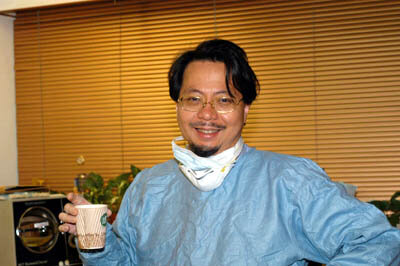
A practising dentist in Hong Kong, Dr Ng never lost his boyhood fascination for space. "I am a very persistent man," he says. "It took me lots and lots of visits in more than 10 years to the space agencies around the world to ensure my idea would go to Mars."
Dr Ng and his team have devised other tools for use in space also. For example, they made a tool that could easily grip objects of any shape and with sizes up to 20 centimetres, in a microgravity environment. The MIR Russian space station used the tool in 1995.
Dr Ng thinks he has had another special gift: "In China, we have a 5000-year-long tradition of 'microgripping', thanks to the chopsticks we use for eating. All I had to do was combine my professional experience with this traditional skill!"

