Splashy portrait paints picture of how stars form
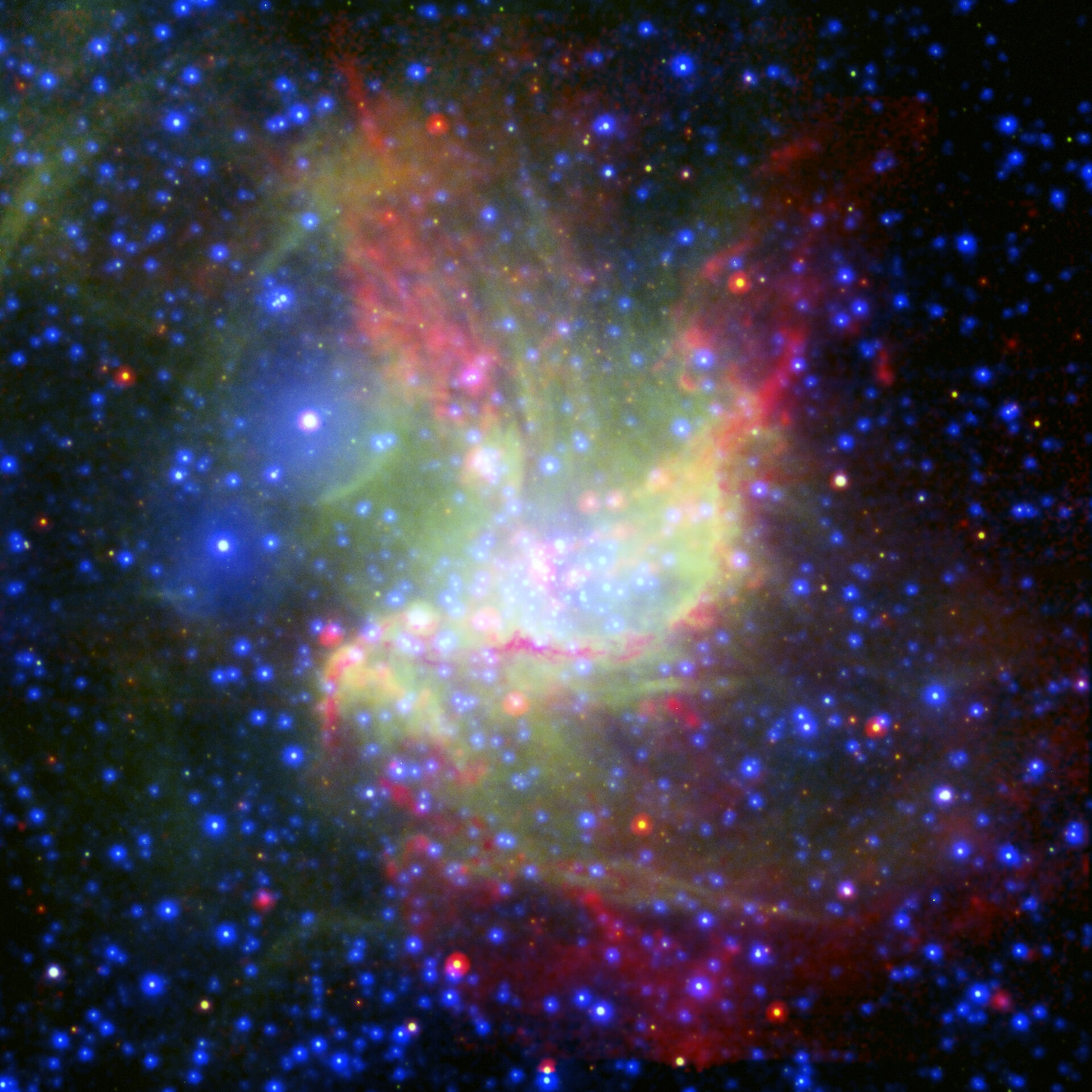
Different wavelengths of light swirl together like watercolours in a new, ethereal portrait of a bright, active star-forming region.
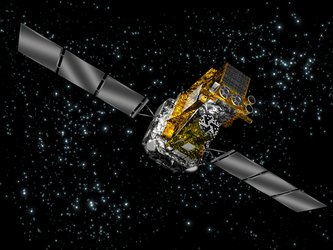
The multi-wavelength picture combines X-ray, infrared and visible light captured by ESA’s XMM-Newton space-borne X-ray observatory, NASA's Spitzer Space Telescope and the European Southern Observatory's New Technology Telescope.
The colourful image offers a fresh look into the history of the star-studded region, called NGC 346, revealing new information on how stars in the Universe form.
NGC 346 is the brightest star-forming region in the Small Magellanic Cloud, a dwarf galaxy that orbits the Milky Way, at a distance of
"NGC 346 is an astronomical zoo," said Dimitrios Gouliermis from the Max Planck Institute for Astronomy in Germany, lead author of a paper describing the observations in an upcoming issue of the Astrophysical Journal. "When we combined data from various wavelengths, we were able to tease apart what's going on in different parts of the cloud."
Star formation is a far more complicated process than we believed, comprising different competitive and collaborative mechanisms.
Previously, astronomers knew that most of NGC 346's smaller stars were created at the same time as the massive stars located at the centre of the region, all out of one dense parent cloud. The intense radiation from the more massive stars ate away at the surrounding dusty cloud, causing gas to expand and compressing cold dust into new stars. This process is known as 'triggered star formation'. The red-orange filaments surrounding the centre of the image show where this process has occurred.
But the formation of a set of younger, small stars in the region, seen at the top of the image, could not be explained by this mechanism. Scientists were puzzled by what triggered the formation of this seemingly isolated group of stars.
By combining multi-wavelength data of NGC 346, Gouliermis and his team were able to trace back the trigger of the formation of these young stars to a very massive star that blasted apart in a supernova explosion about
The finding demonstrates that both wind- and radiation-induced star formation are at play in the same cloud. According to Gouliermis, "The result shows us that star formation is a far more complicated process than we believed, comprising different competitive and collaborative mechanisms."
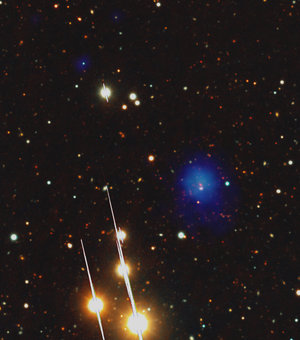
The new image also reveals a bubble, seen as a blue halo to the left, caused by the supernova explosion of the massive star. Analysis shows that this bubble is located within a large, expanding gaseous shell, possibly powered by the explosion and the winds of other bright stars in its vicinity.
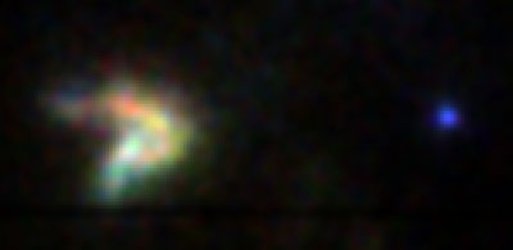
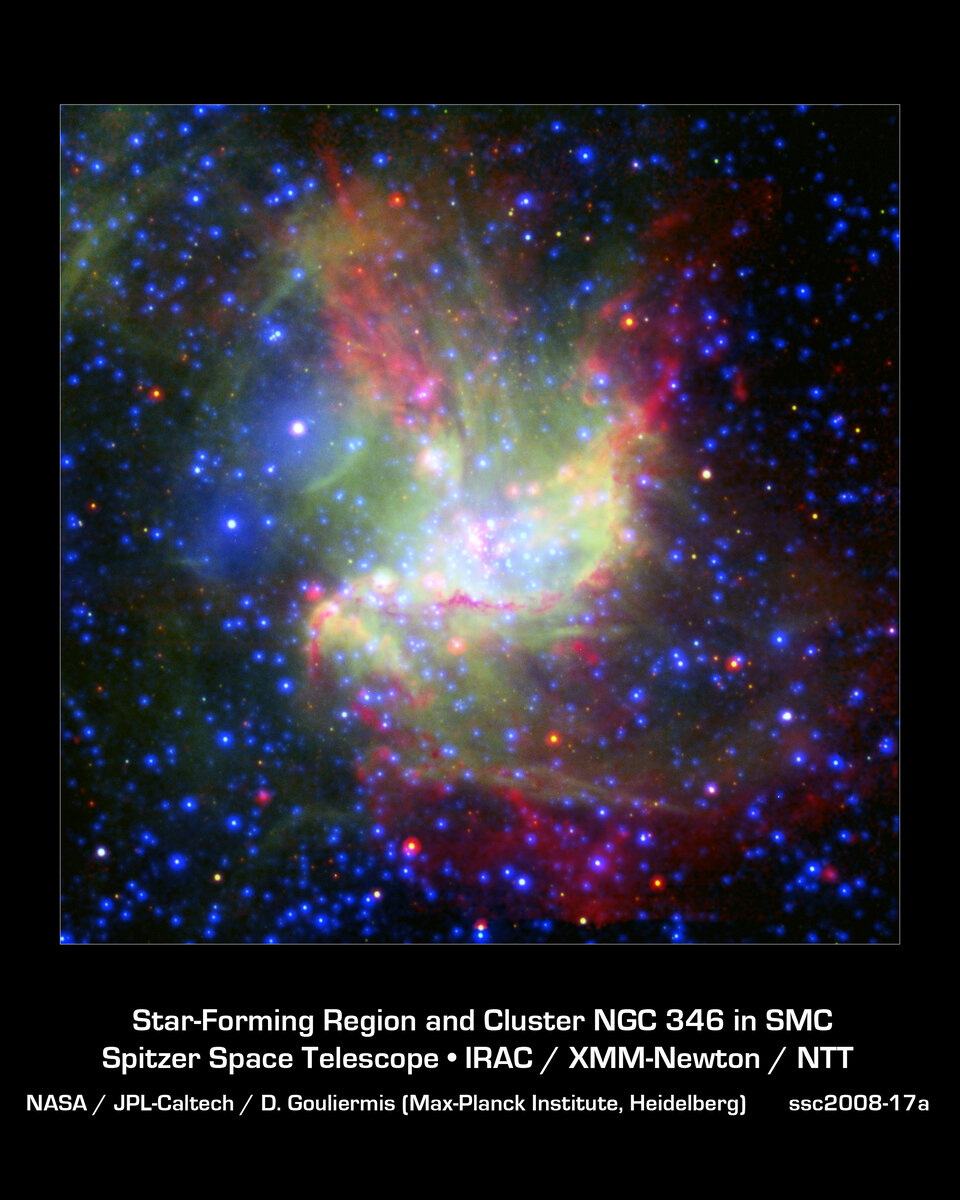
In this image, infrared light (red) shows cold dust; visible light (green) denotes irradiative gas; and X-rays (blue) represent warm gas.
Notes for editors:
The findings appear in the paper ‘NGC 346 in The Small Magellanic Cloud. IV. Triggered Star Formation in the HII Region N66’, which appears in an upcoming issue of the Astrophysical Journal, by D. Gouliermis et al.
The authors of this paper include Thomas Henning and Wolfgang Brandner of the Max Planck Institute for Astronomy, and You-Hua Chu and Robert Gruendl of the University of Illinois at Urbana-Champaign.
The XMM-Newton science teams are based in several European and US institutes, grouped into three instrument teams and the XMM-Newton Survey Science Centre (SSC). Science operations are managed at ESA’s European Space Astronomy Centre (ESAC), at Villanueva de la Cañada near Madrid, Spain. Spacecraft operations are managed at ESA’s European Space Operations Centre (ESOC) in Darmstadt, Germany.
NASA's Jet Propulsion Laboratory, Pasadena, California, manages the Spitzer Space Telescope mission for NASA's Science Mission Directorate, Washington. Science operations are conducted at the Spitzer Science Center at the California Institute of Technology, also in Pasadena. Caltech manages JPL for NASA.