Ground-based observatories join forces with Venus Express
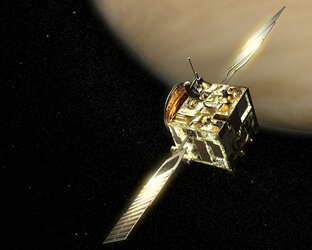
Data from Venus Express, which has been revealing new and crucial details about our closest planetary neighbour, will now be augmented by synoptic data from a coordinated ground-based observation campaign.
This campaign will contribute to the growing body of information on the nature of Venus’s atmosphere and will help put the spacecraft’s observations into a broader context.
Between 23 May and 9 June, scientists working at a dozen telescopes and observatories spread all over the world will examine Venus from the ground and perform measurements, some of which are not feasible for Venus Express.

By applying different techniques and performing measurements at wavelengths that are not within the capabilities of the spacecraft, scientists intend to complement the existing dataset and obtain simultaneous measurements and cross-validation of the spacecraft’s observations.
Thus the ground-based observations - radio, submillimetre, infrared and visible - are very useful for interpretation of Venus Express results.
The main focus of the ground-based observations is on measurements of the atmosphere above Venus’ cloud tops. This will complement Venus Express’ capability to study the cloud layer in high detail and the lower atmospheric altitudes, down to the surface.
Spectroscopy at visible, infrared and submillimetre wavelengths from ground-based observatories will enable direct measurements of the wind and unearth fresh data about the mesosphere and the thermosphere, two atmospheric layers situated above Venus’ cloud deck.
This directly complements Venus Express, which determines wind characteristics by tracking motions of the clouds and studies the distribution of gaseous species and temperatures in Venus’ upper atmosphere.
Previous examples demonstrate the importance of connecting space-borne observations with the synoptic coverage from ground.
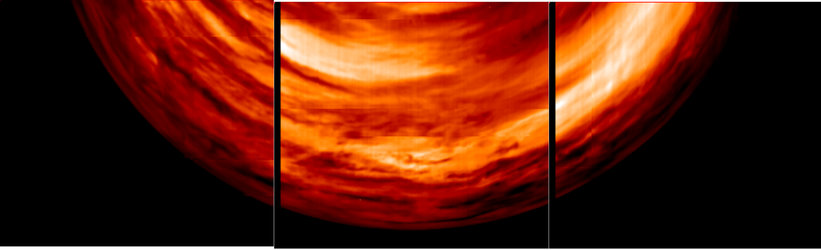
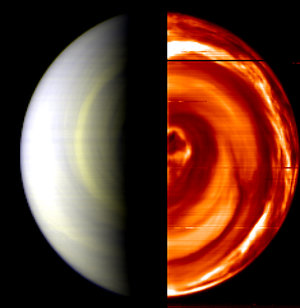
Following on Venus Express’ investigations, the ground-based observations will perform studies of Venus’ oxygen airglow emission – a phenomenon detectable on the night-side that makes the planet glow – and study the composition of the mesosphere and the deep atmosphere.
The timeframe of the ground-based campaign, which extends from 23 May to 9 June, was chosen for different reasons. The most important reason is the fact that Venus is close to its maximum elongation, that is its maximum angular distance from the Sun as seen from Earth, during this period. This is a favourable position for observations of both its day and night sides from Earth.
The time window also encompasses the Venus flyby of NASA’s Messenger on 6 June at 1:10 CEST, en route to its final destination, Mercury. For one day, Messenger’s observations of Venus will also complement those from Venus Express and ground.
Who is involved?

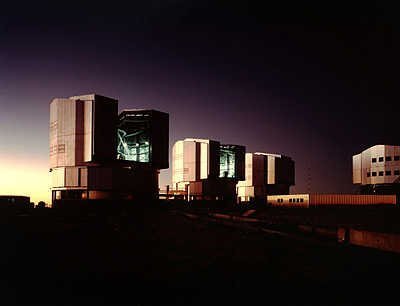
The telescopes involved in the Venus ground-based observation campaign are:
- CFHT: Canada-France-Hawaii Telescope, Hawaii
- OHP: Observatoire de Haute Provence, France
- VLT: Very large Telescope, Chile
- Observatoire du Pic du Midi, Telescope Bernard Lyot (TBL), France
- IRAM: Institut de Radio-Astronomie Millimetrique, Spain
- IRAM PdB: Institut de Radio-Astronomie Millimetrique: antennae at Plateau de Bures, France
- JCMT: James Clerk Maxwell Telescope, Hawaii
- Nobeyama: Radio Observatory, Japan
- HHT: Heinrich Hertz Submillimeter Telescope Observatory, Arizona, USA
- Kitt Peak National Observatory, Arizona, USA
- IRTF: Infrared facility, Hawaii
- AAT: Anglo-Australian Telescope, Siding Spring Mountain in north-western New South Wales, Australia
- Keck telescope (Hawaii)
Ground-based campaigns for previous missions
“Previous examples demonstrate the importance of connecting space-borne observations with the synoptic coverage provided by continued ground-based programmes,” said Emmanuel Lellouch, Venus Express Supporting Investigator and coordinator of the ground-based observation campaign.
One of the recent ground-based observation campaigns in support of a scientific mission was conducted during the Huygens probe’s descent and landing on Titan on 14 January 2005. As Huygens parachuted to the surface of Titan, a battery of radio and optical telescopes around the world were watching and listening.
The observations brought in new information on the atmosphere and surface properties of Saturn’s largest moon. They also provided information about the probe’s drift in the winds and thus helped to reconstruct the descent trajectory and the coordinates of the landing site.
Other supporting ground-based observations were successfully performed for other scientific missions such as ESA’s SMART-1 which flew to the Moon and NASA’s Deep Impact which flew to comet 9P/Tempel 1.
There are also a large number of amateur astronomers watching Venus regularly, obtaining excellent images to complement data from observatories. During the current campaign, Venus is particularly bright and thus easily observable, even with small telescopes, for amateurs’ viewing pleasure.
For more information
Emmanuel Lellouch, VEX Supporting investigator, Observatoire de Paris, France
Email: Emmanuel.Lellouch @ obspm.fr
Olivier Witasse, ESA Venus Express Deputy Project Scientist
Email: Olivier.Witasse @ esa.int