• → European Space Agency

      • Space for Europe
      • Space News
      • Space in Images
      • Space in Videos
    • About Us

      • Welcome to ESA
      • DG's News and Views
      • For Member State Delegations
      • Business with ESA
      • ESA Exhibitions
      • ESA Publications
      • Careers at ESA
    • Our Activities

      • Space News
      • Observing the Earth
      • Human Spaceflight
      • Launchers
      • Navigation
      • Space Science
      • Space Engineering
      • Operations
      • Technology
      • Telecommunications & Integrated Applications
    • For Public

    • For Media

    • For Educators

    • For Kids

    • ESA

    • Venus Express

    • ESA Science

    • Europe goes to Venus

      • Tribute to the cryptic planet
      • Penetrating an impenetrable world
      • Past missions to Venus
    • About Venus Express

      • Venus Express mission facts
      • Venus Express objectives
      • The spacecraft
      • Orbiter instruments
      • The launcher
      • Operating Venus Express
    • About Venus

      • Venusian geography
      • The surface
      • Acid clouds and lightning
      • Greenhouse effect, clouds and winds
      • Venus compared to Earth
    • Meet the team

      • International collaboration
      • Project Manager: An interview with Don McCoy
      • Project Scientist: An interview with Håkan Svedhem
      • Launch Campaign Manager: An interview with Michael Witting
      • Spacecraft Operations Manager: An interview with Andrea Accomazzo
      • Venus Express Flight Control Team
      • Principal Investigators
    • Multimedia
    • Venus Express images
    • Venus Express videos
    • VideoTalk
    • 3D Flash 'model'
    • Build a model (pdf)
    • Wallpapers
    • Screensavers
    • Services
    • Comments

    ESA > Our Activities > Space Science > Venus Express

    Venus Express ready for 'mating' with upper-stage

    Venus Express being lowered onto LVA
    5 October 2005

    The Venus Express spacecraft is now sitting on its Launch Vehicle Adaptor (LVA), ready for the ‘mating’ with the Fregat upper-stage rocket, and only weeks away from launch on 26 October 2005.

    Following the completion of the propellant loading, Venus Express was transferred from the Hazardous Processing Facility to the Upper Composite Integration Facility at Baikonur on 30 September. Here, the joining (or mating) of the spacecraft with the LVA, and subsequently with the Fregat upper stage and the payload fairing will take place.

    On 1 October, the spacecraft was lifted off the base of its transport container using the facility crane, and was carefully moved over the LVA by a team of specialist mechanical operators from Alcatel Alenia Space Italia (Italy).

    The spacecraft was then lowered gently on to the LVA, an operation requiring a very high degree of precision in order to achieve a proper fit of the two items. Because the spacecraft was loaded with half a ton of highly flammable and toxic propellant, all non-essential personnel had to leave the facility for safety reasons.
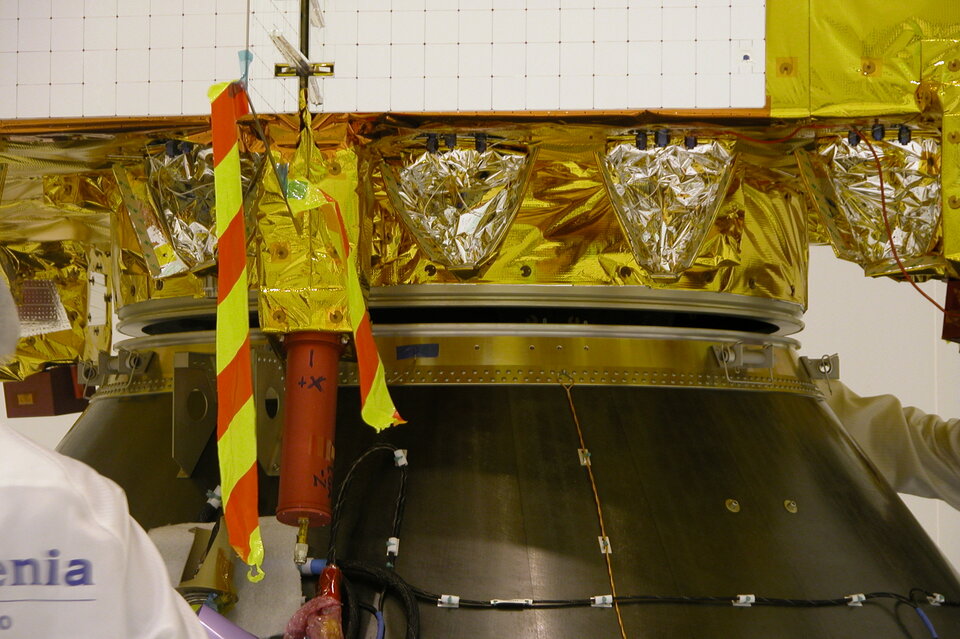
    Last few millimetres: Venus Express lowered onto LVA

    With this being completed, a specialist team from CASA (Spain) proceeded with the installation of the ‘clampband’. The clampband is a metal band, tensioned to the equivalent of roughly 2.5 tons, that sits around the circular interface section between the spacecraft and the LVA and clamps the two items together.

    The clampband includes two pyrotechnic boltcutters, which will eventually be electrically connected to the Fregat upper-stage electrical system. In flight, after injection into the transfer trajectory to Venus, these boltcutters will be fired, thereby cutting the clampband and allowing separation of the spacecraft from the launch vehicle.

    The mating procedure was completed by the connection of the spacecraft's electrical umbilical connectors to the Launch Vehicle Adaptor's harness, which is in turn connected to the electrical ground support equipment.

    The spacecraft was switched on, and had a short and very basic functional test, which successfully verified the proper connection of all umbilical lines used for telemetry, telecommanding and spacecraft power. It is now ready for the ‘mating’ with the Fregat upper-stage rocket.

    Rate this

    Views

    Share

    • Currently 0 out of 5 Stars.
    • 1
    • 2
    • 3
    • 4
    • 5
    Rating: 0/5 (0 votes cast)

    Thank you for rating!

    You have already rated this page, you can only rate it once!

    Your rating has been changed, thanks for rating!

    18
    Tweet
    • Looking at Venus
    • Launch replay
    • Venus Express launch
    • Related articles
      • Venus Express performs flawlessly, LEOP complete
        • Venus Express mission operations update
          • "Venus Express, give me a GO/NO GO for launch..."
            • Venus Express: ready for lift-off
              • Green light for Venus Express launcher fuelling
                • Venus Express countdown activities started
                  • Venus Express moved back to launch pad
                    • Venus Express set for transport to launcher assembly building
                      • Venus Express mated with upper-stage
                      • More about...
                      • Status reports
                      • Launch in detail
                        • Venus Express factsheet
                        • Related links
                        • Starsem - the Soyuz
                        • Venus Express operations
                        • Cebreros station webcam

    Connect with us

    • RSS
    • Youtube
    • Twitter
    • Flickr
    • G+
    • Facebook
    • Livestream
    • Subscribe
    • App Store
    • LATEST ARTICLES
    • · Proba-V opens its eyes
    • · First new Galileo satellite arrive…
    • · Next destination: space
    • · Leak repaired on International Spa…
    • · After Chelyabinsk: European expert…
    • FAQ

    • Jobs at ESA

    • Site Map

    • Contacts

    • Terms and conditions