• → European Space Agency

      • Space for Europe
      • Space News
      • Space in Images
      • Space in Videos
    • About Us

      • Welcome to ESA
      • DG's News and Views
      • For Member State Delegations
      • Business with ESA
      • ESA Exhibitions
      • ESA Publications
      • Careers at ESA
    • Our Activities

      • Space News
      • Observing the Earth
      • Human Spaceflight
      • Launchers
      • Navigation
      • Space Science
      • Space Engineering
      • Operations
      • Technology
      • Telecommunications & Integrated Applications
    • For Public

    • For Media

      • Media
      • ESA TV
      • Videos for professionals
      • Photos
    • For Educators

    • For Kids

    • ESA

    • Space Science

    • Our Universe
    • About Space Science
    • ESA's 'Cosmic Vision'
    • Science missions
    • Mission navigator
    • Target groups
    • For Media
    • For Scientists
    • For Kids
    • Multimedia
    • Science images
    • Science videos
    • Animations
    • Downloads
    • Sounds from space
    • Resources
    • Reference section
    • Services
    • FAQs
    • Glossary
    • Help
    • Portal terms of use
    • Comments
    • Follow us
    • RSS feeds
    • ESA Sci on Twitter
    • ESA Space Science Images on Flickr
    • ESA 3D on Flickr

    ESA > Our Activities > Space Science

    Venus holds warning for Earth

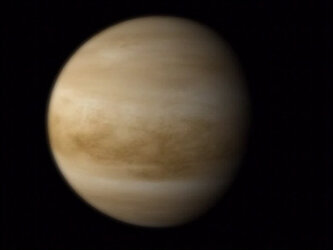
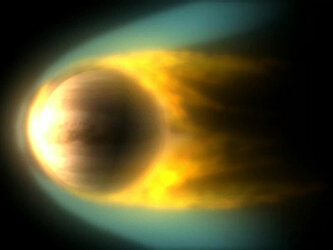
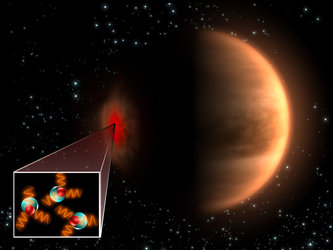
    Artist's impression of Venus
    Animation of planet Venus
    30 November 2010

    A mysterious high-altitude layer of sulphur dioxide discovered by ESA’s Venus Express has been explained. As well as telling us more about Venus, it could be sending a warning to those on Earth seeking to inject our atmosphere with sulphur droplets in an attempt to mitigate climate change.

    Venus is blanketed in sulphuric acid clouds that block our view of the surface. The clouds form at altitudes of 50–70 km when sulphur dioxide from volcanoes combines with water vapour to make sulphuric acid droplets. Any remaining sulphur dioxide should be destroyed rapidly by the intense solar radiation above 70 km.

    So the detection of a sulphur dioxide layer at 90–110 km by ESA’s Venus Express orbiter in 2008 posed a complete mystery. Where did that sulphur dioxide come from?

    Now, computer simulations by Xi Zhang, California Institute of Technology, USA, and colleagues from America, France and Taiwan show that some sulphuric acid droplets may evaporate at high altitude, freeing gaseous sulphuric acid that is then broken apart by sunlight, releasing sulphur dioxide gas.
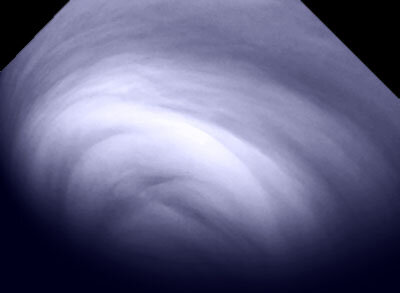
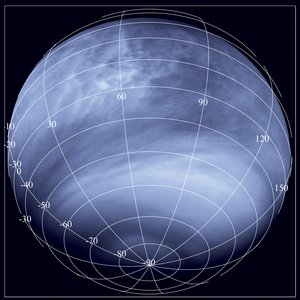
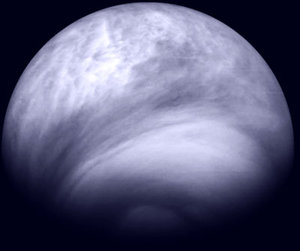
    Close-up on venusian cloud structures at the south pole
    Close-up on venusian cloud structures at the south pole

    “We had not expected the high-altitude sulphur layer, but now we can explain our measurements,” says Håkan Svedhem, ESA’s Venus Express Project Scientist.

    “However, the new findings also mean that the atmospheric sulphur cycle is more complicated than we thought.”

    As well as adding to our knowledge of Venus, this new understanding may be warning us that proposed ways of mitigating climate change on Earth may not be as effective as originally thought.

    Nobel prize winner Paul Crutzen has recently advocated injecting artificially large quantities of sulphur dioxide into Earth’s atmosphere at around 20 km to counteract the global warming resulting from increased greenhouse gases.
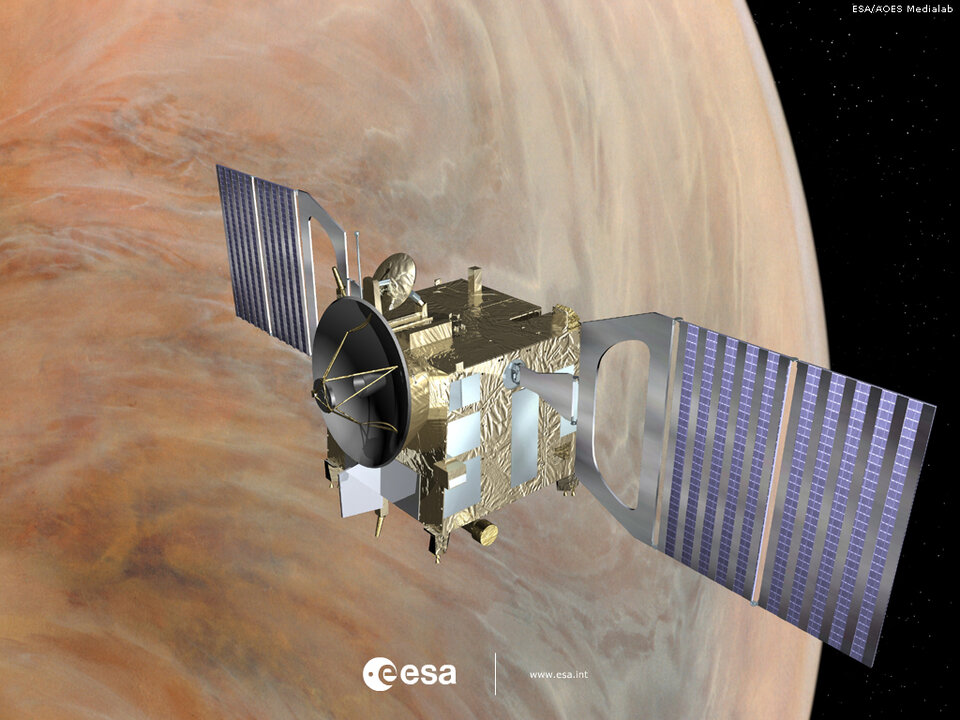

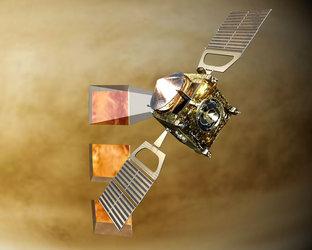
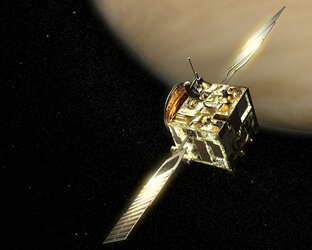
    Venus Express

    The proposal stems from observations of powerful volcanic eruptions, in particular the 1991 eruption of Mount Pinatubo in the Philippines that shot sulphur dioxide up into Earth’s atmosphere. Reaching 20 km in altitude, the gas formed small droplets of concentrated sulphuric acid, like those found in Venus’ clouds, which then spread around Earth. The droplets created a haze layer that reflected some of the Sun’s rays back into space, cooling the whole planet by about 0.5°C.

    However, the new work on the evaporation of sulphuric acid on Venus suggests that such attempts at cooling our planet may not be as successful as first thought, because we do not know how quickly the initially protective haze will be converted back into gaseous sulphuric acid: this is transparent and so allows all the Sun’s rays through.

    “We must study in great detail the potential consequences of such an artificial sulphur layer in the atmosphere of Earth,” says Jean-Loup Bertaux, Université de Versailles-Saint-Quentin, France, Principal Investigator of the SPICAV sensor on Venus Express. “Venus has an enormous layer of such droplets, so anything that we learn about those clouds is likely to be relevant to any geo-engineering of our own planet.”

    In effect, nature is doing the experiment for us and Venus Express allows us to learn the lessons before experimenting with our own world.

    Rate this

    Views

    Share

    • Currently 0 out of 5 Stars.
    • 1
    • 2
    • 3
    • 4
    • 5
    Rating: 0/5 (0 votes cast)

    Thank you for rating!

    You have already rated this page, you can only rate it once!

    Your rating has been changed, thanks for rating!

    192
    Tweet
    • Looking at Venus
    • ESApod: Venus Express
    • Related articles
      • Venus holds warning for Earth
        • Venus Express finds planetary atmospheres such a drag
          • Was Venus once a habitable planet?
            • Venus is alive – geologically speaking
              • New map hints at Venus' wet, volcanic past
                • Watching Venus glow in the dark
                  • ESA extends missions studying Mars, Venus and Earth’s magnetosphere
                    • Where did Venus’s water go?
                      • Venus comes to life at wavelengths invisible to human eyes
                        • Venus Express searching for life – on Earth
                          • How windy is it on Venus? Venus Express answers
                            • Closing in on Venus
                              • New details on venusian clouds revealed
                                • Key molecule discovered in Venus’s atmosphere
                                • In depth
                                  • Notes for editors

    Connect with us

    • RSS
    • Youtube
    • Twitter
    • Flickr
    • G+
    • Facebook
    • Livestream
    • Subscribe
    • App Store
    • ESA Science Twitter

    Follow ESA science

    • LATEST ARTICLES
    • · Rare merger reveals secrets of gal…
    • · Watching for hazards: ESA opens as…
    • · ESA astronaut Timothy Peake set fo…
    • · Space drives e-mobility
    • · Proba-V opens its eyes
    • FAQ

    • Jobs at ESA

    • Site Map

    • Contacts

    • Terms and conditions