

Boiling into space
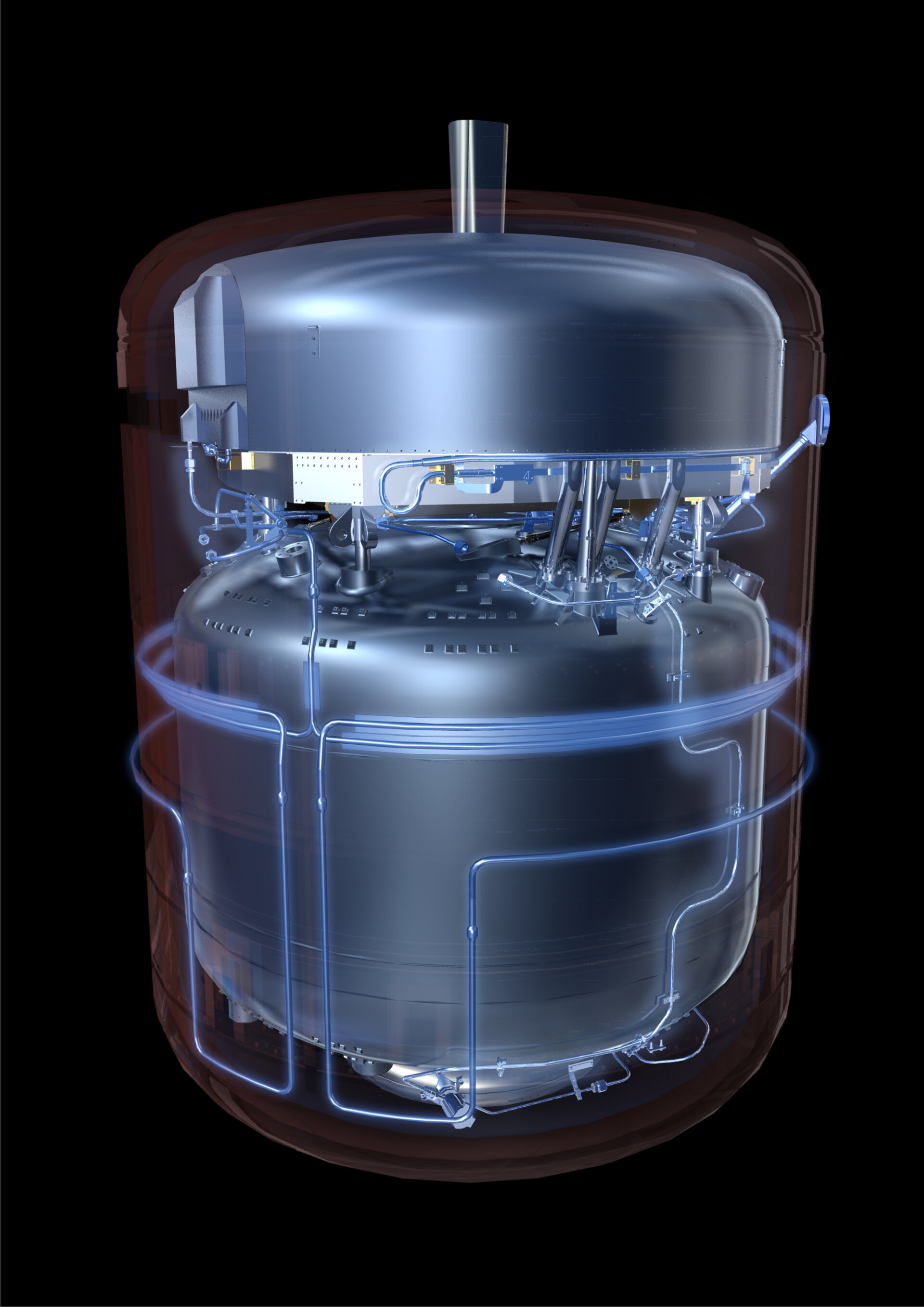
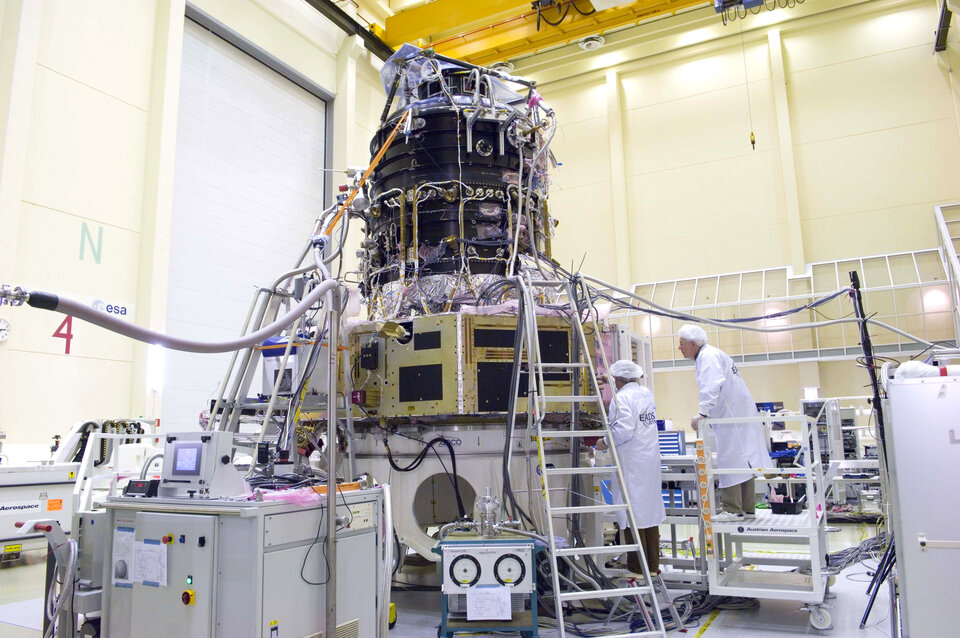
A cryogenic tank called a cryostat is located in the central segment of the Herschel spacecraft, between the service module on one side where all warm onboard electronics are placed and the 3.5m-diameter telescope mirror – the largest ever flown in space – on the other. The cryostat is filled with 2300 litres of liquid helium maintained close to a temperature of 1.65K (-271.5°C).
The optical bench and instruments placed within this cryostat with its telescope above it. The cryostat has vacuum insulation and reflective multi-layer insulation on its Sun side as well as a radiator surface on the side facing deep space to vent excess heat, so the system already gets very cold. However, this combination by itself is not enough to maintain the inside of the cryostat at its design temperature.
Instead the gradual “boiling” of the helium inside is required. Among the bizarre properties of this low temperature superfluid is zero viscosity, which allows it to form a film around the entire reservoir and to flow rapidly along the interior of the reservoir despite the absence of gravity. The helium therefore reaches a porous plug open to the space vacuum at the 'top' of the cryostat.
Keeping cold
The tank plug is also known as a phase separator because it permits gaseous helium to pass through it but prevents liquid helium from seeping out. Constant evaporation of helium at an estimated rate of around 200g per day maintains the temperature of the cryostat in the same way the human body relies on sweat evaporating off the skin to keep cool.
The helium vapour passes through a system of piping employed to cool parts of the instruments and then the cryostat's thermal shields to progressively elevated temperatures before finally being vented to space. Herschel has sufficient helium-4 to support a projected three and a half year observing mission.
"Once the helium is up there in orbit “boiling off” it will continue to do so reliably until it runs out," adds Mr Jewell. "With Herschel the hard work really comes on the ground instead."
Herschel's cryostat has to be filled with superfluid helium on its launch pad within five days of launch, with a secondary external helium dewar used to keep it cool. If the launch is delayed by more than two days however the cryostat temperature grows too high and the main tank will need to be reconditioned and refilled.
ISO and beyond
ESA research into superfluid cryogenics stretches back many years. In particular Herschel derives much of its cryogenic design from ESA's International Space Observatory (ISO), a 60cm-diameter infrared telescope launched in 1995. Employing a similar helium 4 superfluid cryostat, ISO operated for 28 months, outlasting its planned life by ten months.
"Herschel is based on ISO and previous superfluid cryostat designs," says Mr Jewell. "The big difference is we've never flown with such a big telescope and its associated instruments before, which led us to the necessity of having the telescope on the outside as opposed to inside the cryostat, and the instruments at the top of the helium reservoir instead of at the bottom."
With the area of its telescope primary mirror 35 times larger than ISO's and a trio of physically large high-performance instruments, Herschel has the biggest superfluid helium reservoir ever to fly.
Active cooling
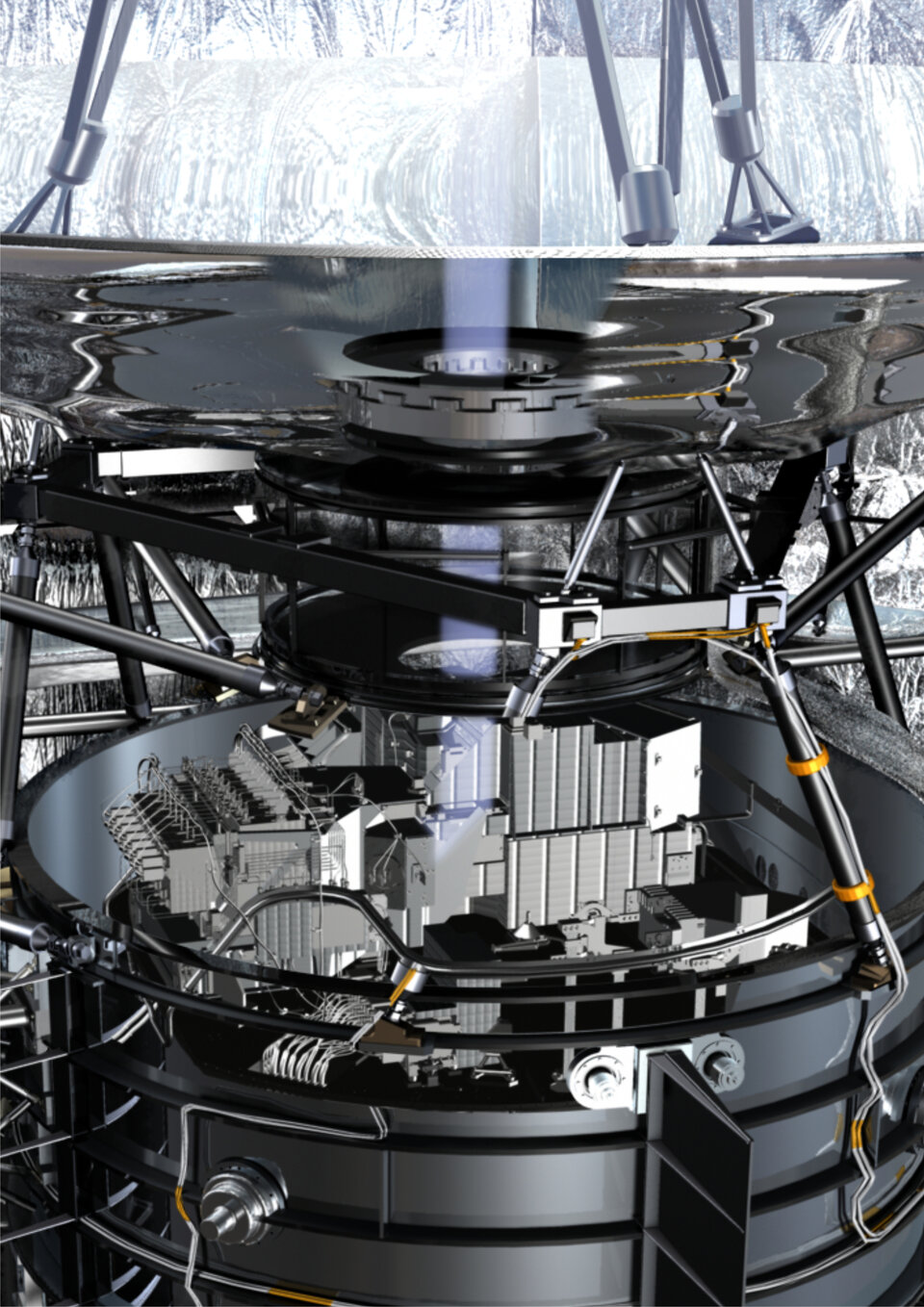
In addition two of Herschel's three instruments require still-lower cooling down to 0.3K. This is done through an active cryogenic technology known as sorption cooling, the design aboard Herschel being originally developed with the help of ESA's Technology Research Programme (TRP). Helium-3 vapour is captured and liquefied in a sponge like sinter and then via a pumping effect in a separate charcoal filled volume provides a cooling effect at the detectors. When all the 3He is in the charcoal pump, this pump is heated and the vapour returns to be liquefied in the sponge like sinter. This process is repeated once every two days for the duration of the mission.
Herschel's improved telescope size, instrument sensitivity and increased spectral range across far-infrared and millimetre wavelengths promises to deliver large performance improvements over ISO, which also had the disadvantage of observing from Earth orbit, inhibited by the planet's own infrared emissions as well as the surrounding radiation belts.
Along with Planck, Herschel will be operating from the colder climes of L2, some 1.5 million km away, the last great infrared observatory until the next-decade launch of the NASA-ESA James Webb Space Telescope (JWST) which will observe in the mid-infrared.
With future interest in ultra-cold spacecraft likely to remain high for Earth Observation and fundamental physics as well as astronomy, it remains to be seen whether Herschel or Planck best represents the likely shape of cryogenics technology to come - or whether the most likely future evolution will be a combination of both liquid cryogenics and active systems.
More information
Chris.Jewell @ esa.int

