Flying a suite of technologies
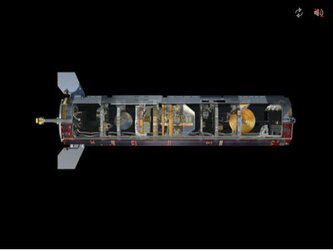
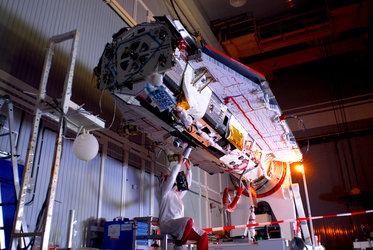
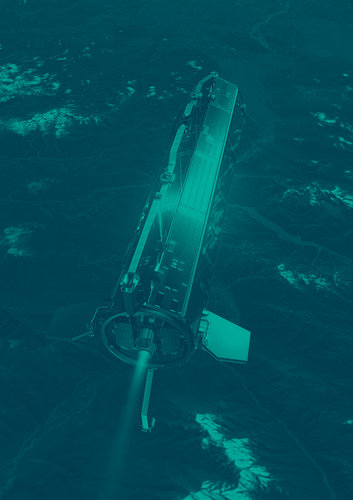
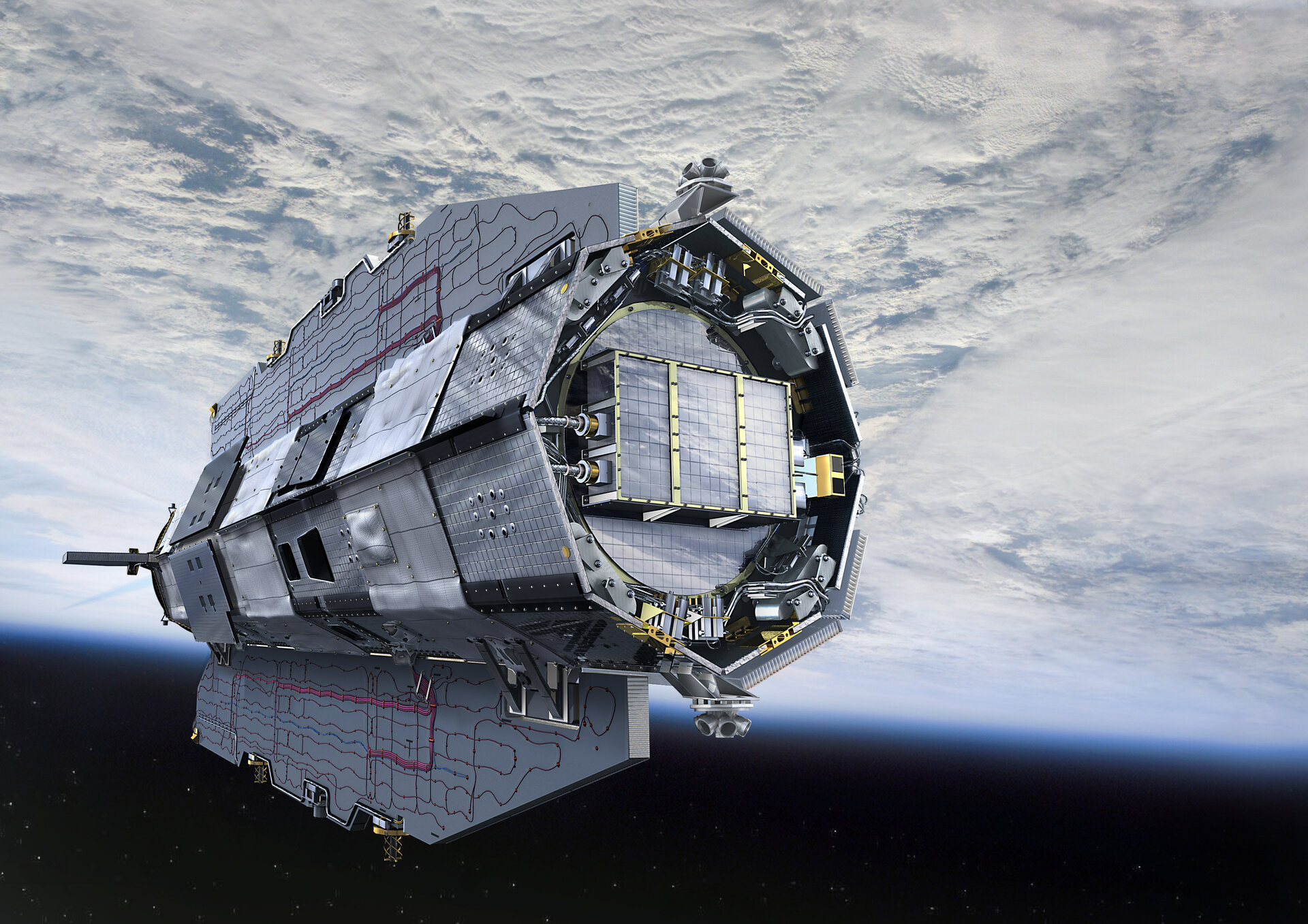
While most remote-sensing missions include an independent instrument package carried aboard a host satellite, with GOCE there is no divide between the two. The spacecraft is an extension of the payload, being aerodynamically styled with winglets to help stabilise its attitude, reduce friction and increase its gravity signal. Significant technologies aboard include:
- Electrostatic Gravity Gradiometer – GOCE's core instrument – of a type never before flown in space - is made up of three pairs of identical ultra-sensitive accelerometers which measure tiny differences in the accelerations acting upon each, to achieve a sensitivity in the finally measured Earth's gravity down to one part in a million. The distance between each accelerometer must not vary in time by more than a few percent of an Angstrom – the diameter of an atom.
- Ion engine for drag-free and attitude-control system – The drag-free control system employs inputs from the gradiometer as well as onboard star trackers and a GPS receiver to detect non-gravitational forces which can then be compensated against using a xenon-gas ion engine capable of recognising perturbations and reacting against them 20 times a second. While other ion engines have been used on ESA missions on a steadily-firing basis, GOCE's engine has to continuously vary its thrust while operating for 20 months without stopping.
- Carbon-carbon and carbon fibre reinforced polymer panels –To ensure the satellite remains as light as possible and stable across the wide range of temperatures it experiences in its low orbit, it is built largely from carbon composite materials - more typically employed on Formula One cars than satellites. For stability the instrument has been mounted on carbon-carbon panels, formed from carbon fibres baked onto a carbon honeycomb for strength, lightness and stiffness. The rest of the spacecraft is built largely from carbon fire reinforced plastic (CRFP) also possessing extreme rigidity. Insulation blankets, heaters and radiators help to achieve thermal stability, with blankets specially protected against the strong atomic oxygen flux encountered at GOCE's orbital height.
- Solar panels – High efficiency gallium arsenide solar cells are designed to tolerate materials from 160°C down to -170°C, mounted on the hull of the spacecraft rather than placed on hinged arrays in order to minimise perturbations. A lithium-ion battery provides back-up power during eclipses.
- Star trackers – These sensors measure the orientation of the spacecraft to be identified relative to the stars to enable angular control with the aid also of the gravity gradiometer data.
- Satellite-To-Satellite Tracking Instrument – This consists of an advanced dual-band frequency GPS receiver, based on a dedicated ASIC chip called AGGA-2 developed through ESA’s EOEP and internal studies, capable of receiving signals from up to 12 navigation satellites simultaneously to deliver real-time orbit navigation information as well as geodetic quality positioning information after post-processing.
- Magnetotorquers – GOCE's need for instrument and platform stability meant it could contain no moving components such as reaction wheels or gyroscopes. Instead pointing control is achieved with coils of wire which generate a magnetic field that reacts with the Earth's own magnetic field to point the spacecraft in the correct direction.