• → European Space Agency

      • Space for Europe
      • Space News
      • Space in Images
      • Space in Videos
    • About Us

      • Welcome to ESA
      • DG's News and Views
      • For Member State Delegations
      • Business with ESA
      • ESA Exhibitions
      • ESA Publications
      • Careers at ESA
    • Our Activities

      • Space News
      • Observing the Earth
      • Human Spaceflight
      • Launchers
      • Navigation
      • Space Science
      • Space Engineering
      • Operations
      • Technology
      • Telecommunications & Integrated Applications
    • For Public

    • For Media

    • For Educators

    • For Kids

    • ESA

    • Space for health

    • What space can do

      • Space for Health
      • Wellness

        • Wellness
        • Exercise
        • Food
      • Medicine

        • Medicine
        • Medical Research

          • Medical research
          • Physiology
          • Psycho-sociological issues, Cognition and performance
          • Clinical research
        • Diagnosis and treatment

          • Diagnosis and treatment
          • Tele-consultation
          • Homecare and mobile care
        • Emergency and disaster medicine
        • Medical education
        • Biomedical engineering
      • Environmental Health

        • Environmental Health
        • Air quality and pollution
        • Water
        • UV radiation
      • Public health

        • Public Health
        • Disease Surveillance
        • Disaster Relief and Emergency Management
        • Patient data management
        • Strategy and policy
    • What space offers

      • Space assets for health - overview
      • Earth observation
      • Satellite communications
      • Satellite positioning/navigation
      • Human spaceflight
      • Operations and infrastructure
    • Users/partners and ESA's role

      • ESA's role and offer
    • Services
    • Questions, ideas, comments... Contact us
    • Site credits

    ESA > Our Activities > Technology > Space for health

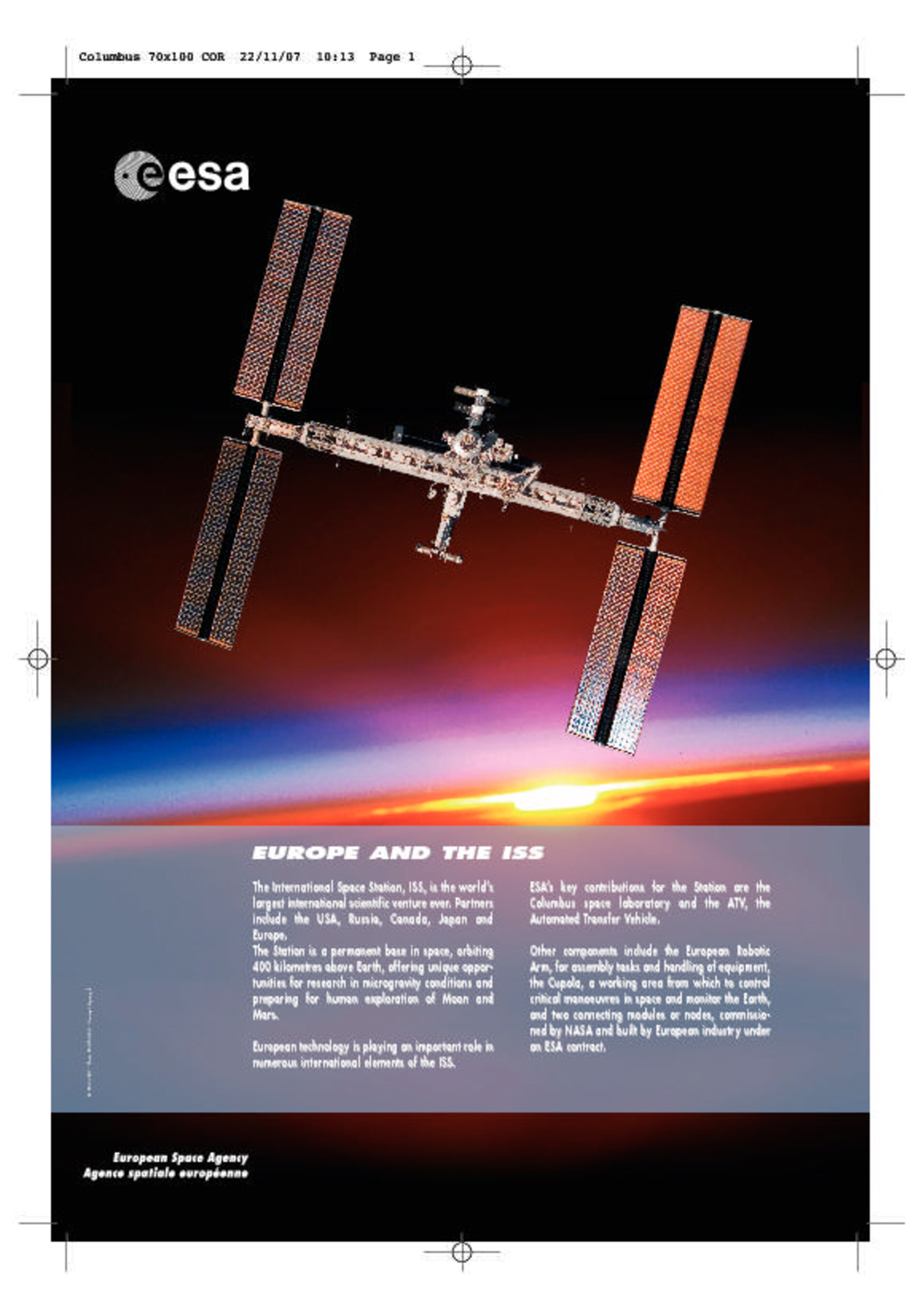
    International Space Station (ISS) - Columbus

    Europe and the ISS
    Poster - Europe and the ISS

    The International Space Station (ISS) offers a broad variety of facilities to perform human medical research. Currently the ISS host a permanent crew of 3 astronauts rotating with the Soyuz vehicle every six months. During their 6 months stay the crew receives the regular visit of progress vehicles for the re-supply of food, water, and other consumables, as well as the visit of Shuttle flights programmed for the completion of the building of the space station. Columbus, Europe’s main contribution to ISS, is one of its research modules. It can accommodate up to 10 international standard payload racks and is equipped with 4 external payload facilities. The latest announcement of opportunity to conduct research in the ISS was in 2004.

    Last update: 16 January 2008

    Rate this

    Views

    Share

    • Currently 0 out of 5 Stars.
    • 1
    • 2
    • 3
    • 4
    • 5
    Rating: 0/5 (0 votes cast)

    Thank you for rating!

    You have already rated this page, you can only rate it once!

    Your rating has been changed, thanks for rating!

    10
    Tweet
    • Related links
    • Concordia Station
    • ESA Human spaceflight and Exploration
    • ESA Life and Physical Sciences Instrumentation section
    • ESA Life support
    • EU Related links
    • eHealth - EU health web page
    • Medicines and Treatment - EU health web page

    Connect with us

    • RSS
    • Youtube
    • Twitter
    • Flickr
    • G+
    • Facebook
    • Livestream
    • Subscribe
    • App Store
    • LATEST ARTICLES
    • · ESA astronaut Timothy Peake set fo…
    • · Space drives e-mobility
    • · Proba-V opens its eyes
    • · First new Galileo satellite arrive…
    • · Next destination: space
    • FAQ

    • Jobs at ESA

    • Site Map

    • Contacts

    • Terms and conditions