• → European Space Agency

      • Space for Europe
      • Space News
      • Space in Images
      • Space in Videos
    • About Us

      • Welcome to ESA
      • DG's News and Views
      • For Member State Delegations
      • Business with ESA
      • ESA Exhibitions
      • ESA Publications
      • Careers at ESA
    • Our Activities

      • Space News
      • Observing the Earth
      • Human Spaceflight
      • Launchers
      • Navigation
      • Space Science
      • Space Engineering
      • Operations
      • Technology
      • Telecommunications & Integrated Applications
    • For Public

    • For Media

    • For Educators

    • For Kids

    • ESA

    • Space for health

    • What space can do

      • Space for Health
      • Wellness

        • Wellness
        • Exercise
        • Food
      • Medicine

        • Medicine
        • Medical Research

          • Medical research
          • Physiology
          • Psycho-sociological issues, Cognition and performance
          • Clinical research
        • Diagnosis and treatment

          • Diagnosis and treatment
          • Tele-consultation
          • Homecare and mobile care
        • Emergency and disaster medicine
        • Medical education
        • Biomedical engineering
      • Environmental Health

        • Environmental Health
        • Air quality and pollution
        • Water
        • UV radiation
      • Public health

        • Public Health
        • Disease Surveillance
        • Disaster Relief and Emergency Management
        • Patient data management
        • Strategy and policy
    • What space offers

      • Space assets for health - overview
      • Earth observation
      • Satellite communications
      • Satellite positioning/navigation
      • Human spaceflight
      • Operations and infrastructure
    • Users/partners and ESA's role

      • ESA's role and offer
    • Services
    • Questions, ideas, comments... Contact us
    • Site credits

    ESA > Our Activities > Technology > Space for health

    Other regulation systems: Endocrine, Immune and fluid/blood regulation systems

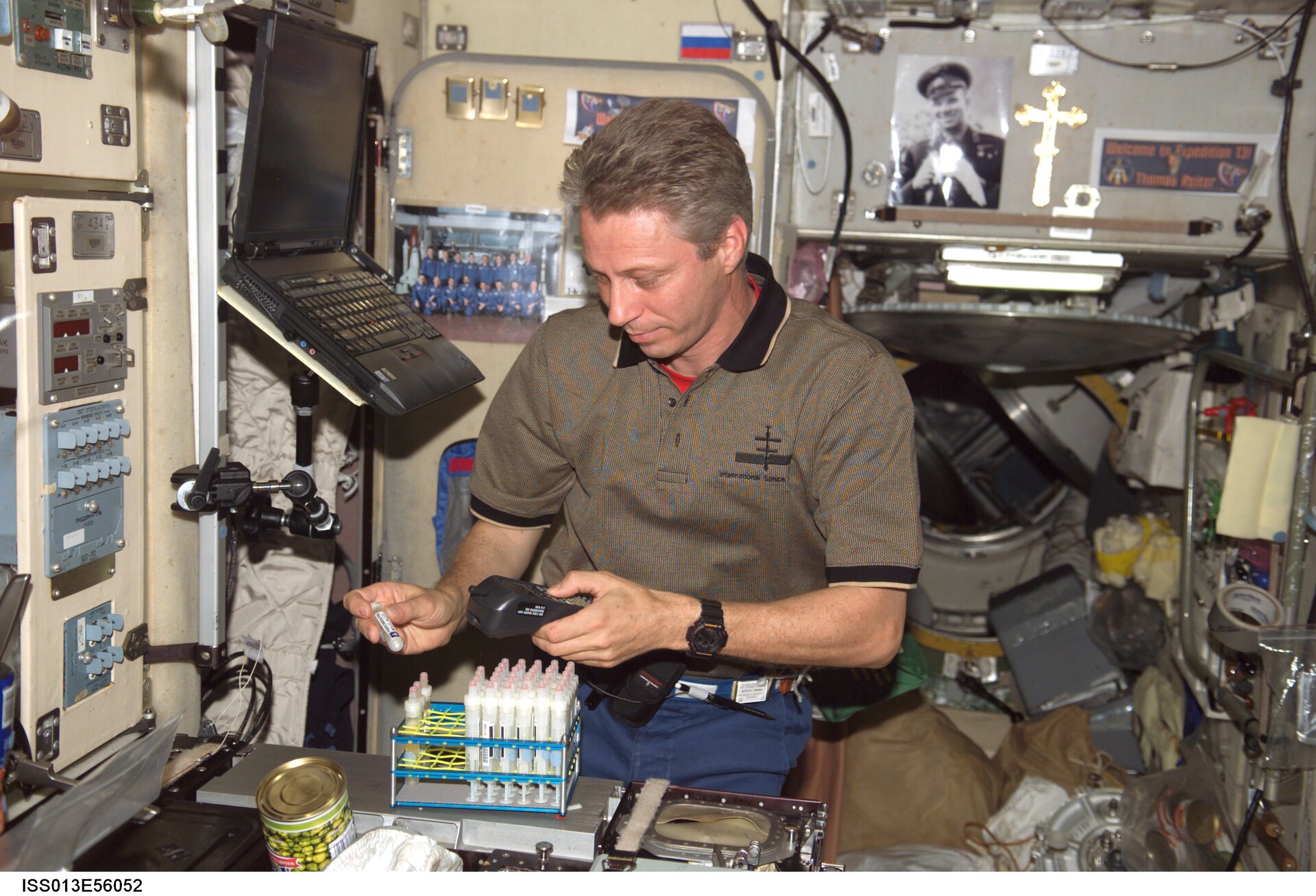
    Thomas Reiter with experiment in the Zvezda module

    Integrative physiology

    Several other human regulatory systems can be affected in space, either directly by exposure to microgravity and high energy radiation or indirectly secondary to other physiological changes induced by spaceflight. Cardiovascular changes trigger adaptation in the autonomic nervous system, the endocrine and the blood volume regulation system (e.g. kidney activity is increased to reduce plasma volume). Sleep deprivation and psycho-sociological issue can induce stress which will in turn trigger the immune, cardiovascular and endocrine systems.

    Integrated health patient care

    Research on space human physiology is often performed with an integrative perspective: the human body acting as a whole, none of its individual organ reaction to the new environment can be purely isolated from other systems. Changes at the cellular level, for example in signal transduction, can affect regulatory mechanisms at a higher level or adaptation of the autonomic nervous system secondary to cardiovascular changes can lead to changes at the neurotransmitter level. This challenging aspect on our understanding of human physiology appeals for an integrative approach to conduct research and eventually for a more integrated patient care. For example in the field of oncology an integrated (also named holistic) approach is more and more often applied: the psychological and quality of life aspects are also taken into account for the selection of a particular cancer treatment. Research & Development
    Research in this field is relatively new and the focus is made on the immune system and the various responses to stress (IMMUNO). Experiments performed in the field of Biology for example on human or mammalian cells are also filling the gap to reach a true integrative aspect.Health related topics: integrative physiology, holistic care, immune - system, endocrine system, autonomic nervous system, stress, kidney, fluid retention.

    Last update: 18 November 2011

    Rate this

    Views

    Share

    • Currently 0 out of 5 Stars.
    • 1
    • 2
    • 3
    • 4
    • 5
    Rating: 0/5 (0 votes cast)

    Thank you for rating!

    You have already rated this page, you can only rate it once!

    Your rating has been changed, thanks for rating!

    27
    Tweet

    Connect with us

    • RSS
    • Youtube
    • Twitter
    • Flickr
    • G+
    • Facebook
    • Livestream
    • Subscribe
    • App Store
    • LATEST ARTICLES
    • · ESA astronaut Timothy Peake set fo…
    • · Space drives e-mobility
    • · Proba-V opens its eyes
    • · First new Galileo satellite arrive…
    • · Next destination: space
    • FAQ

    • Jobs at ESA

    • Site Map

    • Contacts

    • Terms and conditions