• → European Space Agency

      • Space for Europe
      • Space News
      • Space in Images
      • Space in Videos
    • About Us

      • Welcome to ESA
      • DG's News and Views
      • For Member State Delegations
      • Business with ESA
      • ESA Exhibitions
      • ESA Publications
      • Careers at ESA
    • Our Activities

      • Space News
      • Observing the Earth
      • Human Spaceflight
      • Launchers
      • Navigation
      • Space Science
      • Space Engineering
      • Operations
      • Technology
      • Telecommunications & Integrated Applications
    • For Public

    • For Media

    • For Educators

    • For Kids

    • ESA

    • Technology Transfer

    • Business Incubation

    • Business Opportunities

    • Space Solutions

    • Technology Transfer Programme Office
    • About us
    • Benefits
    • Business with Technology Transfer
    • Technology Transfer Process
    • Technology Transfer Network
    • Technology Transfer Opportunities
    • Business with the Incubator
    • Mission
    • Locations
    • How to apply
    • Business with the Fund
    • Open Sky Technologies Fund
    • ESA intellectual property (IP)
    • IP for commercialisation
    • Services
    • Subscribe
    • Contact us

    ESA > Our Activities > Technology > TTP2

    More autonomy for blind people thanks to satellite navigation

    Tormes will help the blind find their way
    Tormes will help the blind find their way
    4 June 2003

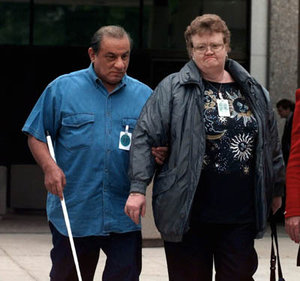
    “When blind people take a taxi, they will be able to give directions to the taxi driver!” says Jose Luis Fernandez Coya. The man speaking really knows what he is talking about: he is blind but also heads the R&D department of ONCE, the National Organization of Spanish Blind people.

    This association has always been looking for helpful innovations and has just developed a system based on GPS to guide blind people. The system called “Tormes”, named after a famous Spanish 16th century story, is a computer with a Braille keyboard and satellite navigation technology that gives verbal directions.

    This personal navigator was presented to the press in Madrid recently. The European Space Agency (ESA) was involved in this event because ONCE and ESA are already working on how to improve “Tormes”.

    The personal navigator will provide routing and guidance information

    The accuracy given by GPS is not precise enough and not guaranteed. A new tool, developed by ESA could be the breakthrough: EGNOS (European Geostationary Navigation Overlay Service). EGNOS corrects the GPS signals and gives an accuracy of 2 m while GPS provides an accuracy of only 15 to 20 m. It also warns the users of any problem with the signal thus giving integrity information.

    EGNOS is transmitted to the ground via geostationary satellites, so sometimes signals are blocked by buildings. This is called the canyon effect. To solve this problem, ESA engineers had the idea of getting the data through the Internet via a GSM connection, a project called SISNeT (Signal In Space through Internet). This makes EGNOS available anywhere downtown. Blind people who are able to access this information could distinguish streets. For a blind person walking in a town this will make all the difference because with an accuracy of 15 m (with GPS) the street is already crossed, with 2 m and less (with EGNOS) you know which pavement you are on.

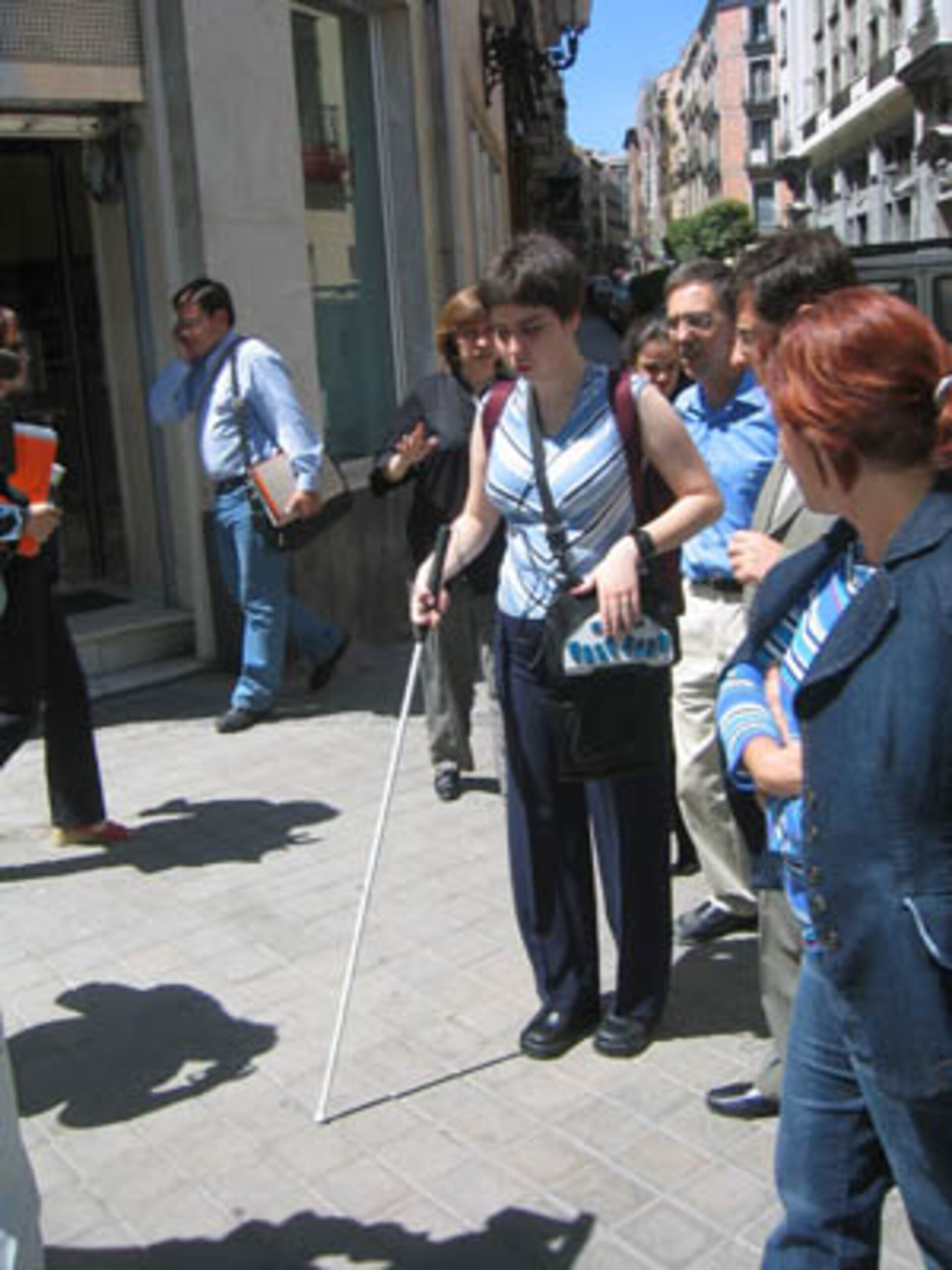
    Tormes, the hand held device developed by ONCE along with the Spanish company GMV Sistemas, speaks to the user, like any GPS device in a car, but weighing less than one kilo it can be carried over the shoulder. It can be used in two ways: to guide the user to their destination or to tell them where they are as they walk around.


    Tormes can be carried over the shoulder
    Tormes can be carried over the shoulder

    Ruben Dominguez, a blind mathematician who has tried out the device says 'This completes what exists for assisting blind people: the dog or the white cane, but furthermore it will really improve the life of the blind community by giving a lot more autonomy when moving around town, specially in unknown places.'

    Testing of the prototype is ongoing but already the results indicate that this is a revolution under way for blind people. When EGNOS is operational in spring 2004, blind people can expect unprecedented assistance giving them more autonomy.

    EGNOS, an initiative of ESA, the European Commission and Eurocontrol, for use in civil aviation and other new services, paves the way for Galileo, the first civil global satellite navigation system.
    Rate this

    Views

    Share

    • Currently 5 out of 5 Stars.
    • 1
    • 2
    • 3
    • 4
    • 5
    Rating: 5/5 (1 votes cast)

    Thank you for rating!

    You have already rated this page, you can only rate it once!

    Your rating has been changed, thanks for rating!

    215
    Tweet
    • Related news
      • Space technology to help the blind
        • Sweden takes part in global navigation
          • Toulouse bus test-drives European satellite navigation
            • Safer harbour operations with EGNOS
              • Signal-in-Space through the Internet
                • Navigate via the web with the SISNeT receiver
                • Related links
                • ESA's Navigation homepage
                • EGNOS resources
                • SISNeT
                • Galileo website (European Commission)
                • Videos
                • A guide dog with satellite technology
                • More about...
                • What is EGNOS?
                  • How does EGNOS work?
                    • Who's involved in EGNOS?
                      • Who benefits from EGNOS?
                      • Interoperability
                      • Satellite navigation today
                      • What is Galileo?

    Connect with us

    • RSS
    • Youtube
    • Twitter
    • Flickr
    • G+
    • Facebook
    • Livestream
    • Subscribe
    • App Store
    • LATEST ARTICLES
    • · Proba-V opens its eyes
    • · First new Galileo satellite arrive…
    • · Next destination: space
    • · Leak repaired on International Spa…
    • · After Chelyabinsk: European expert…
    • FAQ

    • Jobs at ESA

    • Site Map

    • Contacts

    • Terms and conditions