

Space sensor perks up medical analysis and environmental protection
Miniaturised ceramic gas sensors, originally developed for measuring oxygen levels for spacecraft re-entry vehicles, enables improved human breath measurement apparatus, better control of heater combustion thereby reducing pollution, and higher safety in fuel cell manufacturing.
It all began in 1993 when the Institute of Space Systems (IRS) of the University of Stuttgart started to develop special ceramic gas sensors to measure oxygen distribution in the plasma wind tunnels used to test heat-shield materials for re-entry spacecraft in extreme conditions.

"The sensors available at that time were no good for space systems because they were big, quite heavy and used a lot of heating power," explains Rainer Baumann from the Technical University of Dresden (TU Dresden) who participated to the development of this new and very small type of sensor.
"So we had to develop a new type of miniaturized sensor to measure re-entry conditions for spacecraft. The sensors had to be very small and capable of measuring oxygen at high altitudes and during re-entry."

Since then this ceramic sensor was further developed by TU Dresden for a multitude of space experiments, among others onboard the Russian Inflatable Re-entry and Descent Technology (IRDT) research capsule. The IRDT is a system that uses an inflatable cone-shaped heat shield and a parachute to return to Earth cargo from orbit.
Although the ceramic sensors were originally developed for space, when shown to industry at a series of presentations organised by ESA's Technology Transfer Programme and its technology transfer network partner MST, the gas sensor technology attracted a great deal of interest for possible use in terrestrial applications.
As a result, three IRS employees, together with the former head of the IRS institute, founded the company ESCUBE Space Sensor Systems GmbH in 2000 to further develop and market the sensor for use in the field of modern gas analysis, both on Earth and in space.
Accurate human breath analysis

"It is very easy to find terrestrial applications for this miniaturized gas sensor. The sensor reacts very fast and this is useful in many cases where you need to measure ambient conditions on Earth," says Rainer Baumann.
"One application where the sensor is particularly useful is measurement of the human breath. With this sensor we can measure oxygen, carbon dioxide and the flow of human breath, and obtain the results immediately; something which is impossible with the conventional systems."
The very quick response time makes it possible to obtain a very accurate breath-by-breath analysis. As the sensor is light and very small it can be incorporated easily into a mask and used, for instance, in hospitals and clinics, or by top athletes during extreme strain conditions.
Further development could even lead to a special mask for monitoring and evaluating the health of astronauts undertaking space missions.
Reducing environmental pollution

Another application is the control of exhaust gases in heating systems for home and industry. The majority of the man-produced pollutants on Earth originate from burning processing in automotive, industrial and domestic applications and the sensors can be used to control and optimise these combustion processes.
"The sensor works well with combustible gasses and can be used to optimise the burners in industrial plants and home heating systems. If you place the sensor in the exhaust gases you can control the heaters in real time by using a special algorithm and ensure that the burner operates at an optimum level," says Rainer Baumann.
"This system can reduce the exhaust gases that are harmful for the environment and at the same time, by ensuring the heating system works at an optimum level, it can also reduce fuel consumption by about 10 to 15%."
Spotting hydrogen leakage

Another terrestrial application for the miniature sensor is the development of a handy, easy-to-use portable system to test for hydrogen leakage in industrial installations such as the ones used for manufacturing fuel cells.
"Technology transfer is not a one-way street", says Frank M. Salzgeber, Head of ESA’s Technology Transfer Programme. "We will see more technology spinning back into space in the future."
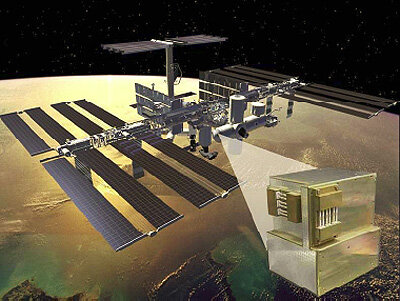
Today these miniature ceramic sensors developed for terrestrial use have also found their way back to space again.
They are now used in the small 'Flux (Phi) Probe Experiment - Time resolved Measurement of Atomic Oxygen' (FIPEX) unit located outside the International Space Station (ISS) where they measure the level of gasses outside the space station.
ESA's Technology Transfer Programme Office
The main mission of the ESA's Technology Transfer Programme Office (TTPO) is to facilitate the use of space technology and space systems for non-space applications and to further demonstrate the benefit of the European space programme to European citizens. The TTPO is responsible for defining the overall approach and strategy for the transfer of space technologies including the incubation of start-up companies and their funding.
For more information on ESA's Technology Transfer Programme, please contact:
Technology Transfer Programme
European Space Agency - ESTEC
Keplerlaan 1, P.O. BOX 299, 2200 AG, Noordwijk
The Netherlands
Office: +31 (0) 71 565 3910
Fax: +31 (0) 71 565 6635
Email: ttp @ esa.int
Website: http://www.esa.int/ttp

