• → European Space Agency

      • Space for Europe
      • Space News
      • Space in Images
      • Space in Videos
    • About Us

      • Welcome to ESA
      • DG's News and Views
      • For Member State Delegations
      • Business with ESA
      • ESA Exhibitions
      • ESA Publications
      • Careers at ESA
    • Our Activities

      • Space News
      • Observing the Earth
      • Human Spaceflight
      • Launchers
      • Navigation
      • Space Science
      • Space Engineering
      • Operations
      • Technology
      • Telecommunications & Integrated Applications
    • For Public

    • For Media

      • Media
      • ESA TV
      • Videos for professionals
      • Photos
    • For Educators

    • For Kids

    • ESA

    • Telecommunications & Integrated Applications

    • ARTES

    • Alphasat

    • TIA - About Telecommunications
    • About ESA's TIA Directorate
    • Telecommunications satellites
    • Orbits
    • The Satcom market
    • Historical overview
    • Artemis
    • Hylas-1
    • ESA's Telecommunication Programmes
    • ARTES programme overview
    • Alphabus/Alphasat
    • SmallGEO
    • EDRS
    • Iris
    • Integrated Applications Promotion (IAP)
    • Partner Programme: Electra
    • Multimedia
    • Image gallery
    • Video gallery
    • Services
    • Subscribe
    • RSS feeds

    ESA > Our Activities > Telecommunications & Integrated Applications

    Artemis team receives award for space rescue

    The Artemis recovery team
    The Artemis recovery team
    8 October 2003

    The Artemis Satellite Team has been awarded the 2003 Space Operations & Support Award at the AIAA's Space 2003 Conference at Long Beach, California (USA).

    The Artemis team consists of the European Space Agency (ESA), Alenia Spazio, the prime contractor, Telespazio and Astrium, the company that designed the satellite’s ion propulsion system.

    The citation reads: "For recovering Artemis and demonstrating the following firsts: Optical inter-orbit satellite link, major on-orbit reprogramming of a telecommunications satellite, orbital transfer to geostationary orbit using ion propulsion, and longest ever operational drift orbit."

    The American Institute of Aeronautics and Astronautics (AIAA) is the principal society for the aerospace engineering and scientific community. The Space Operations and Support Award is presented every two years to teams or individuals that make exceptional contributions critical to an anomaly recovery, crew rescue or space failure. This is a prestigious award which is a distinct honour for ESA as well as for the recovery team. Previous awards include the STS-61 Crew, the JPL Galileo Team and the Near Earth Asteroid Rendezvous Team.
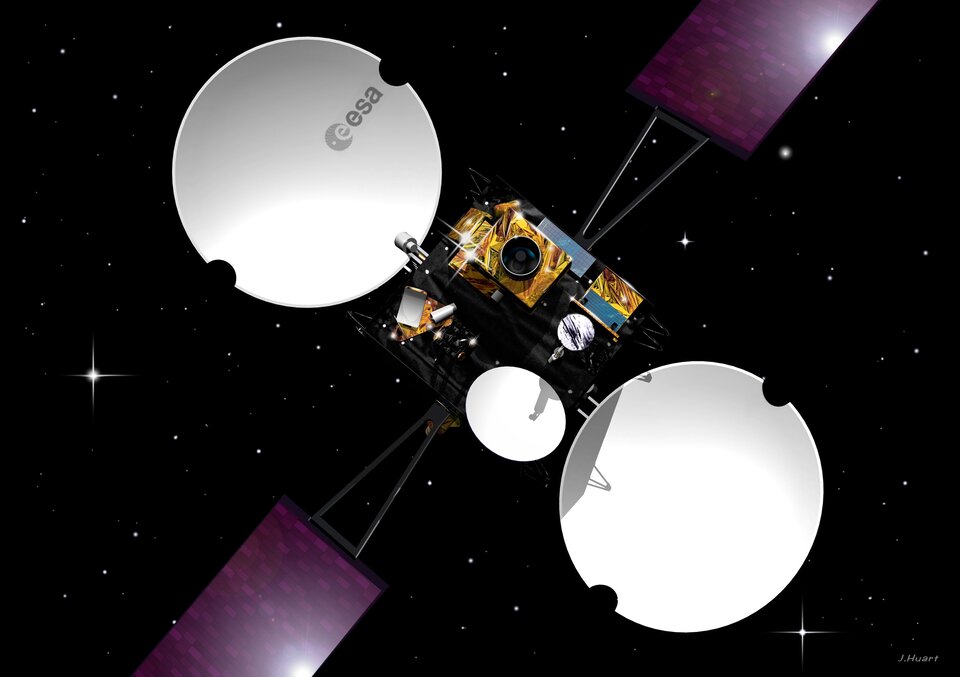
    The Artemis satellite
    The Artemis satellite

    The Artemis mission began on 12 July 2001 and was the subject of an unprecedented rescue that spanned 18 months. A malfunction in the upper stage of an Ariane-5 launcher left the satellite in an abnormally low transfer orbit. However, thanks to a combination of advanced technologies on board, coupled with the innovative procedures devised by the spacecraft control team, it was possible to slowly coax the satellite to its intended position.

    A team of ESA and industry specialists immediately set to work to rescue the satellite. The shortfall in the satellite’s velocity was such that the amount of chemical propellant remaining on board was insufficient. It was decided to employ the satellite’s novel experimental ion-propulsion system, originally designed to prevent the satellite from drifting from its working position, to slowly manoeuvre the troubled spacecraft into place.

    In all, about 20% of the original spacecraft control software had to be modified in order to accomplish the new mission scenario. Thanks, however, to the re-programmable onboard control concept that had been used on Artemis, remote software patches could be uplinked from the ground. The modified code amounted to a total of 15 000 words, making it the largest reprogramming of flight software ever attempted for a telecommunications satellite.

    It was only in January this year that Artemis reached its intended destination, a geostationary orbit some 36 000 km above earth.

    “Mission impossible, mission accomplished…Artemis is a great success for the European Space Agency since we have demonstrated our ability both to develop new technologies effectively and also our capabilities to recover a mission that many believed to be lost.” Claudio Mastracci, Director of Applications, ESA

    Rate this

    Views

    Share

    • Currently 0 out of 5 Stars.
    • 1
    • 2
    • 3
    • 4
    • 5
    Rating: 0/5 (0 votes cast)

    Thank you for rating!

    You have already rated this page, you can only rate it once!

    Your rating has been changed, thanks for rating!

    49
    Tweet
    • Related news
      • Artemis finally reaches operational orbit
        • Artemis nearly there
          • Artemis, one year after launch
            • Artemis starts its journey to final orbit
              • Slowly but surely - Artemis heads towards its working position
                • ESA's Artemis satellite reaches geostationary orbit - from total loss to full recovery
                • Related links
                • Artemis
                • More about Artemis
                • Videos
                • video  Artemis
                • video  Artemis on its way to final orbit
                • video  Artemis: Mission impossible, Mission accomplished

    Connect with us

    • RSS
    • Youtube
    • Twitter
    • Flickr
    • G+
    • Facebook
    • Livestream
    • Subscribe
    • App Store
    • LATEST ARTICLES
    • · Earth Explorers take centre stage …
    • · The fast winds of Venus are gettin…
    • · ExoMars 2016 set to complete const…
    • · Herschel ends operations as orbiti…
    • · Europe’s largest spaceship reache…
    • FAQ

    • Jobs at ESA

    • Site Map

    • Contacts

    • Terms and conditions