

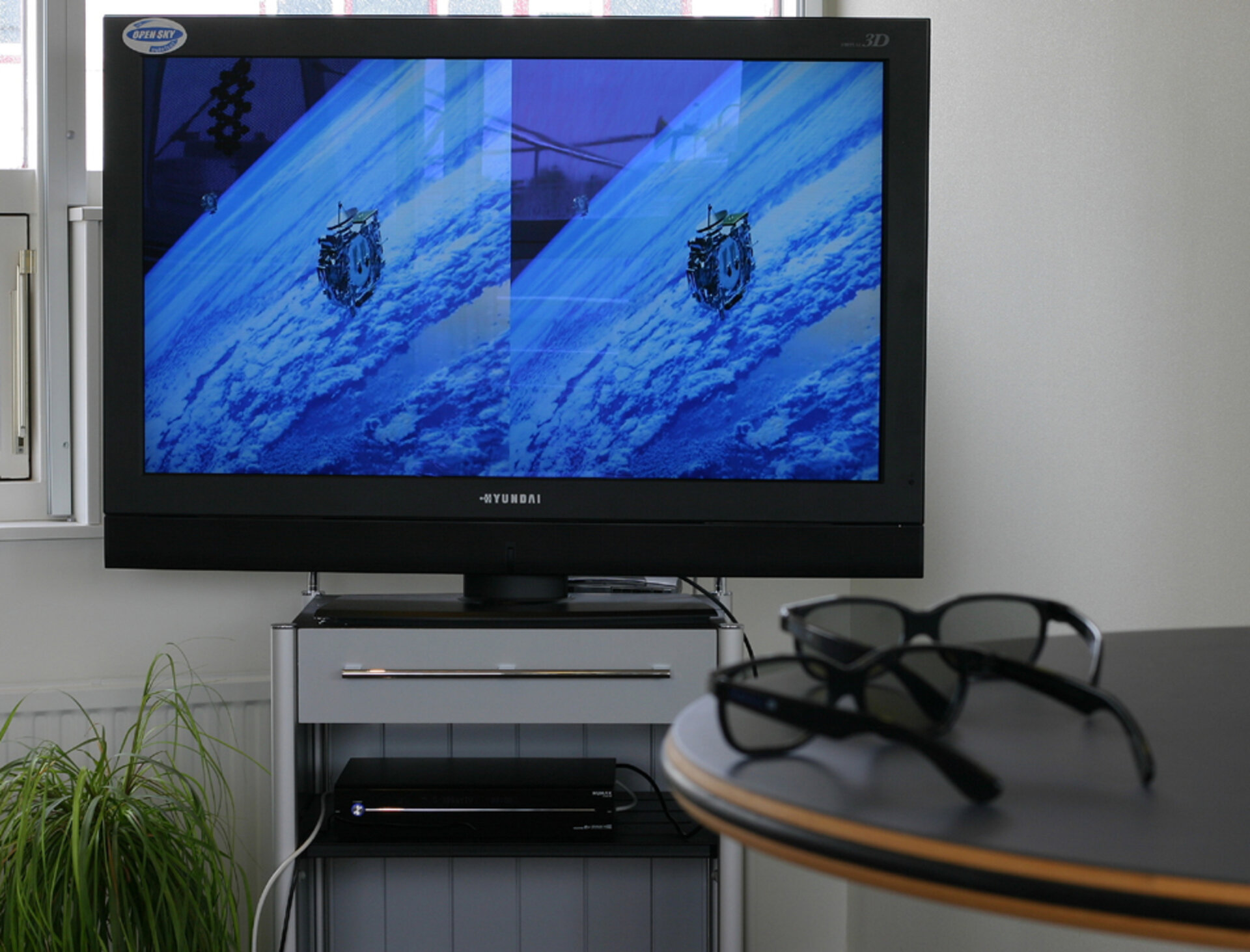
ESA supports satellite delivery of 3D television to homes
ESA is taking a practical step towards a new viewing experience: 3D television at home, delivered by satellite.
Through its Advanced Research in Telecommunications Systems (ARTES) programme and the ‘Stereoscopic Broadcasting’ project, ESA is supporting the OpenSky and SkyLogic companies in providing a 3D television service to consumers.
The 3D televisions and standard reception equipment are being deployed across Europe, at selected sites. Transmission of a continuous 3D channel began on 12 March via the Eurobird 9A satellite. The channel offers a range of programme lengths and material, including sport, a short film and trailers, and events filmed in live 3D will be added.
Since the first broadcasts in the 1920s by Scottish engineer John Logie Baird – the first person to produce a live, moving, television image from reflected light – broadcasting and viewing have been continually improved. In 2008 there were more than 100 million European homes receiving TV programmes transmitted by satellites, either by direct reception or through cable distribution systems.
Viewers have enjoyed the arrival of High Definition (HD), surround-sound and both widescreen and flatscreen televisions, all aimed at enhancing the user experience. Many of these developments were the result of technical advances pioneered in the cinema. This trend continues with a recent crop of high-quality 3D productions being released in cinemas, which have whetted the appetite of the viewing public.
ESA, recognising the importance of assisting in the development of new technologies, is supporting OpenSky and Skylogic in the delivery of 3D television into viewers’ homes.
The project objectives include: setting up a complete end-to-end chain for satellite 3D TV broadcasting; viable consumer 3D TV products; producing 3D content and delivering 3D events for the on-air pilot trial; setting up reception sites to gather consumer feedback.
Two types of reception sites are being created: one mimics a home environment using longer content, while the other is a public venue with shorter content. A ‘home site’ has been set up at ESTEC, ESA’s research and technology centre in Noordwijk, the Netherlands.
Marco Sartori, ESA’s technical officer for this project explains, “3D TV is a step forward from HD by offering an exciting new dimension to home viewing. It benefits from the ability of a satellite HD channel to carry the necessary 3D TV information. This is a first-generation system but, importantly, it is available now, can be installed easily at home and generally provokes a ‘wow!’ from viewers.”
This ARTES project has given partners OpenSky and SkyLogic the opportunity to explore the different aspects of running a 3D TV channel, says Walter Munarini from OpenSky.
“The first challenges overcome by OpenSky were a proper architecture for delivering the service and the different critical aspects, such as maintaining frame-accurate synchronisation over a long period between the left- and right-eye images,” he explains. “In addition, the project is giving evidence of the content management process that is needed behind the broadcasting in order to provide and play the 3D content properly.”
The perceived quality of 3D content is dependent on more factors than 2D, including resolution, bandwidth and the size and aspect ratio of the screen. “Now, thanks to the ESA ARTES programme we know all these aspects and we can do it properly,” concludes Mr Munarini. ESA’s Telecommunications and Integrated Applications directorate is supporting the development of 3D TV through several ARTES elements.
In the longer term, for example, a study is being conducted under ARTES 1 called 3D@SAT (3D Scalable Multi-View Satcom Services), while activities are being proposed in the ARTES 5 work plan to maximise the data throughput for next generation satellites.
For more information, see the links on the right of this page. For those with the capability for viewing the 3D channel, Eurobird-9A is located at 9°E (transponder frequency 11 747 MHz, symbol rate 27 500, horizontal polarisation). Videos are transmitted in a modified side-by-side arrangement. To view them properly, a 3D-capable TV and glasses are required.


