ESAEducationHomeEarth from SpaceEnvironmental IssuesEnvisat for Schools
   
Weather and climate
Global Change
Disaster monitoring
Resources
Multimedia
Image GalleryVideo Gallery
Services
Search in Eduspace


Bookmark and Share


printer friendly page
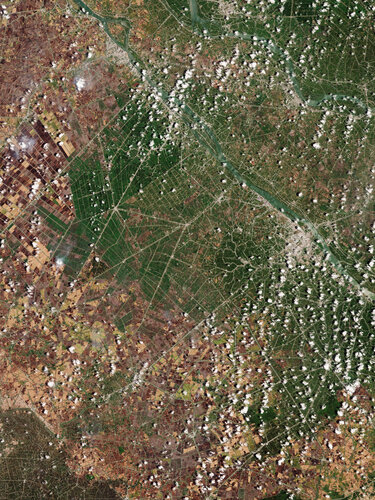
Labutta, Myanmar
Damage caused by cyclones
Cyclone Olga
 
The damages of Cyclone Olga
 
Olga developed as a tropical depression about 550 km northwest of Yap on 29 July 1999. It adopted a north-northwestern course, and intensified gradually into a typhoon over the next few days while heading towards Okinawa. The estimated maximum wind speeds (140 km/h) were reached on 1 August (25.4 N 128.8 E at 06 Z) and 2 August (31.4 N 126.1 E at 18 Z). On 3 August at 00 Z, Olga turned to the north-northeast and inland over Korea (37.4 N 126.5 E) at 12 Z with wind speeds of 105 km/h.

Meteorologists say the flooding was the worst Asia has seen in 30 years. Authorities across Asia estimated a total of 949 dead from flooding, mostly in China, where the Civil Affairs Ministry said 725 had died and 5.5 million people in 23 provinces were evacuated since the flood season began in June.

Four days of torrential rains in the central Philippines left 92 dead. In the Philippines' capital, Manila, heavy rains unleashed a massive landslide that swallowed an entire hillside community. The landslide buried 25 houses and damaged 378 others, leaving 31 people dead. Rescuers continued to search for another 33 missing people, holding out some hope that survivors may have been sheltering in one house.

In Vietnam, 24 people died and 25 others were still missing after downpours flooded parts of the central provinces. Vietnam's Binh Thuan province was reeling from 550 mm of rain that swamped large areas of land and caused heavy losses. The flooding, the worst in the region in nearly 50 years, left more than 5,000 people homeless.

In South Korea, 43 were reported dead and 21 missing following strong rains along the border with North Korea. International Red Cross officials said at least 42 people were killed and 94 others badly injured in North Korea, and warned of worsening food shortages.

The total rainfall in the peninsula was between 480 and 850 mm.

In Thailand, five people died and about 1,000 more were left homeless after five days of flash floods engulfed the low-lying coastal province of Chanthaburi, 210 kilometres southeast of Bangkok. Authorities estimated that some 90,000 people were affected by floods. Three inmates were evacuated from a prison when the ground floor became flooded.

Rains damaged 16,000 hectares of fruit orchards and Cambodian officials said four children died in a flash flood.  
 
The images
 
The images show data from the scatterometer instrument coloured in red, green, and blue, according to which of the three antennas of the instrument provided the measurements.


tropical cyclone Olga on 2 August 1999
 
 
This image shows a representation of the tropical cyclone Olga on 2 August 1999 at 14:14 UTC based on measurements of the wind scatterometer instrument.
 
 
tropical cyclone Olga on 2 August 1999
 
 
GMS image of Olga taken on 2 August 1999 at 08:32 UTC.


Disaster monitoring
Disaster monitoring - Introduction
Tropical cyclones
IntroductionCyclone FloydCyclone Mitch
Related article
Cyclones and scatterometer
GOES-8 animations
Cyclone Floyd - 9 September 1999
(0.7 Mb)
Cyclone Floyd - 13 September 1999
(1.5 Mb)
Cyclone Floyd - 14 September 1999
(1.6 Mb)
Cyclone Floyd - 15-16 September 1999
(3.4 Mb)


   Copyright 2000 - 2013 © European Space Agency. All rights reserved.