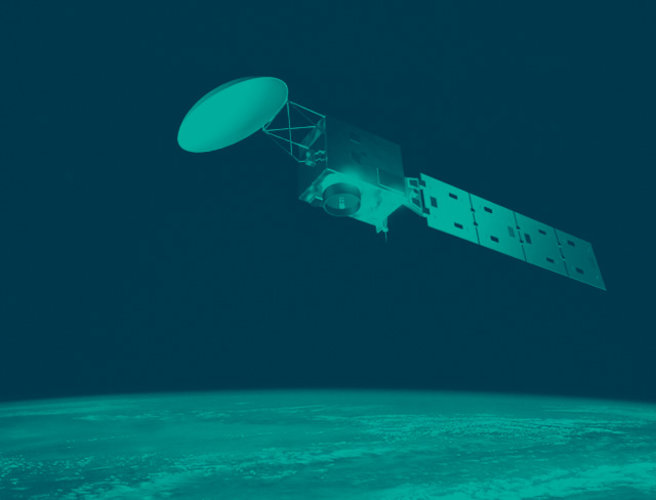
|  | Sloshsat - FLEVO satellite artwork | | Sloshsat FLEVO
Name
The name Sloshsat Flevo is derived from: 'Slosh' for the movement of liquid, 'sat' for satellite and FLEVO, the acronym for Facility for Liquid Experimentation and Verification in Orbit, and also one of the newest regions in the Netherlands, Flevoland, east of Amsterdam.
Description
Sloshsat FLEVO is a small satellite designed to investigate the dynamics of fluids in microgravity. The behaviour of water in an instrumented tank will be monitored to help understand how sloshing affects the attitude control of launchers and space vehicles.
This is a joint programme between ESA and the Netherlands Agency for Aerospace Programmes (NIVR). The National Aerospace Laboratory (NLR) of the Netherlands is prime contractor with Dutch Space providing the spacecraft structure and power systems, Verhaert (Belgium) the ejection system and ground support equipment and NEWTEC (Belgium) the radio frequency sub-system and the ground receiver. Rafael (Israel) was responsible for the reaction control system and Kvant (Russia) delivered the solar panels.
Mission objectives
The effect of sloshing on spacecraft control has so far been impossible to predict precisely. The main objective of this mission is to use the results to validate and refine existing fluid dynamic simulation models for spacecraft design and operation. This will lead to improved models able to better predict sloshing behaviour in microgravity resulting in more accurate control of satellites as well as other space structures carrying large quantities of fluids.
Spacecraft
Sloshsat FLEVO is a 90-cm cube mini-satellite covered by solar cells and fitted with 12 small thrusters. The total mass at launch, including water, will be 129 kg.
Experiment
The satellite includes one experiment: an 87-litre cylindrical tank containing 33.5 litres of de-ionised water. On the tank walls, 270 sensors will measure the sloshing behaviour by calculating the thickness of the water. At the same time, the temperature, pressure and fluid velocity will be measured at 17 locations while three accelerometers and fibre-optic gyroscopes will monitor the resulting spacecraft motions. Thrusters, powered by a cold-gas nitrogen system, will provide linear and rotational movement to excite fluid motion.
Launch
Sloshsat FLEVO will be launched from Europe's Spaceport in French Guiana by the Ariane-5 ECA qualification flight scheduled for February 2005.
Orbit
Sloshsat FLEVO will operate in geostationary transfer orbit. The satellite will transmit data for 14 days with a total experiment time of around 24 hours. This will be spread over the two weeks to allow periods for the water to settle and the battery to recharge.
Operations
Sloshsat FLEVO will be controlled by operators at ESA's Diane ground station in Kourou, French Guiana, with the support of the European Space Operations Centre (ESOC) in Germany.
Last update: 7 February 2005 |