ESAMeteosat Second GenerationObserving the Earth
   
About MSG
MSG Overview
MSG-2 Facts and FiguresWhy we need MSGHow MSG-2 works
Spacecraft details
Building and flying MSG
Meet the teamMSG ContractorsDesigned for spaceReaching orbitLaunch and early operations update
The future
Next stepsBeyond MSG and MetOp
Multimedia
Image GalleryVideo GalleryWallpapersScreensavers
Services


Bookmark and Share


printer friendly page
MSG Overview
 
A virtually cloud-free Europe captured by MSG-1
 
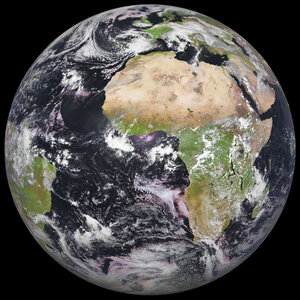
One of Europe's hardest working satellites now has an orbiting twin. Launched on 28 August 2002, the first Meteosat Second Generation (MSG) satellite became operational on 29 January 2004, when it was redesignated Meteosat-8. Since then it has continuously returned highly detailed imagery of Europe, the North Atlantic and Africa every 15 minutes, for operational use by meteorologists.
 
The second MSG was launched on 21 December 2005 on the type of launcher as its predecessor - a standard Ariane 5 - from the same launch site - Kourou in French Guiana. It is currently in the same fixed section of orbital space as MSG-1 – in geostationary orbit, close to where the equator meets the Greenwich meridian.

The reason for the duplication is simply to guarantee continuity of service in case of satellite failure. Weather satellites have become so crucial a part of our daily life that any long gap in service coverage has become inconceivable.

For almost 30 years ESA has been building Europe's orbital weather satellites: the Meteosat series of geostationary spacecraft, the first of which was launched in 1977. The success of the early Meteosats led to the creation of the European Organisation for the Exploitation of Meteorological Satellites (EUMETSAT) in 1986.  
 
MSG-2
MSG-2
ESA and EUMETSAT worked together on the later satellites in the series, designed to deliver continuous weather images to European forecasters on an operational basis. This cooperation between the two international organisations continues now the original satellites are gradually being replaced by a new, second generation of Meteosats.

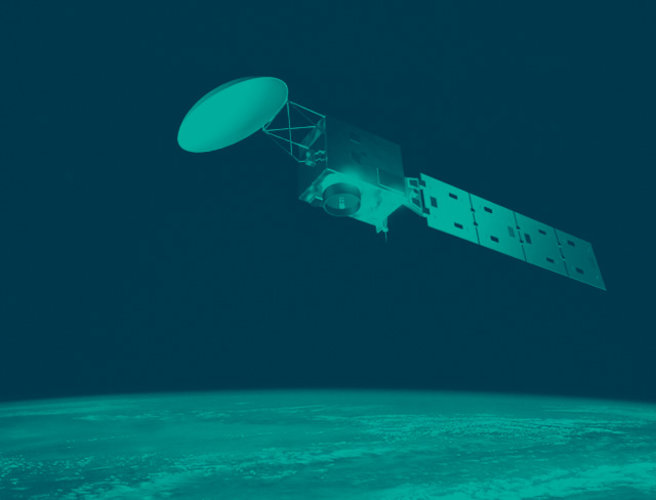
While retaining the drum-shaped design of their Meteosat predecessors, the new MSG spacecraft are two and a half times larger and have many extra imaging capabilities. Each one has a lift-off mass of two tonnes.

ESA was responsible for designing and developing the first MSG satellite, and for procuring the other three on behalf of EUMETSAT. Meanwhile EUMETSAT has responsibility for defining the payload based on user needs, procuring the ground segment and launchers, and operating the system.

After control of MSG-2 passed from ESA to EUMETSAT the satellite was redesignated Meteosat-9, becoming the prime observational satellite at 0 degrees longitude, in geostationary orbit, 35 800 km above the Gulf of Guinea. Meteosat-8 became the in-orbit spare, positioned at 3.4 degrees West.

Two further MSG satellites should guarantee continuity of service through to around 2021.MSG-3 is actually long-term storage in the Thales Alenia Space Cannes. It will come out of its storage in spring 2011, to prepare it for its launch, planned for mid-2012 on Ariane 5. The fourth satellite (MSG-4) is planned for a launch in 2014.
 
 
A dust storm as seen by MSG-1
European forecasters and researchers are already benefiting from the advanced data and images provided by Meteosat-8. The image data generated by its 12 spectral channels provide 20 times the information of previous generation satellites.

Meteosat-8 acquires improved information and imagery for weather forecasting as well as other applications such as hydrology, agriculture, environmental studies as well as risk prevention and disaster warnings. The data collected are routinely used for the study of meteorology and climate change.

EUMETSAT is currently operating Meteosat-6, -7 and -8 over Europe and Africa, and Meteosat-5 over the Indian Ocean. The data, product and services from these satellites - jointly developed by ESA and EUMETSAT - make a significant contribution to weather forecasting and global climate monitoring.
 
 
Last update: 21 January 2010


Related links
EUMETSAT


   Copyright 2000 - 2012 © European Space Agency. All rights reserved.