ESAESA ScienceMars Express
   
Europe goes to Mars
About Mars Express
About Mars
Meet the team
Multimedia
VideoTalkMars Express imagesMars Express videosHRSC videosAnimation in 11 languagesDownload wallpapersDownload screensavers3D Flash 'model'Make a model
Services
Comments


News
 
printer friendly page
Ancient caldera in Apollinaris Patera
 
Ancient caldera in Apollinaris Patera
Apollinaris Patera caldera in false colour
 
9 June 2006
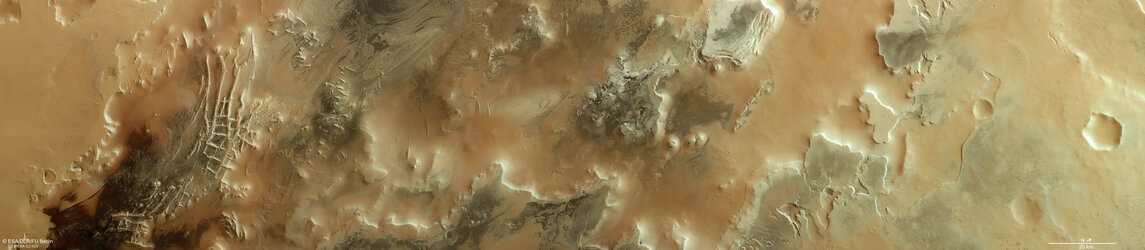
These images, taken by the High Resolution Stereo Camera (HRSC) on board ESA's Mars Express spacecraft, show the caldera of Apollinaris Patera, an ancient, 5-kilometre-high volcano northwest of Gusev Crater.
 
 
Apollinaris Patera context map
Map showing Apollinaris Patera in context
The HRSC obtained these images during orbit 987 with a ground resolution of approximately 11.1 metres per pixel. The images show part of Apollinaris Patera, a volcano lying at approximately 7.2° South and 174.6° East.

Apollinaris Patera is an ancient shield volcano located at the northern edge of the Southern Highlands, lying to the south-east of Elysium Planitia and to the north of Gusev Crater, which is now being explored by NASA's Mars Rover, Spirit.

The volcano measures approximately 180 by 280 kilometres at its base and rises to a maximum of 5 kilometres above the surrounding terrain.
 
 
Apollinaris Patera caldera in true colour
Apollinaris Patera caldera (north to the right)
Shield volcanos are large volcanic structures with gently sloping flanks. The caldera of Apollinaris Patera takes the form of a large crater approximately 80 kilometres in diameter and up to 1 kilometre deep. Volcanic calderas are formed when a volcano explodes or when the cone collapses.

In the true-colour image, the terrain is partly covered by thin, diffuse, whitish-appearing clouds. In the false-colour image, the clouds appear as bluish-tinted areas.
 
 
Apollinaris Patera caldera
Apollinaris Patera caldera, black and white
The western region of the colour image (top of the image, as north is to the right) is characterized by brighter material, which seems to be layered and could be the result of sedimentary deposition. Distinct layering, causing a terrace-like appearance, is also visible east of this brighter material and in the relatively flat region located in the northwest (top right) of the colour image.
 
 
Apollinaris Patera caldera 3D
Apollinaris Patera caldera, 3D anaglyph
The colour scenes have been derived from the three HRSC-colour channels and the nadir channel. The anaglyph image was calculated from the nadir and one stereo channel. Image resolution has been decreased for use on the internet.

For more information on Mars Express HRSC images, please read our updated FAQ (frequently asked questions).


Mars Express image browser
3D anaglyph images
3D anaglyph images - Kasei Valles
Recent images
Granicus and Tinjar VallesChaotic terrain in Iani ChaosHeavily eroded Aram ChaosLava tubes on Pavonis MonsExtensional tectonics in Tempe TerraNanedi Valles system on Mars'Happy face' crater on MarsThe Libya Montes valley on Mars'Hourglass'-shaped crater - new video and perspectivesEastern scarp of Olympus MonsAusonia Mensa remnant massifPits and tectonic grabens in Phlegethon CatenaClaritas Fossae region of Mars
More information
High Resolution Stereo CameraBehind the lens...


   Copyright 2000 - 2009 © European Space Agency. All rights reserved.