ESAESA ScienceMars Express
   
Europe goes to Mars
About Mars Express
About Mars
Meet the team
Multimedia
VideoTalkMars Express imagesMars Express videosHRSC videosAnimation in 11 languagesDownload wallpapersDownload screensavers3D Flash 'model'Make a model
Services
Comments


Bookmark and Share


Article Images
Mars Express acquires sharpest images of martian moon Phobos
 
30 July 2008

Phobos
Download:
 HI-RES JPEG (Size: 888 kb)  HI-RES TIFF (Size: 7366 kb)
On 23 July 2008, the High Resolution Stereo Camera on board the ESA’s Mars Express took the highest-resolution full-disc image yet of the surface of the moon Phobos.

The image data was acquired from a distance of 97 km with a spatial resolution of about 3.7 m/pixel in orbit 5851. These images have surpassed all previous images from other missions in continuous coverage of the illuminated surface at the highest spatial resolution of 3.7 m/pixel.

This image has been geometrically corrected and exhibits the original illumination and photometric conditions.

Credits: ESA/ DLR/ FU Berlin (G. Neukum)
 
  The best full-disc images of Phobos ever
 
Phobos in 3-D
Download:
 HI-RES JPEG (Size: 1261 kb)  HI-RES TIFF (Size: 9524 kb)
Phobos in 3-D (red-cyan anaglyph).

On 23 July 2008, the High Resolution Stereo Camera on board ESA’s Mars Express took the highest-resolution full-disc image yet of the surface of the moon Phobos.

The image data was acquired from a distance of 97 km with a spatial resolution of about 3.7 m/pixel. These images have surpassed all previous images from other missions in continuous coverage of the illuminated surface at the highest spatial resolution of 3.7 m/pixel.

Credits: ESA/ DLR/ FU Berlin (G. Neukum)
 
  Scientific bounty
 
Potential Phobos-Grunt landing site
Download:
 HI-RES JPEG (Size: 1343 kb)  HI-RES TIFF (Size: 19 741 kb)
HRSC Stereo Channel 1 image of Phobos with a resolution of 3.7 m/pixel at its best. The inset to the right shows the potential landing region and sites for the Russia’s Phobos-Grunt sample return mission, due for launch in 2009.

Credits: ESA/ DLR/ FU Berlin (G. Neukum)
 
 
Phobos
Download:
 HI-RES JPEG (Size: 1165 kb)  HI-RES TIFF (Size: 4260 kb)
On 23 July 2008, the High Resolution Stereo Camera on board the ESA’s Mars Express took the highest-resolution full-disc image yet of the surface of the moon Phobos.

The image data was acquired from a distance of 97 km with a spatial resolution of about 3.7 m/pixel in orbit 5851. These images have surpassed all previous images from other missions in continuous coverage of the illuminated surface at the highest spatial resolution of 3.7 m/pixel.

This image is photometrically enhanced to bring out the features in the less illuminated part.

Credits: ESA/ DLR/ FU Berlin (G. Neukum)
 
 
Phobos
Download:
 HI-RES JPEG (Size: 190 kb)  HI-RES TIFF (Size: 1770 kb)
HRSC Super-resolution channel (SRC) image taken on 22 July 2008 from a distance of 4500 km, showing the illuminated edge of the potential landing site of the Russian Phobos-Grunt mission.

Credits: ESA/ DLR/ FU Berlin (G. Neukum)
 
  An operational challenge
 
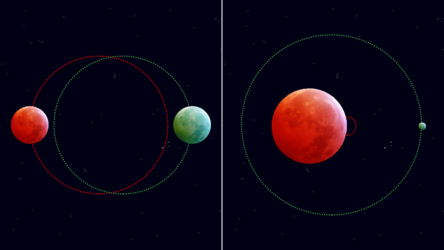
Geometry of the Phobos fly-by
Download:
 HI-RES PNG (Size: 218 kb)
Geometry of the Phobos fly-by. Phobos and Mars Express are not to scale.

Credits: ESA/ DLR/ FU Berlin (G. Neukum)
 
 
Download:
 HI-RES PNG (Size: 2342 kb)
Phobos fly-by orbital characteristics animation. NASA’s Mars Odyssey (MO) and Mars Reconnaissance Orbiter (MRO) are in a low orbit around Mars.

In observing Phobos, Mars Express benefits from its highly elliptical orbit which takes it from a closest distance of 270 km from the planet to a maximum of 10 000 km, crossing the 9000 km orbit of the moon. Mars Express imaged the far-side of Phobos (with respect to Mars) for the first time by flying outside the spacecraft’s orbit around Mars.

Credits: ESA/ DLR/ FU Berlin (G. Neukum)


Looking at Mars
Mars Express highlights
Water on Mars
Related articles
Mars Express to rendezvous with Martian moonListen to Phoenix descendMars Express supports Phoenix Mars landingTimeline: Mars Express support to Phoenix landingInterviews: the martian water cycle and climateMars radar opens up a planet’s third dimensionFrom Mars to the Earth: Studying ice beneath the surfaceMars Express reveals the Red Planet’s volcanic pastMars and Venus are surprisingly similar


   Copyright 2000 - 2012 © European Space Agency. All rights reserved.