| Europe goes to Mars About Mars Express About Mars Meet the team Multimedia VideoTalkMars Express imagesMars Express videosHRSC videosAnimation in 11 languagesDownload wallpapersDownload screensavers3D Flash 'model'Make a modelServices Comments
|  |  |  |  | | | | Article Images |  | Icy Promethei Planum 12 March 2008
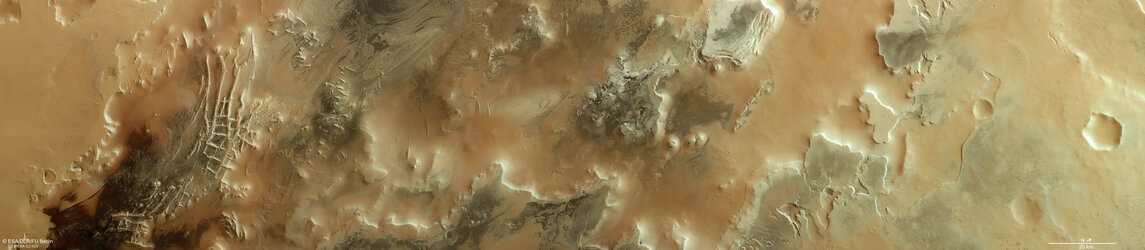
 | Promethei Planum, an area seasonally covered with layer of ice more than 3500 m thick layer of ice in the martian south polar region, was the subject of the High Resolution Stereo Camera’s focus on 22 September 2005 as Mars Express was in orbit above the Red Planet.
Promethei Planum lies at approximately 76° south and 105° east.
An approximately 100 km-large and 800 m-deep impact crater is visible in the northern part of the image. The crater’s interior is partly covered in ice.
In the centre of the image are structures that may have been created by basaltic lava flow from a volcano. This area is covered in ice. The dark dunes towards the bottom of the image are most likely made up of dust originating from this lava flow or volcanic ash.
A broad sheet of ice, which is an extension of the south polar ice cap is located south of the lava flow, to the left in the (nadir) image. The steep flanks clearly show white, clean ice. The thickness of the ice is between 900 and 1100 m.
Credits: ESA/ DLR/ FU Berlin (G. Neukum) |  |  |  |  |
| | | |  | Context map of Promethei Planum. It lies at approximately 76° south and 105° east on the Red Planet.
This area is seasonally covered with a layer of ice more than 3500 m thick in the martian south polar region. It was the subject of the High Resolution Stereo Camera’s (HRSC) focus on 22 September 2005 as Mars Express was in orbit above the Red Planet.
Credits: ESA/ DLR/ FU Berlin (G. Neukum) |  |  |  |  |
| | | |  | Promethei Planum, an area seasonally covered with a layer of ice more than 3500 m thick layer of ice in the martian south polar region, was the subject of the High Resolution Stereo Camera’s (HRSC) focus on 22 September 2005 as Mars Express was in orbit the Red Planet.
Promethei Planum lies at approximately 76° south and 105° east.
Credits: ESA/ DLR/ FU Berlin (G. Neukum) |  |  |  |  |
| | | |  | Promethei Planum, an area seasonally covered with a layer of ice more than 3500-m thick layer of ice in the martian south polar region, was the subject of the High Resolution Stereo Camera’s (HRSC) focus on 22 September 2005 as Mars Express was in orbit above the Red Planet.
Promethei Planum lies at approximately 76° south and 105° east.
Credits: ESA/ DLR/ FU Berlin (G. Neukum) |  |  |  |  |
| | | |  | Promethei Planum, an area seasonally covered with a layer of ice more than 3500 m thick in the martian south polar region, was the subject of the High Resolution Stereo Camera’s (HRSC) focus on 22 September 2005 as Mars Express was in orbit above the Red Planet.
Promethei Planum lies at approximately 76° south and 105° east.
An approximately 100 km-large and 800 m-deep impact crater is visible in the northern part of the image. The crater’s interior is partly covered in ice.
In the centre of the image are structures that may have been created by basaltic lava flow from a volcano. This area is covered in ice. The dark dunes towards the bottom of the image are most likely made up of dust originating from this lava flow or volcanic ash.
A broad sheet of ice, which is an extension of the south polar ice cap, is located south of the lava flow, to the left in the (nadir) image. The steep flanks clearly show white, clean ice. The thickness of the ice is between 900 and 1100 m.
Credits: ESA/ DLR/ FU Berlin (G. Neukum) |  |  |  |  |
| | | |  | Promethei Planum, an area seasonally covered with a layer of ice more than 3500 m thick in the martian south polar region, was the subject of the High Resolution Stereo Camera’s (HRSC) focus on 22 September 2005 as Mars Express was in orbit above the Red Planet.
Promethei Planum lies at approximately 76° south and 105° east.
An approximately 100 km-large and 800 m-deep impact crater is visible in the northern part of the image. The crater’s interior is partly covered in ice.
In the centre of the image are structures that may have been created by basaltic lava flow from a volcano. This area is covered in what is either ice. The dark dunes towards the bottom of the image are most likely made up of dust originating from this lava flow or volcanic ash.
A broad sheet of ice, which is an extension of the south polar ice cap, is located south of the lava flow, to the left in the (nadir) image. The steep flanks clearly show white, clean ice. The thickness of the ice is between 900 and 1100 m.
Credits: ESA/ DLR/ FU Berlin (G. Neukum) |  |  |  |  |
| | | |  | Promethei Planum, an area seasonally covered with a layer of ice more than 3500 m thick in the martian south polar region, was the subject of the High Resolution Stereo Camera’s (HRSC) focus on 22 September 2005 as Mars Express was in orbit above the Red Planet.
Promethei Planum lies at approximately 76° south and 105° east.
An approximately 100 km-large and 800 m-deep impact crater is visible in the northern part of the image. The crater’s interior is partly covered in ice.
In the centre of the image are structures that may have been created by basaltic lava flow from a volcano. This area is covered in what is either ice. The dark dunes towards the bottom of the image are most likely made up of dust originating from this lava flow or volcanic ash.
A broad sheet of ice, which is an extension of the south polar ice cap, is located south of the lava flow, to the left in the (nadir) image. The steep flanks clearly show white, clean ice. The thickness of the ice is between 900 and 1100 m.
Credits: ESA/ DLR/ FU Berlin (G. Neukum) |  |  |  |  |
| | | |  | Promethei Planum, an area seasonally covered with layer of ice a more than 3500 m thick in the martian south polar region, was the subject of the High Resolution Stereo Camera’s (HRSC) focus on 22 September 2005 as Mars Express was in orbit above the Red Planet.
Promethei Planum lies at approximately 76° south and 105° east.
An approximately 100 km-large and 800 m-deep impact crater is visible in the northern part of the image (1). The crater’s interior is partly covered in ice.
In the centre of the image are structures that may have been created by basaltic lava flow from a volcano (2). This area is covered in ice. The dark dunes towards the bottom of the image are most likely made up of dust originating from this lava flow or volcanic ash (3).
A broad sheet of ice, which is an extension of the south polar ice cap, is located south of the lava flow, to the left in the (nadir) image. The steep flanks clearly show white, clean ice (4). The thickness of the ice is between 900 and 1100 m.
Credits: ESA/ DLR/ FU Berlin (G. Neukum) |  |  |  |  |
| |
|  | Mars Express image browser Related articles Mars Express radar gauges water quantity around Mars’ south poleDeep valleys of Candor ChasmaESA presents Mars in 3DTraces of the martian past in the Terby craterNoctis Labyrinthus, labyrinth of the nightHummocky and shallow Maunder craterThe mysterious ridges at the mouth of Tiu VallesImpact Craters in Tyrrhena TerraTectonic signatures at Aeolis MensaeBreathtaking views of Deuteronilus Mensae on MarsThe first hiking maps of MarsCydonia's 'Face on Mars' in 3D animationSpacecraft fleet zeroing in on Martian water reservesRelated links High Resolution Stereo CameraBehind the lens...Frequently asked questionsFor specialists ESA Planetary Science archive (PSA)NASA Planetary Data SystemHRSC data viewer
|