ESAESA ScienceMars Express
   
Europe goes to Mars
About Mars Express
About Mars
Meet the team
Multimedia
VideoTalkMars Express imagesMars Express videosHRSC videosAnimation in 11 languagesDownload wallpapersDownload screensavers3D Flash 'model'Make a model
Services
Comments Bookmark and Share


Article Images
Craters, lava flows and tectonic features near Ma'adim Vallis
 
24 July 2009

Close to Ma'adim Vallis
Download:
 HI-RES JPEG (Size: 2188 kb)  HI-RES TIFF (Size: 58 236 kb)
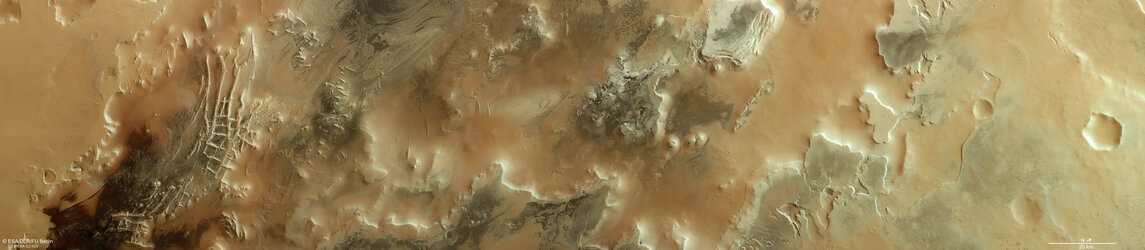
Mars Express image of a region close to Ma’adim Vallis, one of the largest canyons on Mars. After Valles Marineris, Ma’adim Vallis is one of the largest canyons on Mars. The imaged region lies south-east of Ma’adim Vallis; the pictures are centred at about 29°S and 182°E and have a ground resolution of 15 m/pixel.

Ma’adim Vallis is located between the volcanic region of Tharsis, which harbours four volcanoes, including the largest in the Solar System, and the Hellas Planitia impact basin. The canyon, 20 km wide and 2 km deep, originates in the southern highlands close to the ‘dichotomy boundary’ and ends in Gusev crater. The dichotomy boundary is a narrow region separating the cratered highlands, located mostly in the southern hemisphere of Mars, from the northern hemisphere's lowland plains.

Credits: ESA/DLR/FU Berlin (G. Neukum)
 
 
Ma'adim Vallis context map
Download:
 HI-RES JPEG (Size: 712 kb)  HI-RES TIFF (Size: 3396 kb)
Mars Express image of a region close to Ma’adim Vallis, one of the largest canyons on Mars. After Valles Marineris, Ma’adim Vallis is one of the largest canyons on Mars. The imaged region lies south-east of Ma’adim Vallis; the pictures are centred at about 29°S and 182°E and have a ground resolution of 15 m/pixel.

Ma’adim Vallis is located between the volcanic region of Tharsis, which harbours four volcanoes, including the largest in the Solar System, and the Hellas Planitia impact basin. The canyon, 20 km wide and 2 km deep, originates in the southern highlands close to the ‘dichotomy boundary’ and ends in Gusev crater. The dichotomy boundary is a narrow region separating the cratered highlands, located mostly in the southern hemisphere of Mars, from the northern hemisphere's lowland plains.

Credits: FU Berlin/ MOLA
 
 
Close to Ma'adim Vallis, ortho-image
Download:
 HI-RES JPEG (Size: 2097 kb)  HI-RES TIFF (Size: 73 753 kb)
Mars Express image of a region close to Ma’adim Vallis, one of the largest canyons on Mars. After Valles Marineris, Ma’adim Vallis is one of the largest canyons on Mars. The imaged region lies south-east of Ma’adim Vallis; the pictures are centred at about 29°S and 182°E and have a ground resolution of 15 m/pixel.

Ma’adim Vallis is located between the volcanic region of Tharsis, which harbours four volcanoes, including the largest in the Solar System, and the Hellas Planitia impact basin. The canyon, 20 km wide and 2 km deep, originates in the southern highlands close to the ‘dichotomy boundary’ and ends in Gusev crater. The dichotomy boundary is a narrow region separating the cratered highlands, located mostly in the southern hemisphere of Mars, from the northern hemisphere's lowland plains.

This ortho-image was rectified using elevation data derived from a high-resolution Digital Terrain Model, or DTM (obtained from HRSC data), such that distortions introduced during imaging are corrected. Such an image can be used to derive maps. Elevation data from the DTM has been colour-coded and overlain on the ortho-image so that elevation data and the image itself are displayed in a single scene.

The scale is in metres.

Credits: ESA/DLR/FU Berlin (G. Neukum)
 
 
Close to Ma'adim Vallis, perspective view
Download:
 HI-RES JPEG (Size: 2033 kb)  HI-RES TIFF (Size: 29 410 kb)
Mars Express image of a region close to Ma’adim Vallis, one of the largest canyons on Mars. After Valles Marineris, Ma’adim Vallis is one of the largest canyons on Mars. The imaged region lies south-east of Ma’adim Vallis; the pictures are centred at about 29°S and 182°E and have a ground resolution of 15 m/pixel.

Ma’adim Vallis is located between the volcanic region of Tharsis, which harbours four volcanoes, including the largest in the Solar System, and the Hellas Planitia impact basin. The canyon, 20 km wide and 2 km deep, originates in the southern highlands close to the ‘dichotomy boundary’ and ends in Gusev crater. The dichotomy boundary is a narrow region separating the cratered highlands, located mostly in the southern hemisphere of Mars, from the northern hemisphere's lowland plains.

The images cover 138 x 70 km, roughly the size of Cyprus. A sharp boundary is visible in the centre, dividing dark material to the west and light material to the east. Scientists suspect that this feature is most likely the edge of a basaltic lava flow.

Wrinkle ridges are clearly visible on the surface of the lava flow. They were most likely formed by compressive forces.

To the north is a crater, almost 20 km in size. It is partially filled with lava, which shows that it must have formed before the lava set in. The smaller, 7 km crater at the southern edge of the larger crater must have formed later because it has an ejecta blanket that may have formed from material rich in water-ice ejected during impact.

A linear feature, more than 200 km long, divides the image almost in the centre. It is most likely a trough associated with the uprising of the Tharsis volcanic region in the north-east. The uprising may have created a lot of stress in the crust which was released when the fracture zones formed, creating the trough.

Credits: ESA/DLR/FU Berlin (G. Neukum)
 
 
Close to Ma'adim Vallis, perspective view
Download:
 HI-RES JPEG (Size: 2199 kb)  HI-RES TIFF (Size: 33 905 kb)
Mars Express image of a region close to Ma’adim Vallis, one of the largest canyons on Mars. After Valles Marineris, Ma’adim Vallis is one of the largest canyons on Mars. The imaged region lies south-east of Ma’adim Vallis; the pictures are centred at about 29°S and 182°E and have a ground resolution of 15 m/pixel.

Ma’adim Vallis is located between the volcanic region of Tharsis, which harbours four volcanoes, including the largest in the Solar System, and the Hellas Planitia impact basin. The canyon, 20 km wide and 2 km deep, originates in the southern highlands close to the ‘dichotomy boundary’ and ends in Gusev crater. The dichotomy boundary is a narrow region separating the cratered highlands, located mostly in the southern hemisphere of Mars, from the northern hemisphere's lowland plains.

The images cover 138 x 70 km, roughly the size of Cyprus. A sharp boundary is visible in the centre, dividing dark material to the west and light material to the east. Scientists suspect that this feature is most likely the edge of a basaltic lava flow.

Credits: ESA/DLR/FU Berlin (G. Neukum)
 
 
Close to Ma'adim Vallis, perspective view
Download:
 HI-RES JPEG (Size: 2175 kb)  HI-RES TIFF (Size: 32 902 kb)
Mars Express image of a region close to Ma’adim Vallis, one of the largest canyons on Mars. After Valles Marineris, Ma’adim Vallis is one of the largest canyons on Mars. The imaged region lies south-east of Ma’adim Vallis; the pictures are centred at about 29°S and 182°E and have a ground resolution of 15 m/pixel.

Ma’adim Vallis is located between the volcanic region of Tharsis, which harbours four volcanoes, including the largest in the Solar System, and the Hellas Planitia impact basin. The canyon, 20 km wide and 2 km deep, originates in the southern highlands close to the ‘dichotomy boundary’ and ends in Gusev crater. The dichotomy boundary is a narrow region separating the cratered highlands, located mostly in the southern hemisphere of Mars, from the northern hemisphere's lowland plains.

The images cover 138 x 70 km, roughly the size of Cyprus. A sharp boundary is visible in the centre, dividing dark material to the west and light material to the east. Scientists suspect that this feature is most likely the edge of a basaltic lava flow.

Wrinkle ridges are clearly visible on the surface of the lava flow. They were most likely formed by compressive forces.

To the north is a crater, almost 20 km in size. It is partially filled with lava, which shows that it must have formed before the lava set in. The smaller, 7 km crater at the southern edge of the larger crater must have formed later because it has an ejecta blanket that may have formed from material rich in water-ice ejected during impact.

Credits: ESA/DLR/FU Berlin (G. Neukum)
 
 
Close to Ma'adim Vallis, annotated nadir view
Download:
 HI-RES JPEG (Size: 1610 kb)  HI-RES TIFF (Size: 20 670 kb)
Mars Express image of a region close to Ma’adim Vallis, one of the largest canyons on Mars. After Valles Marineris, Ma’adim Vallis is one of the largest canyons on Mars. The imaged region lies south-east of Ma’adim Vallis; the pictures are centred at about 29°S and 182°E and have a ground resolution of 15 m/pixel.

Ma’adim Vallis is located between the volcanic region of Tharsis, which harbours four volcanoes, including the largest in the Solar System, and the Hellas Planitia impact basin. The canyon, 20 km wide and 2 km deep, originates in the southern highlands close to the ‘dichotomy boundary’ and ends in Gusev crater. The dichotomy boundary is a narrow region separating the cratered highlands, located mostly in the southern hemisphere of Mars, from the northern hemisphere's lowland plains.

The images cover 138 x 70 km, roughly the size of Cyprus. A sharp boundary is visible in the centre (1), dividing dark material to the west and light material to the east. Scientists suspect that this feature is most likely the edge of a basaltic lava flow.

Wrinkle ridges are clearly visible on the surface of the lava flow. They were most likely formed by compressive forces.

To the north is a crater, almost 20 km in size(2). It is partially filled with lava, which shows that it must have formed before the lava set in. The smaller, 7 km crater at the southern edge of the larger crater must have formed later because it has an ejecta blanket that may have formed from material rich in water-ice ejected during impact.

A linear feature, more than 200 km long, divides the image almost in the centre(3). It is most likely a trough associated with the uprising of the Tharsis volcanic region in the north-east. The uprising may have created a lot of stress in the crust which was released when the fracture zones formed, creating the trough.

Credits: ESA/DLR/FU Berlin (G. Neukum)
 
 
Close to Ma'adim Vallis, nadir view
Download:
 HI-RES JPEG (Size: 1647 kb)  HI-RES TIFF (Size: 21 001 kb)
Mars Express image of a region close to Ma’adim Vallis, one of the largest canyons on Mars. After Valles Marineris, Ma’adim Vallis is one of the largest canyons on Mars. The imaged region lies south-east of Ma’adim Vallis; the pictures are centred at about 29°S and 182°E and have a ground resolution of 15 m/pixel.

Ma’adim Vallis is located between the volcanic region of Tharsis, which harbours four volcanoes, including the largest in the Solar System, and the Hellas Planitia impact basin. The canyon, 20 km wide and 2 km deep, originates in the southern highlands close to the ‘dichotomy boundary’ and ends in Gusev crater. The dichotomy boundary is a narrow region separating the cratered highlands, located mostly in the southern hemisphere of Mars, from the northern hemisphere's lowland plains.

Credits: ESA/DLR/FU Berlin (G. Neukum)
 
 
Close to Ma'adim Vallis, in 3D
Download:
 HI-RES JPEG (Size: 1313 kb)  HI-RES TIFF (Size: 51 297 kb)
Mars Express image of a region close to Ma’adim Vallis, one of the largest canyons on Mars. After Valles Marineris, Ma’adim Vallis is one of the largest canyons on Mars. The imaged region lies south-east of Ma’adim Vallis; the pictures are centred at about 29°S and 182°E and have a ground resolution of 15 m/pixel.

Ma’adim Vallis is located between the volcanic region of Tharsis, which harbours four volcanoes, including the largest in the Solar System, and the Hellas Planitia impact basin. The canyon, 20 km wide and 2 km deep, originates in the southern highlands close to the ‘dichotomy boundary’ and ends in Gusev crater. The dichotomy boundary is a narrow region separating the cratered highlands, located mostly in the southern hemisphere of Mars, from the northern hemisphere's lowland plains.

The 3D image was calculated from the nadir and one stereo channel. Stereoscopic glasses are required for viewing.

Credits: ESA/DLR/FU Berlin (G. Neukum)


Mars Express image browser
Related articles
Craters and channels in Hephaestus FossaeChaotic terrain in Ariadnes CollesIce-covered martian North PoleThe Euminedes Dorsum mountains on MarsLava deposits in Mangala FossaeEchus ChasmaEchus Chasma, page twoCrater in martian valley Mamers VallesHebes Chasma, a trough in the Grand Canyon of Mars
Related links
High Resolution Stereo CameraBehind the lens...Frequently asked questions
For specialists
ESA Planetary Science archive (PSA)NASA Planetary Data SystemHRSC data viewer


   Copyright 2000 - 2010 © European Space Agency. All rights reserved.