|  |  |  |  |
| |  | |  | |
 |
| Europe goes to Mars About Mars Express About Mars Meet the team Multimedia VideoTalkMars Express imagesMars Express videosHRSC videosAnimation in 11 languagesDownload wallpapersDownload screensavers3D Flash 'model'Make a modelServices Comments
|  |  |  |  | | | | Article Images |  | Light and dark in the Phoenix Lake 12 November 2010
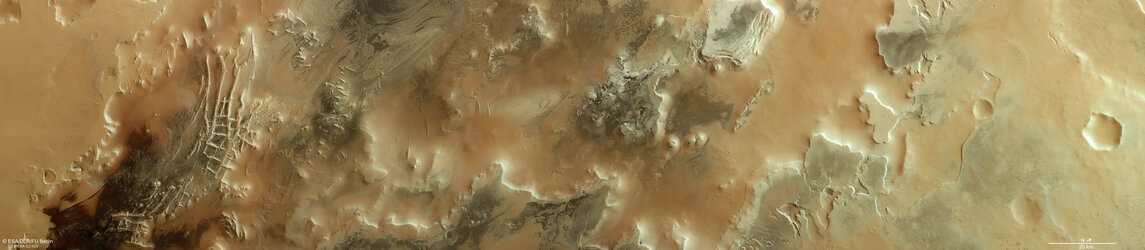
 | Phoenicis Lacus has an area of 8100 sq km (59.5 x 136 km), which corresponds to the size of Corsica. This image was obtained on 31 July 2010 using the High-Resolution Stereo Camera (HRSC) on ESA’s Mars Express spacecraft.
Credits: ESA/DLR/FU Berlin (G. Neukum) |  |  |  |  |
| | | |  | On 31 July 2010 the High-Resolution Stereo Camera (HRSC) on the ESA spacecraft Mars Express obtained images of Phoenicis Lacus at approximately 13°S/249°E. The data were acquired during orbit 8417 with a ground resolution of approximately 17 m per pixel.
Credits: NASA MGS MOLA Science Team |  |  |  |  |
| | | |  | Phoenicis Lacus was formed by the uplift of the Tharsis volcanic plateau. The continual episodes of strong volcanic activity in Tharsis not only lifted the plateau, but also deformed Phoenicis Lacus, creating uplifted blocks and multiple fault lines at different orientations. A prominent collapse feature in Phoenicis Lacus sinks to a depth of about 3 km below the surrounding terrain. This image was created using a Digital Terrain Model (DTM) obtained from the High-Resolution Stereo Camera on ESA’s Mars Express spacecraft. Elevation data from the DTM are colour-coded: purple indicates the lowest-lying regions, and grey the highest elevations. The scale is in metres.
Credits: ESA/DLR/FU Berlin (G. Neukum) |  |  |  |  |
| | | |  | This prominent collapse feature in Phoenicis Lacus sinks to a depth of about 3 km below the surrounding terrain. Its walls give a glimpse of the likely extensive basalt layers in the canyon. A small field of sand dunes covers its floor.
Credits: ESA/DLR/FU Berlin (G. Neukum) |  |  |  |  |
| | | |  | Phoenicis Lacus was formed by the uplift of the Tharsis volcanic plateau. The continual episodes of strong volcanic activity in Tharsis not only lifted the plateau, but also deformed Phoenicis Lacus, creating blocks and multiple fault lines at different orientations. Extension has taken place here, resulting in this characteristic horst-and-graben (cliffs and valleys) landscape.
Credits: ESA/DLR/FU Berlin (G. Neukum) |  |  |  |  |
| | | |  | A prominent collapse feature [box 1] can be seen in Phoenicis Lacus. It is a long pit with a depth of about 3 km below the surrounding terrain. In the central fault zone, there are uplifted blocks [box 2], showing that significant tectonic deformation has taken place in this region. A crater can be seen [box 3]. This impact structure was elongated during the spreading of the region and evolved from a circular to an ellipsoidal form.
Credits: ESA/DLR/FU Berlin (G. Neukum) |  |  |  |  |
| | | |  | On 31 July 2010 the High-Resolution Stereo Camera (HRSC) on the ESA spacecraft Mars Express obtained images of Phoenicis Lacus at approximately 13°S/249°E. The data were acquired during orbit 8417 with a ground resolution of approximately 17 m per pixel. This image was derived from the HRSC nadir channel, which provides the highest detail of all the channels.
Credits: ESA/DLR/FU Berlin (G. Neukum) |  |  |  |  |
| | | |  | Phoenicis Lacus was formed by the uplift of the Tharsis volcanic plateau. The continual episodes of strong volcanic activity in Tharsis not only lifted the plateau, but also compressed Phoenicis Lacus, creating uplifted blocks and multiple fault lines at different orientations. Extension has taken place here, resulting in this characteristic horst-and-graben (cliffs and valleys) landscape. This image was obtained on 31 July 2010 using the High-Resolution Stereo Camera (HRSC) on ESA’s Mars Express spacecraft. It combines data from the nadir channel and one stereo channel of HRSC. Stereoscopic glasses are required to see the 3D effect.
Credits: ESA/DLR/FU Berlin (G. Neukum) |  |  |  |  |
| |
|  | Mars Express image browser Mars Express on YouTube Traces of Martian lifeRelated articles Mars Express close flybys of martian moon PhobosWind and water have shaped Schiaparelli on MarsMars: how low can you go?Mars’s mysterious elongated craterRocky mounds and a plateau on MarsWet era on early Mars was globalVolcanic ash in Meridiani PlanumCraters young and old in Sirenum FossaeCraters, lava flows and tectonic features near Ma'adim VallisCraters and channels in Hephaestus FossaeChaotic terrain in Ariadnes CollesIce-covered martian North PoleThe Euminedes Dorsum mountains on MarsLava deposits in Mangala FossaeRelated links High Resolution Stereo CameraBehind the lens...Frequently asked questionsFor specialists ESA Planetary Science archive (PSA)NASA Planetary Data SystemHRSC data viewer
|