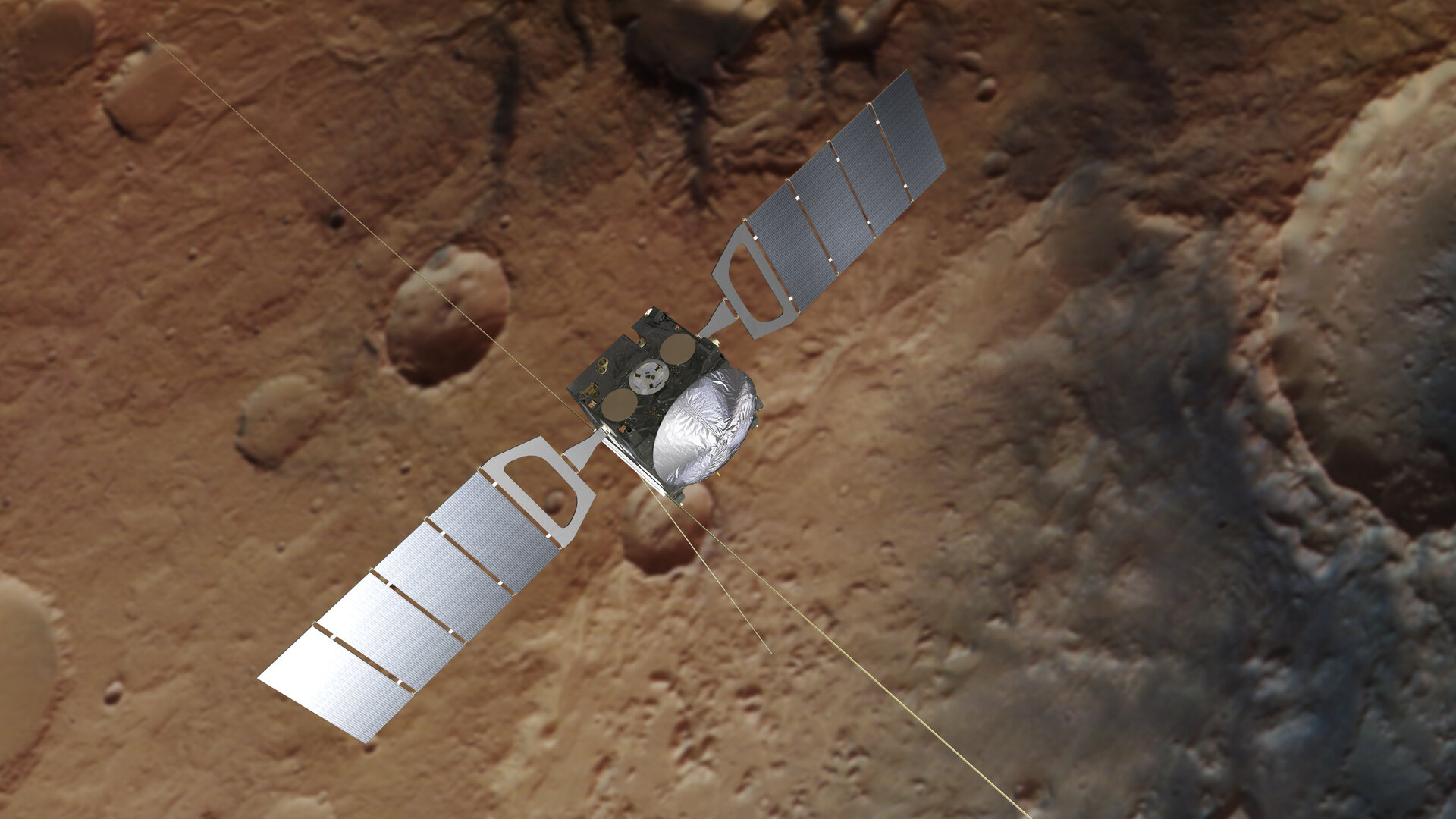
Mars Express operations
Editor's note: This page is no longer being updated, but will be preserved as a record. Click here for the latest information on Mars Express.
Mars Express – ESA's mission to the Red Planet – was launched in 2003, marking the start of a new era for Europe in planetary exploration. Mars Express also marked the start of a cost-effective and innovative way of organising the teams and ground systems that comprise European space missions into the 'mission family' concept.
Mars Express shares a great deal of commonality with Venus Express and Rosetta in terms of the spacecraft platform, several of the instruments and the ground segment. Due to this commonality, the spacecraft was built and launched in record time and at a much lower cost than previous, similar missions to deep-space destinations, and is now being operated in coordination with Venus Express to rationalise resources.
The mission
The mission's main objective is to search for sub-surface water and deploy a lander onto the Martian surface. Seven scientific instruments on board the orbiter are performing a series of remote-sensing observations designed to shed new light on the Martian atmosphere, the planet's structure, geology and composition.
The lander, called Beagle 2 after the ship in which Charles Darwin set sail to explore unchartered areas of the Earth in 1831, was to be used to study the geology, mineral and chemical composition of the landing site, search for life signatures, and study the weather and climate. Beagle 2 was lost upon landing, five days after separation from Mars Express. In 2015, it was announced that the Beagle-2 lander had been imaged on the surface by a NASA orbiter.
| ROLE | Mars observation and exploration |
| LAUNCH DATE | 2 June 2003 |
| LAUNCHER/LOCATION | Soyuz-Fregat/Baikonur, Kazakhstan |
| LAUNCH MASS | 1223 kg |
| PERIAPSIS/APOAPSIS | 330 km/10 500 km |
| ORBIT | Quasi-polar orbit |
| NOMINAL MISSION | One Martian year (687 days Earth days) | Extended until end of 2020 |
| + ESA's first mission to another planet in our Solar System + | |
The Flight Control Team

The Flight Control Team (FCT) operates Mars Express from a combined Dedicated Control Room (co-located with the DCR for Venus Express and Rosetta) located at ESOC, Darmstadt, Germany. Spacecraft Operations Manager (SOM) Michel Denis oversees a team of 15, including spacecraft operations engineers, mission planners and spacecraft controllers.
Additional experts from ESOC support the mission with specialised knowledge in several areas, including flight dynamics, software support and ground stations.
Michel Denis joined ESA in 1992 as a flight control team engineer for Meteosat; he later worked on Cluster, Huygens and XMM-Newton.
Mission operations overview

Mars Express was launched on 2 June 2003 at 17:45 UT by a Soyuz-Fregat launcher from the Baikonur Cosmodrome in Kazakhstan; at that time of year, the positions of the two planets made for the shortest possible route, a condition that occurs once every 26 months.
After launch and separation of the various stages, the spacecraft was placed into a parking orbit following an initial firing of the Fregat stage. One hour and thirty-two minutes after launch, the Fregat stage was re-ignited, directing the spacecraft into interplanetary space and the start of a 400-million-km voyage.
The cruise phase
Once in interplanetary cruise, the satellite's first task was to steady itself by locking onto the Sun using a Sun sensor. Then the solar arrays deployed and a message was sent back to ESOC with information on the state of the instruments and on-board systems after the vibrations of launch through Earth's atmosphere. Contact with Earth was made via the omni-directional Low Gain Antenna (LGA), while Mars Express was still close to home, and via the directional High Gain Antenna (HGA) at larger distances from Earth.
In order to avoid having the discarded Fregat upper stage also end up on Mars, it was decided to off-target the launcher slightly; thus Mars Express was not yet headed along the correct trajectory. Two days and 600 000 km later, therefore, ground control at ESOC sent a message to Mars Express to conduct a small thruster burn to offset its trajectory in a direction closer to Mars. All it took was a burn of the small on-board thrusters for a few minutes to produce the desired effect; the Fregat upper stage, meanwhile, continued on into space.
(This strategy was due to the fact that Mars Express, should have it failed later on, had to respect the Interplanetary Protection Requirements set by the Committee on Space Research Cospar, and not impact Mars. Subsequent trajectory correction manoeuvres performed over the cruise progressively re-targeted the spacecraft until two months before arrival when it was finally put onto a collision course with the Red Planet.)

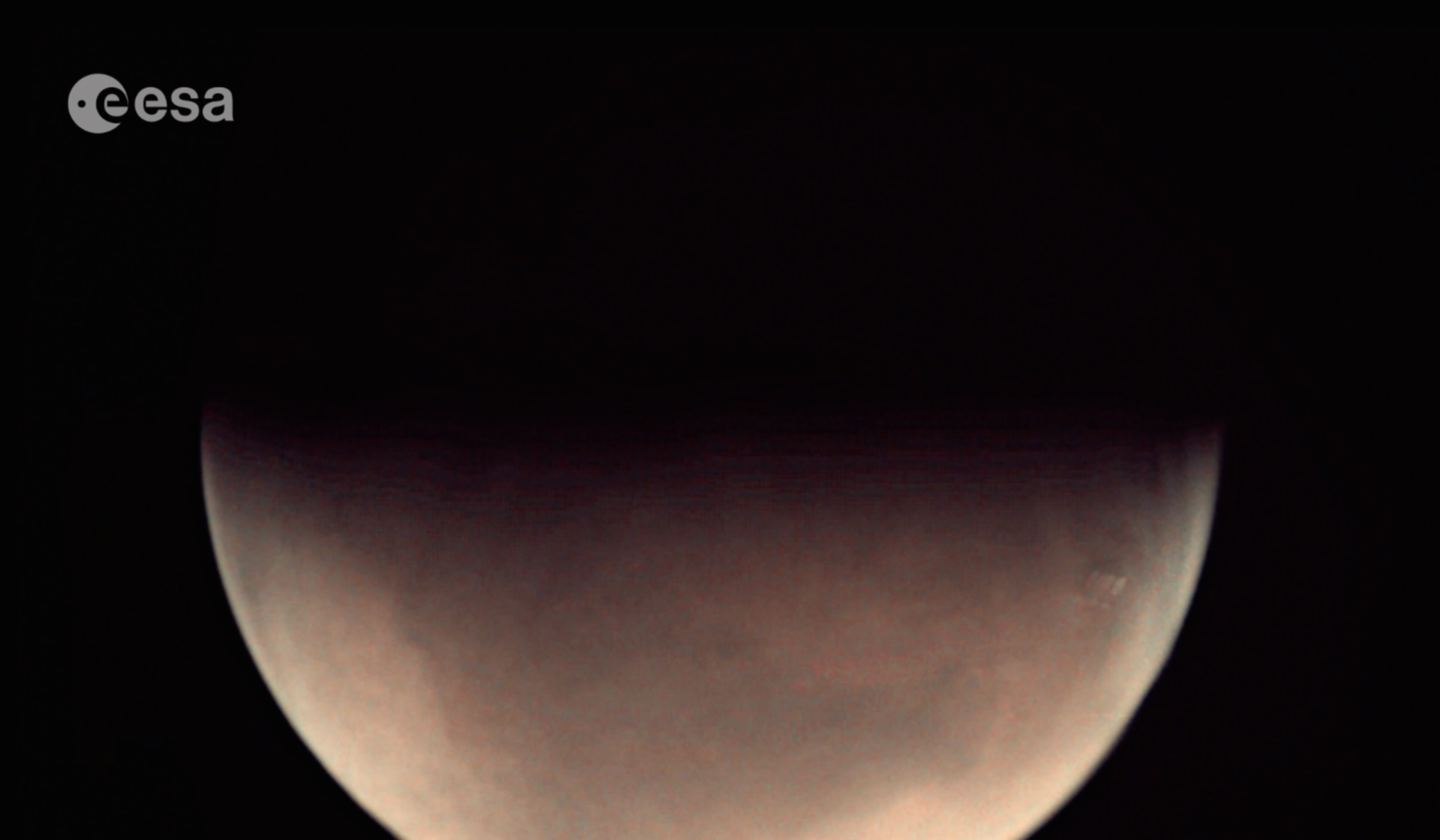
Access the video
At that point, Mars Express was hurtling through interplanetary space with an absolute velocity of 116 800 km per hour and a velocity relative to Earth of 10 800 km per hour.
For the first month, detailed checks of each payload instrument were carried out before switching them off for this phase of the mission. In principle, Operations entered a routine housekeeping phase with minimal contact with ESOC, just sufficient to obtain daily health checks and initiate minor course corrections. But the cruise phase for a brand-new spacecraft, the first of its family to be launched, turned out to be a busier period than originally envisaged.
Spacecraft Operations Manager Denis recalls that Mars Express experienced numerous challenges during initial operations and the cruise to Mars. "On rare occasions, a lot of effort is invested by scientists and engineers involved in MEX to prepare a special observation or operational improvement, but it only partly works because of a trivial issue due to a spacecraft hiccough, a human mistake – the best processes cannot fully avoid them – or an environmental issue like a solar flare," he says.
Nonetheless, the team guided the spacecraft successfully to its remote destination, and at two points along the way, the HRSC (High Resolution Stereo Camera) was activated to capture images of the Earth and Moon and then Mars – from a distance of just 5.5 million km.
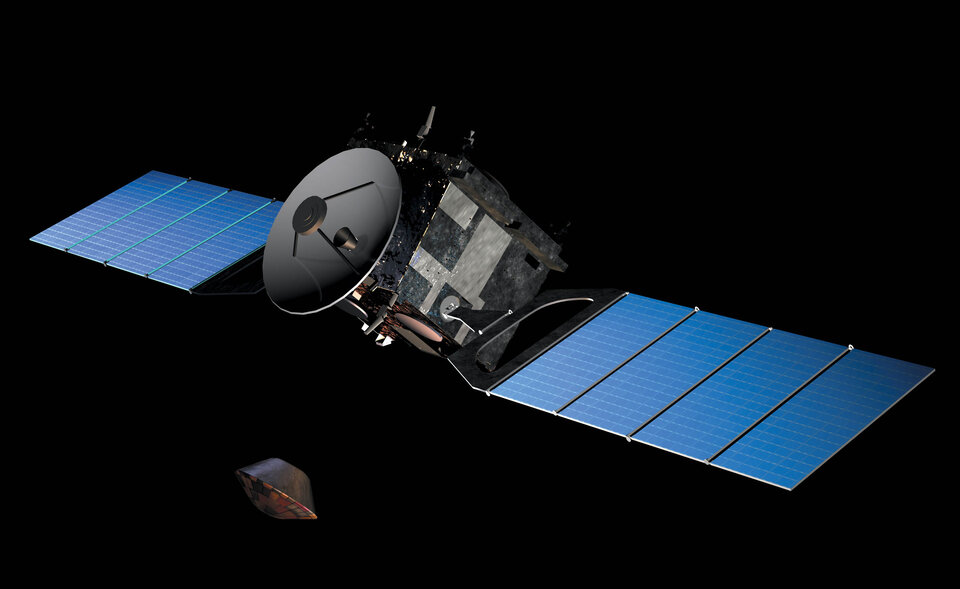
Beagle 2 release
One month before arrival, in November 2003, preparations began for the separation of the Beagle 2 lander. Once again, the spacecraft's small thrusters would be fired to put Mars Express onto a trajectory that would allow Beagle 2, which has no propulsion of its own, to enter the Martian atmosphere and attain the correct landing site on the surface.
At 08:31 UT, 19 December 2003, the pyrotechnic mechanisms on Mars Express were activated to release the Beagle probe toward the surface of the Red Planet. This operation took place as late as possible to give scientists the best possible chance of calculating the landing site.
The first radio contact with Beagle 2 was expected shortly after the scheduled landing time but no signal was received. Many attempts were made to establish contact over the following days and weeks, but without result. By early February 2004, it became clear that there was no prospect of communicating with Beagle 2 and a joint ESA/UK enquiry was established to investigate the circumstances and determine possible reasons for the loss of Beagle 2. In 2015, it was announced that the Beagle-2 lander had been imaged on the surface by a NASA orbiter.
Orbit insertion
At the same time that Beagle 2 was scheduled to reach the Mars surface, the spacecraft fired its main engine for the first time since launch to initiate the critical orbit insertion manoeuvre.
An engine burn lasting 37 minutes was required to place the spacecraft into a highly elliptical orbit several hundreds of thousand kilometres above the surface of the planet at apocentre. During the days following the initial capture orbit, the orbital trajectory was gradually corrected to bring it closer to the operational scientific orbit.

Access the video
On 30 December 2003, a major engine firing brought the spacecraft into a polar orbit. Through January 2004, a series of manoeuvres progressively reduced the maximum distance to the planet and positioned the spacecraft into a polar orbit with a pericentre of 300 km, an apocentre 10 000 km, and an inclination of 86°.
The spacecraft has since performed fully as planned, and has become one of ESA's most successful missions ever. Full details of the mission's numerous scientific discoveries are published at ESA's dedicated Mars Express website.
Ground stations
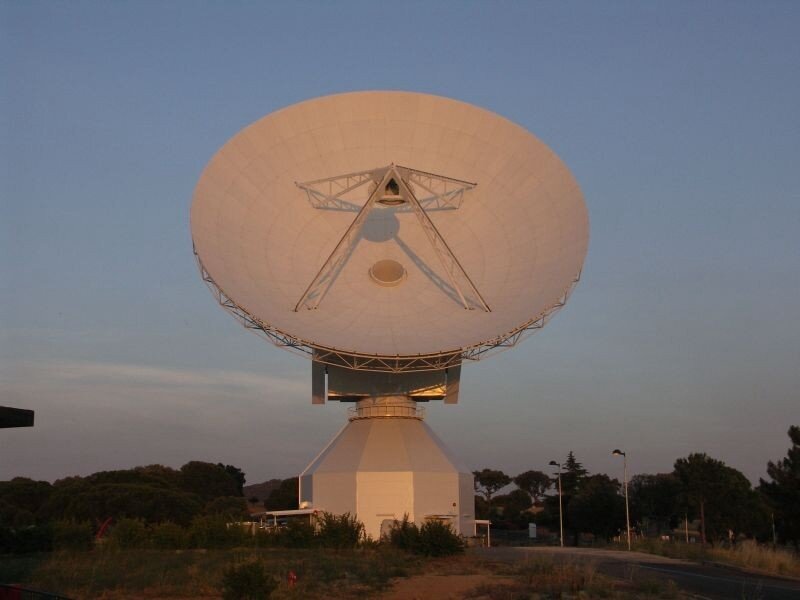
Telecommunications for Mars Express are provided by ESA's ESTRACK Deep Space Antennas (DSA) at New Norcia, Australia (DSA 1), Cebreros, Spain (DSA 2), and Malargüe, Argentina (DSA 3), complemented by stations from NASA's Deep Space Network (DSN) in Spain and California.
All deep-space stations provide facilities for tacking, telemetry, telecommand and radiometric measurements (ranging, Doppler, meteo).
Ground segment
During each orbit, Mars Express spends some time turned toward the planet for instrument observations and some time turned toward Earth for communications with ground stations, similar to the operational concept behind sister spacecraft Venus Express.
Data collected by the orbiter instruments are transmitted to New Norcia at a rate of up to 230 kbps. Between 1 and 5 Gbits of scientific data are downlinked from the spacecraft to Earth every day. From the ground station, data are transferred to ESOC in Darmstadt, Germany, which adds spacecraft attitude and orbital data, and then retransmits the data to the various instrument's principal investigators (PI) for scientific processing and analysis.
After about six months, all processed data are sent to ESA's European Space Astronomy Centre (ESAC), Spain, for storage in a publicly available Mars Express science data archive.
Information on the health and position of the spacecraft is included in a separate data stream. The Mars Express operations team at ESOC use this information, together with the forthcoming operational needs of the instruments, to work out new commands to instruct the spacecraft how to behave over the coming months. The new commands are uplinked via any ground station in order to keep a stack of several days' worth of commands pre-programmed in the on-board schedule.
The platform and payload

The Mars Express spacecraft and its instruments represent a truly international endeavour - a stereoscopic camera from Germany, a mineralogical mapping device from France and an atmospheric sounder from Italy. The radar instrument, to probe for water at depths of several kilometres below the surface, was built jointly between Italy and NASA's JPL (Jet Propulsion Laboratory), in California, USA. The Beagle 2 landing craft was designed and built in the UK.
Mars Express is a cube-shaped spacecraft with two solar panel wings extending from opposite sides. The 1123 kg launch mass includes 113 kg of payload, the 60 kg lander, and 457 kg of propellant. The main body is 1.5 m x 1.8 m x 1.4 m in size, with an aluminium honeycomb structure covered by an aluminium skin. The solar panels measure about 12 m tip-to-tip. Two 20m-long wire dipole antennas extend from opposite side faces perpendicular to the solar panels as part of the radar sounder.
The payload
The payload consists of the following instruments:
|
Instrument |
Name |
|
HRSC |
High Resolution Stereo Camera - high-resolution surface imaging |
|
OMEGA |
Visible and Infrared Mineralogical Mapping Spectrometer - determine surface composition and evolution processes |
|
SPICAM |
Ultraviolet and Infrared Mars Atmospheric Spectrometer - determine composition of the atmosphere |
|
PFS |
Planetary Fourier Spectrometer - study the atmospheric composition and circulation |
|
MARSIS |
Sub-Surface Sounding Radar Altimeter - search for subsurface water |
|
ASPERA |
Energetic Neutron Atoms Analyser - how the solar wind erodes the Martian atmosphere |
|
MaRS |
Radio Science Experiment - sounding of the internal structure, atmosphere and environment |
|
Lander (Beagle 2) |
Geochemistry and exobiology (lost) |