Timeline: Mars Express support to Phoenix landing
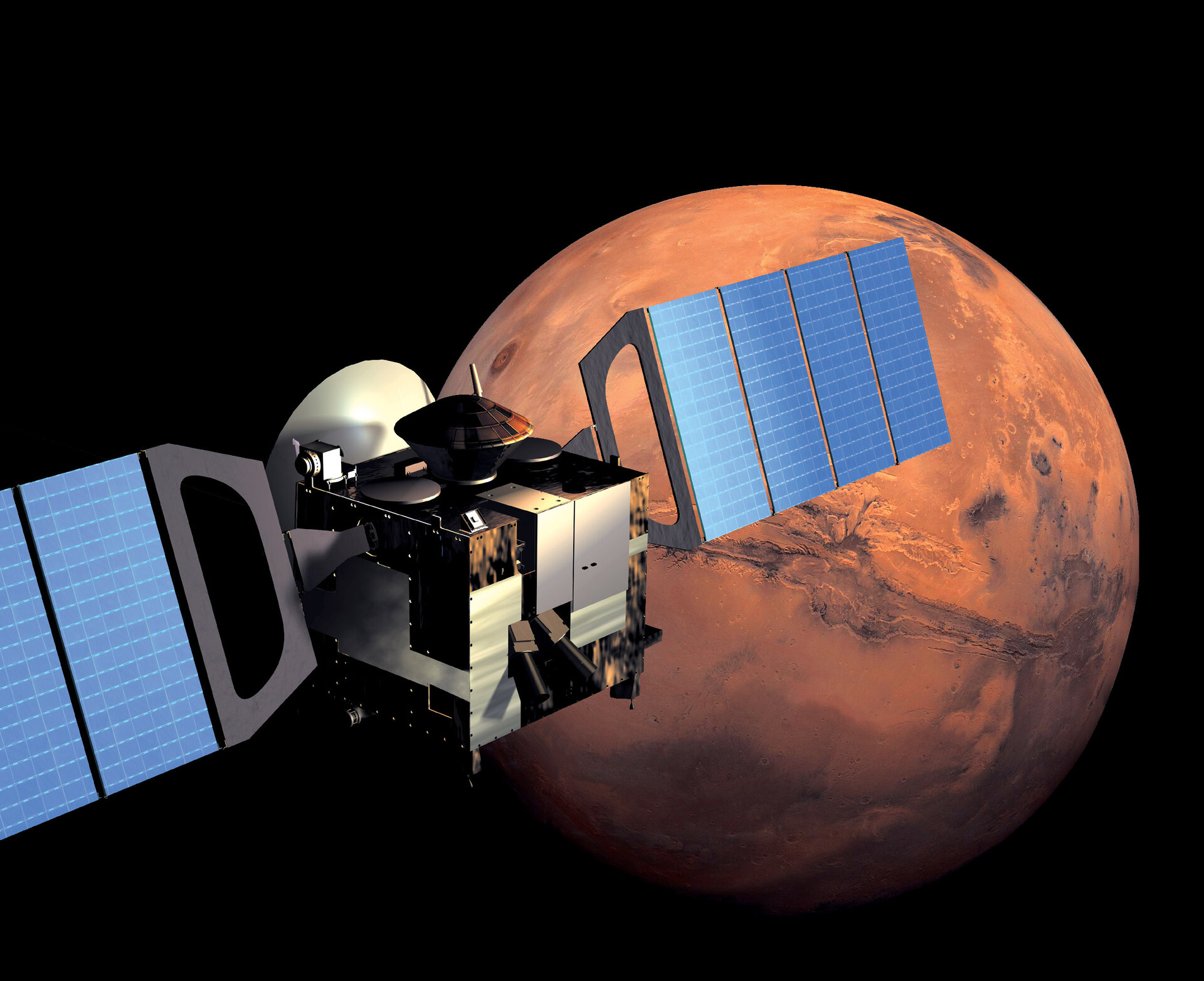
Beginning late on 25 May, Mars Express will execute a series of pre-programmed commands specially designed to support NASA's Phoenix lander. The ESA spacecraft will conduct a high-speed slew, enabling it to track Phoenix as it enters the Martian atmosphere.
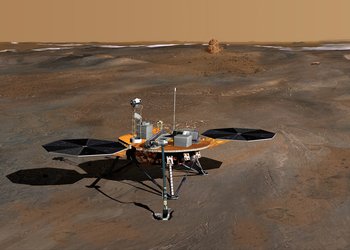
Mars Express will point its Lander Communications Antenna toward Phoenix's planned entry trajectory and record signals transmitted from the lander as it plunges toward the surface during the critical entry, descent and landing (EDL) phase.
Support for Phoenix starts at 19:00 UTC (21:00 CEST) when the spacecraft's MELACOM (Mars Express Lander Communications) system is switched on. Recording of radio signals transmitted by Phoenix will begin at 23:21 UTC (01:21 CEST, 26 May) and end at 23:47 UTC (01:47 CEST, 26 May).
During the recording, Mars Express will conduct a high-speed slew as MELACOM tracks Phoenix, keeping Phoenix in the line of sight of the MELACOM antenna.
Upon completion of recording, Mars Express will perform a (normal) slew to Earth pointing attitude, and at 00:25 UTC 26 May (02:25 CEST), the spacecraft will begin transmitting the recorded data, via a NASA deep-space ground station, to ESA's Space Operations Centre (ESOC), Darmstadt, Germany. The one-way signal travel time will be 15 minutes and 20 seconds. The download will be complete by 00:57 UTC (Earth receive time, equal to 02:57 CEST), and ESOC will make the data available to NASA immediately upon receipt.
Mars Express will subsequently download the recorded data two more times to ensure redundancy. The ESA spacecraft will additionally monitor signals from Phoenix during an overflight of the landing zone, 06:12-06:23 UTC (08:12-08:23 CEST), and 14 more times during the following week.
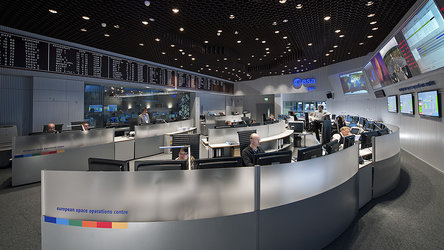
During the night of 25/26 May, Mars Express will be controlled by the Flight Control Team working in the Dedicated Control Room at ESOC.
Observations before and during Phoenix descent
It is planned that two Mars Express instruments, the High Resolution Stereo Camera (HRSC) and the Ultraviolet and Infrared Atmospheric Spectrometer (SPICAM), will be turned on for observations during the Phoenix EDL.
The observations are aimed at visually capturing the trail of the lander's trajectory to the Martian surface, studying the characteristics of the atmosphere during the lander's descent, and monitoring the lander's performance during EDL.
It is not possible to know the exact route Phoenix will take when descending to the surface, and so it is possible that the instruments may not be looking in the correct direction during the event. This makes the likelihood of success less than certain.
Nonetheless, and despite the technical and physical challenges, the Mars Express science teams are doing their best to boost the potential scientific value of the observations. In any event, highest priority will be given to tracking the lander using MELACOM.
These challenging scientific observations have never been performed at Mars before, and if successful, the knowledge gained will be useful for future missions.
In addition to the observations planned during EDL, the Planetary Fourier Spectrometer (PFS) on board Mars Express has been collecting relevant data since 8 May this year. This includes information on the physical conditions of the Martian atmosphere (temperature, pressure and density) above the expected the landing site. This data is being provided to NASA in support of their observations of the physical conditions in the atmosphere prior to landing.
Timeline
Notes:
- S/C = spacecraft
- CEST = UTC + 2 hours
- Earth time = spacecraft event time + 15:20 min:sec
- MEX: Mars Express | PHX: Phoenix | O/F: Overflight | DSS: Deep space station
- All times subject to change. For latest times relevant to Phoenix, see NASA Phoenix website.
| Event | S/C UTC | Earth UTC | Earth CEST | Notes |
|---|---|---|---|---|
| MEX MELACOM ON | 19:00:00 | 19:15:20 | 21:15:20 | |
| MEX Start recording | 23:21:12 | 23:36:32 | 01:36:32 | |
| PHX Entry | 23:30:59 | 23:46:19 | 01:46:19 | |
| PHX Chute deployment | 23:34:42 | 23:50:02 | 01:50:02 | |
| PHX Lander separation | 23:37:41 | 23:53:01 | 01:53:01 | |
| PHX Landing | 23:38:21 | 23:53:41 | 01:53:01 | |
| MEX Stop recording | 23:47:12 | 00:02:32 | 02:02:32 | |
| MEX Slew to Earth pointing | 23:47:12 | 00:02:32 | 02:02:32 | |
| MEX 1st MELACOM data download start | 00:25:00 | 00:40:20 | 02:40:20 | Via DSS-15 & DSS-25 |
| MEX 1st MELACOM data download end | 00:42:00 | 00:57:20 | 02:57:20 | |
| MEX MELACOM data available to NASA | 00:42:00 | 00:57:20 | 02:57:20 | |
| MEX 2nd MELACOM data download start | 00:42:00 | 00:57:20 | 02:57:20 | Via DSS-15 & DSS-25 |
| MEX 2st MELACOM data download end | 00:59:00 | 01:14:20 | 03:14:20 | |
| MEX Slew to PHX pointing | 05:35:33 | 05:50:53 | 07:50:53 | |
| MEX 1st PHX O/F start | 06:12:00 | 06:27:20 | 08:27:20 | MELACOM ON |
| MEX 1st PHX O/F end | 06:23:00 | 06:38:20 | 08:38:20 | MELACOM OFF |
| MEX Slew to Earth pointing | 06:26:14 | 06:41:34 | 08:41:34 | |
| MEX 3rd MELACOM data download | 08:25:00 | 08:40:20 | 10:40:20 | Via ESTRACK New Norcia |
| MEX 3rd MELACOM data download end | 08:42:00 | 08:57:20 | 10:57:20 | |
| MEX 1st PHX O/F data download start | 08:45:00 | 09:00:20 | 11:00:20 | Via ESTRACK New Norcia |
| MEX 1st PHX O/F data download end | 09:01:00 | 09:16:20 | 11:16:20 |