Space Exploration Strategy
   
Exploration Strategy
Why explore?Europe's journey of explorationStrategic plan 2020European themes
Context
Context analysisRelated ESA programmes
The global space exploration strategy
International plans
Reference Architecture
Architecture studiesInternational exploration architecture
Events
Past Events
Services
Bookmark and Share


Contextprinter friendly page
Aurora artist's impression
Aurora Programme - artist's impression
The global space exploration strategy
 
An important element in the definition of Europe’s long-term plan for space exploration is the development of an international strategic exploration framework. The Global Exploration Strategy, published in 2007, was developed by an international group made of representatives of 14 space agencies (NASA, CSIRO, KSA, CNSA, BNSC, ESA, ASI, CNES, CSA, JAXA, DLR, ROSCOSMOS, KARI, NSAU).
 
This document not only supports international space exploration, but it also proposes a vision of globally coordinated exploration which is focused on Earth-Moon-Mars space - places where humans will one day live and work.

While the long-term objective is to enable human missions to Mars, other destinations are of equal interest, including low orbits around Earth and the Moon, the lunar surface and near-Earth objects. The Moon is recognised as an important destination in its own right, as well as a stepping-stone to Mars and beyond.

The Global Exploration Strategy emphasises the need for both robotic and human explorers. It does not propose a single programme, but describes a vision based on a common set of exploration themes and values in the service of society. It emphasises that space exploration is essential to humanity’s future, since it can help to answer fundamental questions, bring nations together in a common cause, reveal new knowledge, inspire the next generation of scientists and engineers, and stimulate technical and commercial innovation on Earth.  
 
The Strategy’s five exploration themes are:

  • New Knowledge in Science and Technology: global space exploration drives scientific and technical progress, leading to innovation.

  • A Sustained Presence in Space – Extending Human Frontiers: robotic and human exploration together are necessary to answer key scientific questions. Humans have unique decision-making capabilities that allow them to respond to new situations based on previous experience and knowledge.

  • Economic Expansion: this can be expected as a consequence of the technology developments required for space exploration and the new opportunities for business. Many of the capabilities and technologies developed for the space programme probably would not have appeared in its absence, even with the same level of investment.

  • A Global Partnership: the shared challenges of space exploration and the common desire to answer fundamental scientific questions encourage all nations to work together in a spirit of friendship and cooperation.

  • Inspiration and Education: space exploration helps to inspire young people to pursue scientific and technical careers, thereby addressing the major concern in many countries about how to attract and sustain the scientists and engineers of the future.
Following the publication of the Global Exploration Strategy, an International Space Coordination Group (ISECG) was established. The ISECG met for the first time in Berlin in November 2007. The overall scope of the long-term ISECG activities is defined in the Terms of Reference document.

The Work Plan provides an outline of the activities the ISECG is involved with yearly.

The Annual report 2009 has been published to inform the wider community about the past year's activities and outcome of ISECG discussions.


For any enquiries or to provide feedback please contact: architecture@esa.int
 
 
Last update: 9 February 2010


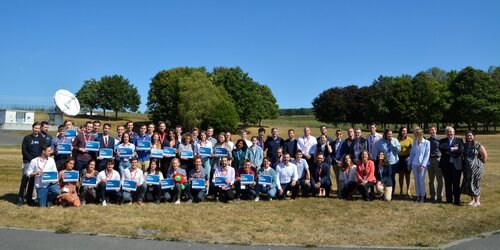
ISEC, Berlin 2007
Conference ProceedingsExecutive SummaryGeneral Information
Related links
International Cooperation for Sustainable Space ExplorationInternational Space Exploration Coordination Group -ISECG


   ESA