ESAYES2Education
   
YES programme
The YES programme
About YES2
About YES2
Mission factsTechnical factsLaunch facts
Young engineers
Team overviewMeet the team
YES2 partners
YES2 partnersCentres of Expertise
YES2 deployment
Observe YES2
YES2 multimedia
Foton Mission Video-On-DemandESA Multimedia galleryImage diaryVideo clipPress fact sheetPresentation Bookmark and Share


printer friendly page
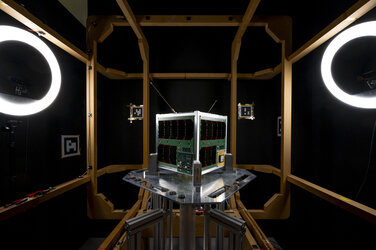
YES2 experiment prepared at ESTEC
A student works on YES2 in the vibration facility at ESTEC
About YES2
 
How do you deliver a parcel down to Earth from space without using a rocket engine and fuel? YES2 hopes to answer that with a daring experiment using a tether rather than chemical retro rockets.
 
Almost five hundred students from all over Europe have worked on the second Young Engineers Satellite (YES2) experiment in conjunction with prime contractor Delta-Utec.


Technology Demonstration

Besides the educational challenge, YES2 is also a demonstration of new technologies. It will be the first time in history a thirty kilometre long tether will be deployed in space and a parcel will be shot back down to Earth from a tether.

The three-part experiment is mounted on the outside of the Russian research capsule Foton M3. In September 2007 Foton M3 will be launched into Earth orbit from the launch base at Baikonur, Kazakhstan.

YES2 operations will start just before the Foton returns to Earth, when the student satellite is activated.  
 
YES2 team members
Valuable hands-on experience for all YES 2 team members
The Experiment
 
At an altitude of 260 to 300 kilometres a half millimetre thick, thirty kilometre long tether will be rolled out below Foton. This is so long, that the tether will even be visible from Earth in the night sky (from South America and eastern Russia).

At the end of the tether hangs the spherical re-entry capsule Fotino (the parcel). Gravity will cause Fotino to swing forwards and back to the vertical. At exactly the right moment the Fotino is released from the tether and the slingshot places the capsule on a path towards the Earth's atmosphere. A heat shield protects the experiment against the same heat the Space Shuttle faces during its return to Earth and Fotino will use parachutes to prepare for a soft landing.
 
 
YES 2
Fotino will be deployed on a 30km tether
Space Mail
 
More than twenty experiments have been conducted in which a tether has been deployed in space. The longest so far was twenty kilometres and never before was a re-entry capsule attached to the end. The special material used for tether allows it to hold the full weight of the Fotino module – six kilograms – while only being half a millimetre in diameter.

If YES2 is successful it will be the first proof that 'space mail' can be sent using a relatively simple and cheap mechanism. Simple and cheap enough to send experiments from the International Space Station down to scientists on Earth...


More information
Technology demonstration
Web diary
Sites


   Copyright 2000 - 2010 © European Space Agency. All rights reserved.