ESAMechanismsSpace EngineeringMechanical
   
About
MechanismsMechanisms standard
Technology areas
Contactless power and data transferDampers developmentDeployable BoomsElectrical MotorsElectric Propulsion Pointing Mechanisms (EPPM)High Accuracy Position and Scanning MechanismsHold-Down and Separation SystemsLaunch Vehicle actuatorsMicro Electro Mechanical SystemsMultibody DynamicsMulti-purpose Rotary and Linear ActuatorsSolar Array Drive Mechanisms (SADM)Sampling Devices for Planetary ExplorationTribology
Multibody and Advanced Simulation
Multibody & Advanced Simulation Team
Project support activities
Events
Events
Contact
Contact us


Bookmark and Share


printer friendly page
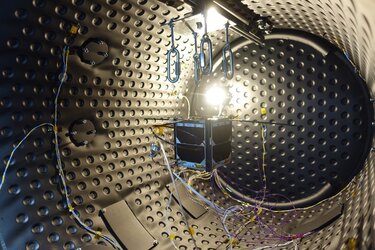
SAS-1m, Coring tests of cometary analogue material
SAS-1m: A) Coring tests of cometary analogue material in thermal vacuum.,
CNSR SAS-1m (90-95)
 
The SAS-1m, like previously the SAS-3m, was intended for a Comet Nucleus Sample Return mission. In order to get a simpler, robust system, the sampling depth requirement was reconsidered, and its goal reduced from 3 m to 1 m: 1 m was given as the very minimum depth to find a meaningful volatile sample. Technically, a corer of 1 m, in one piece, could be used. The diameter of the core sample was still equal to 10 cm, (Fenzi M. ET AL. 1993). The sample was held in a container tube inside the corer; having reached 1 m depth, a bottom shutter closed two hemispherical segments to cut the base; the container tube holding the sample was extracted and segmented in two, using an external cutter; the segments were closed with caps, and stored in the Earth Return Container (ERC).
 
 
SAS-1m:disassembled corer
SAS-1m: disassembled corer; from left to right: corer tube and drill bit; sample
The SAS-1m consortium associated Tecnospazio with Tecnomare and Rodio (I), DLR (D) and Rogalands (N). An extensive testing program was performed. Rodio selected a coring drill bit with polycrystalline diamond from initial tests. The industrial team at DLR extensively tested a prototype of the SAS-1m; Ettringer tuff (one of the reference materials) and solid ice were cored in liquid nitrogen. A cometary analogue material (a frozen, dusty water emulsion), was cored in thermal vacuum in a large Space Simulation chamber of DLR. These tests demonstrated that core sample acquisition could be achieved, respecting the requirements of low power (100 W at the bit), low axial force (100 N) and low torque (<50 Nm). Within the same study, a surface sampler able to gather some 5 kg of loose soil, and spacecraft anchors were developed and tested.
 
 
The SAS-1m was compliant with its requirements of coring at 1-m depth [http://adsabs.harvard.edu/abs/1993aems.nasa....1C ].

The heritage of this drill development is still alive in two ESA project activities:

  • the drill SD2 on PHILAE, the ROSETTA lander;
  • the EXOMARS drill.
ROSETTA has been launched on March 2nd, 2004; it is due to rendezvous Comet 67 P / Churyumov-Gerasimenko in May 2014. The PHILAE Lander should be ejected on the Comet in November 2014, The drilling tool ‘SD2’ will acquire small core samples (inner diameter 2.5 mm, max. lenght 6.5 mm) and deliver them to ovens for analysis by microscope and gas chromatographs (Civa, Cesac / Modulus) [Magnani 1998]. SD2 development was managed by SELEX GALILEO for ASI [http://www.esa.int/esapub/pff/pffv7n2/pozzv7n2.htm ].

The rover-mounted EXOMARS corer/drill [http://exploration.esa.int/science-e/www/object/index.cfm?fobjectid=43611 ] shall acquire core samples at selected intermediate depths down to 2 m, using up to three extension rods.
 
 
Last update: 24 February 2011


Sampling Devices for Planetary Exploration
Soil sampling devices
SSA/DT (95-97)CNSR– SAS-3m (88-90)
Mars and future planets
Drill with hammering mechanism (DHM) (05-07)Ultrasonic Drill Tool (05-07)Instrumented Mole System (IMS) (02-06)Sampling Mole (99-02)Mobile Penetrometer: “Mole” (96-97)Mobile Instrument Deployment Device (MIDD) (94-02)Current and future developments


   Copyright 2000 - 2011 © European Space Agency. All rights reserved.