Mir FAQs - Facts and history
What is Mir?
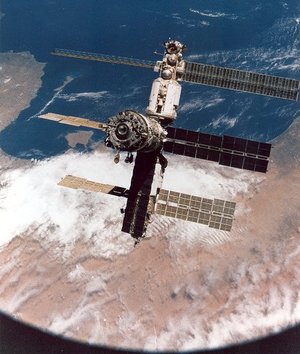
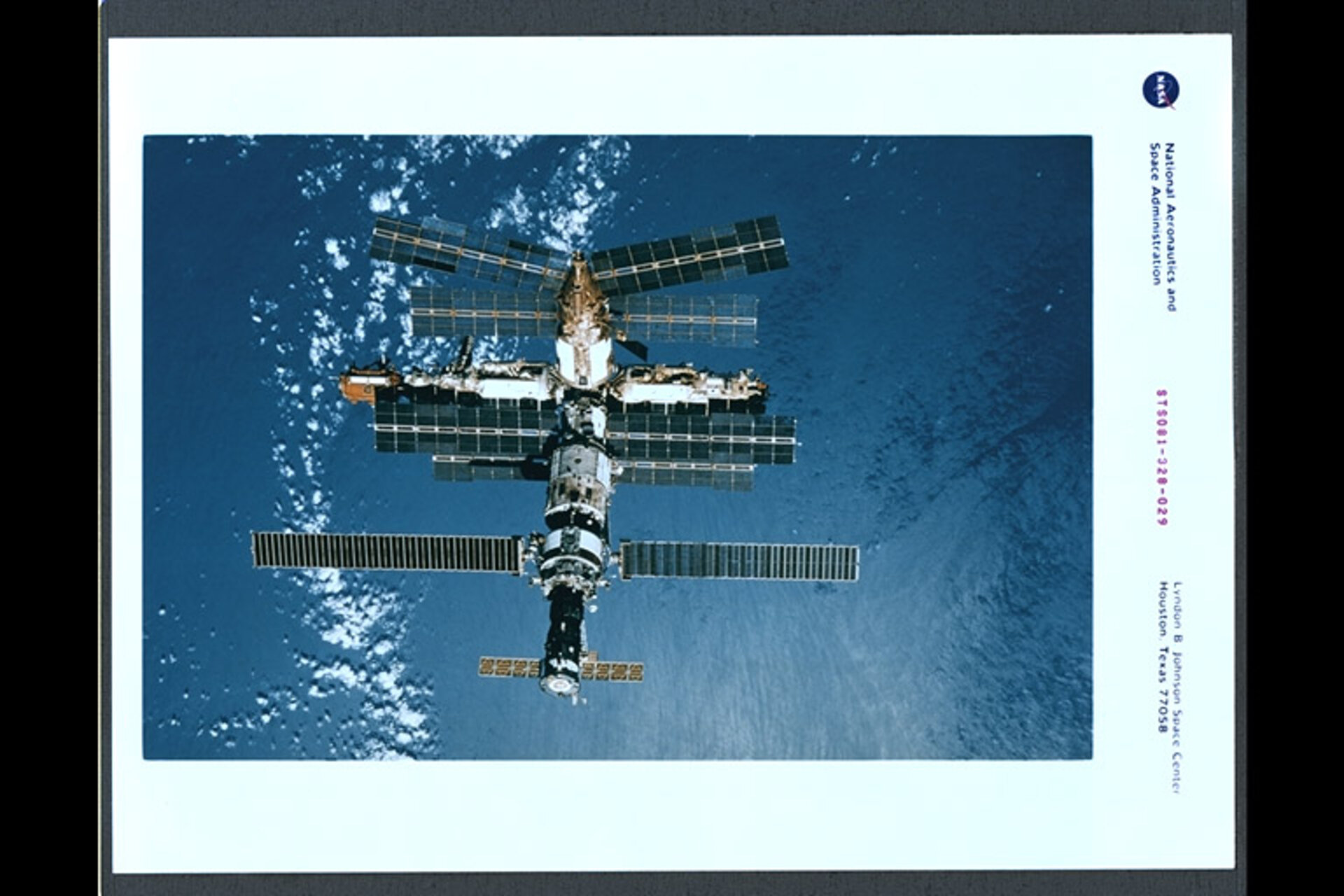
Mir is the longest lasting, most elaborate space station to date. At Mir's core is a module where the astronauts live and six docking ports which are used for re-supply vehicles and to lock on the specialised modules that are used for various technical work. Mir is under the responsibility of the Russian Aviation and Space Agency (Rosaviakosmos) and is operated by RSC Energia. Although it is a Russian space station it has also been open for international use.
What are its dimensions?
The overall dimensions are: 33 m (Progress M- Kvant 1- Core Module – Soyuz TM) x 31 m (Priroda- Kristall- Docking module) x 27.5 m (Kvant 2- Spektr). The core module of MIR is approximately 13 m long and 4 m in diameter (slightly larger than a railway carriage). Several smaller modules and solar arrays are attached laterally.
What is the mass of Mir?
Mir has an in-orbit mass of 130 to 140 tonnes (130,000-140,000 kg). This is comparable to half the mass of a Boeing 747 airliner.
What has been the value of MIR?

MIR’s purpose was to improve understanding of the difficulties faced in establishing a permanent presence in space. The experience derived from the extended stays of international crews on MIR (including several ESA and West European astronauts) was used to prepare for the International Space Station.
In total, 105 cosmonauts, including 82 non-Russians of 11 nationalities, have flown on Mir between 1988 and 1999. Among these were western European astronauts Jean-Loup Chretien (1988 France), Helen Sharman (1991 UK), Franz Viehböch (1991 Austria), Klaus-Dietrich Flade (1992 Germany), Michel Tognini (1992 France), Jean-Pierre Haigneré (1993 France and 1999 France/ESA), Ulf Merbold (1994 Germany/ESA), Thomas Reiter (1995 Germany/ESA), Claudie André-Deshays (1996 France), Reinhold Ewald (1997 Germany) and Leopold Eyharts (1998 France).
When was MIR launched?
The main MIR module was launched on 20 February 1986. Additional modules were launched as follows: Kvant 1 (March 1987), Kvant 2 (November 1989), Kristall (May 1990), Spektr (May 1995) and Priroda (April 1996).
What are the modules of MIR?
MIR core module (20.9 tonnes, 13.13 m x 4.15 m) Living quarters: galley/table, cooking elements and storage, individual crew cabins and personal hygiene area. Also a working compartment for monitoring and commanding the core systems supported by an electric power system, thermal control system, computer systems, environmental control and life support systems, communications and tracking systems.
Kvant 1 (11 tonnes, 5.8 m x 4.15 m) Laboratory bay/astronomical observatory to provide data and observation for research into the physics of active galaxies, quasars and neutron stars, and also used for biotechnology experiments. This is the primary docking port for Progress vehicles.
Kvant 2 (18.5 tonnes, 13.73 m x 4.35 m) Extension unit: provides airlock and base for Extra Vehicular Activity (EVA). Also used to provide biological research data.
Kristall (19.6 tonnes, 13.7 m x 4.35 m) Materials processing with foldable/unfoldable solar panels for the electrical power requirement, supports docking port for Shuttle.
Spektr (19.6 tonnes, 13m x 4,35 m) Used for Earth remote sensing to study X-rays and gamma rays in particular: damaged on 25 June 1997 by a Progress module crashing into solar panels.
Priroda (19.7 tonnes) Used for Earth remote sensing, dedicated to monitoring ecological problems, study of ozone concentration, ocean and cloud temperatures.
Soyuz TM (6.8 tonnes, 7 m x 2.6 m) Transport of crews and cargo to and from the MIR complex. Made up of three compartments: the orbital module, the descent module and the instrumentation module. The descent module can accommodate three crew members during launch, rendezvous, docking and descent.
Progress M (7.2 tonnes, 7 m x 2.6 m) Unmanned vehicle to transport cargo and re-supply materials to MIR, remove waste material and return scientific data to Earth. Cargo capacity of 2400 kg in three compartments: orbital (spherical section for docking), tanker (propellant and air supply) and service/instrument (equipment and rocket motor section).
What is MIR made of; does it carry dangerous material?
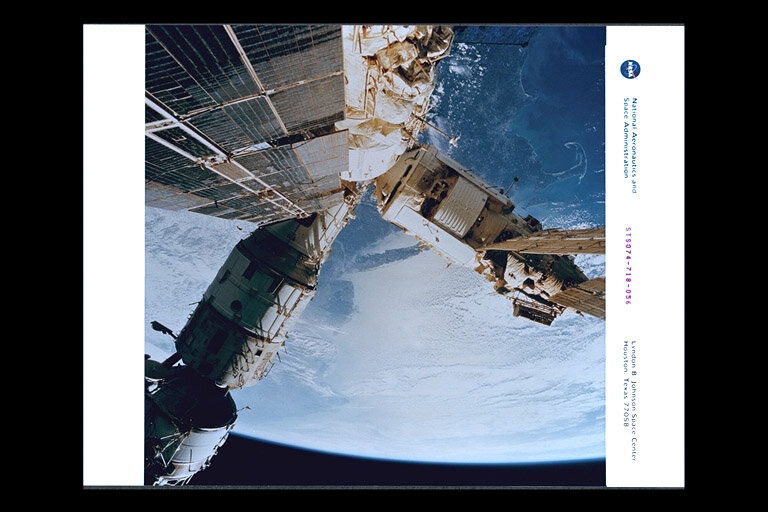
MIR is made of the kind of materials found in an aeroplane – mostly aluminium and lightweight structures. Most of these materials, including any residual fuel, will burn in the heat of re-entry. In particular, as the Russian Ministry of Foreign Affairs recently confirmed, there are no nuclear power sources on MIR, nor biological or chemical hazardous materials.
What happened to Salyut 7, the station that MIR replaced?
Salyut 7, the forerunner to MIR, was launched in August 1982 and returned to Earth in February 1991. Salyut 7 had an in-orbit mass of 40 tonnes and was 26 m long. As Salyut 7 had lost its control capability attitude control was used in an attempt to control the re-entry trajectory but aerodynamic torques overwhelmed the control system and the vehicle could not be recovered (re-oriented) due to insufficient fuel. The Russian Mission Control Centre reported that Salyut 7 re-entered over Argentina. Possibly three elements of about 1 m in size survived re-entry heating to impact on the Earth.
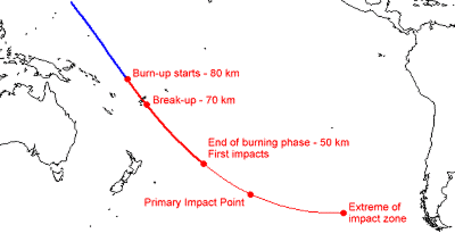
MIR’s re-entry is a completely different as it is a controlled re-entry. The Progress vehicle is used to 'drive' the MIR station to a particular altitude and to make it fall into the atmosphere at a particular pitch (1°) to maximise burn up and limit the surface where debris is spread. The event and the behaviour of the Progress-MIR complex can be predicted relatively accurately.
More Mir FAQs
- About the re-entry >
- Safety issues >