

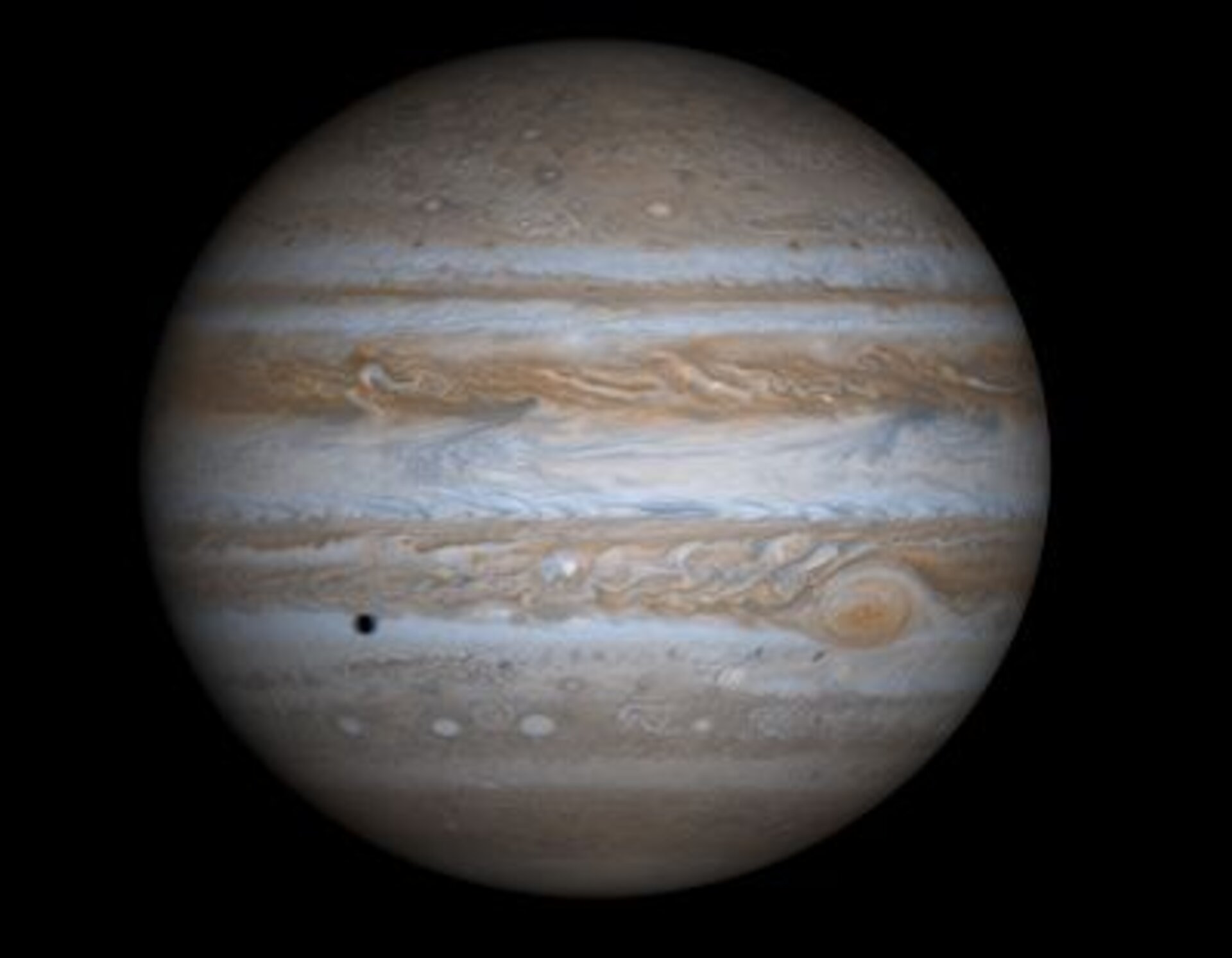
Happy New Year from Jupiter!
As the year draws to a close international teams of scientists have been enjoying a unique opportunity to make co-ordinated observations of the largest planet in our Solar System. The NASA/ESA/ASI Cassini-Huygens spacecraft made its closest approach to Jupiter, around 9.7 million kilometres, yesterday morning.
NASA's Galileo spacecraft has already been orbiting Jupiter since 1995. Scientists using instruments on both Cassini-Huygens and Galileo gave a preview at a press conference at JPL of what they are beginning to discover from their joint studies.
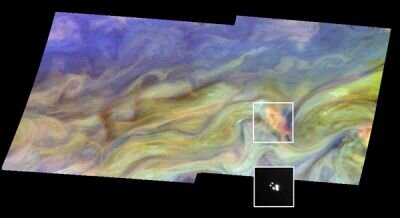
Large storms on Jupiter, which can be larger than those on Earth and last for centuries, gain energy from swallowing smaller storms, preliminary analysis of Jupiter movies taken by Cassini-Huygens suggest. The smaller storms pull their energy from lower depths, according to information collected by Galileo.
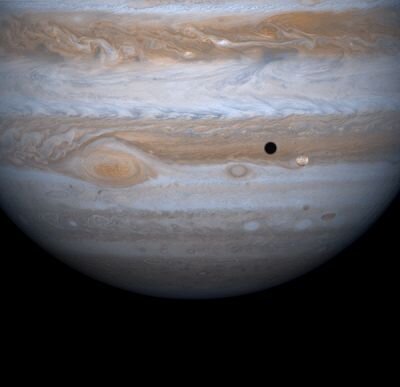
The joint observations continue for another three months, but Cassini-Huygens is already speeding onwards towards the final destination of its seven-year interplanetary cruise, Saturn. This final planetary swing-by was vital to allow it to acquire the velocity needed to reach Saturn.
Even at such a vast distance the gravity of Jupiter is sufficient to bend Cassini-Huygens' trajectory and re-direct it to Saturn. During the flyby ESA's Huygens probe is playing a passive but crucial role in serving as a sunshield protecting Cassini's instruments from the heat of the Sun.
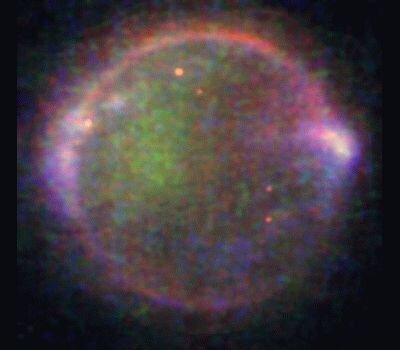
Meanwhile on 28 December Galileo flew past Jupiter's moon Ganymede, the largest moon in the solar system, while Ganymede was eclipsed in Jupiter's shadow. Engineers at JPL said that Galileo dipped within 2337 kilometres of the surface.
Another remarkable campaign combining observations by Cassini and the NASA/ESA Hubble Space Telescope that began on 14 December draws to a close. In the coming weeks on both sides of the Atlantic researchers will begin to examine the images and a host of statistics about the solar wind, including velocity, temperature, pressure, density and magnetic field direction. The goal of these concerted efforts is to combine solar wind measurements with images to determine how the solar wind influences the aurorae around Jupiter.
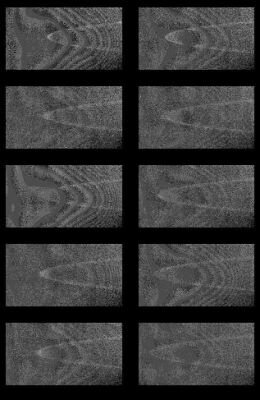
Ground-based telescopes are also joining Cassini-Huygens and Galileo in studying Jupiter, in particular in observing the planet in the radio window, and in mapping the synchrotron emissions which are due to the interaction of energetic electrons with Jupiter's intense magnetic field.
With these co-ordinated international efforts providing new insights on the largest planet in the Solar System, and with the first crew in residence on the International Space Station, 2001 looks set to be an exciting year in space.
Cassini-Huygens is a collaborative effort of NASA, ESA and the Italian space agency ASI.


