Liftoff for Galileo constellation
27 October 2011
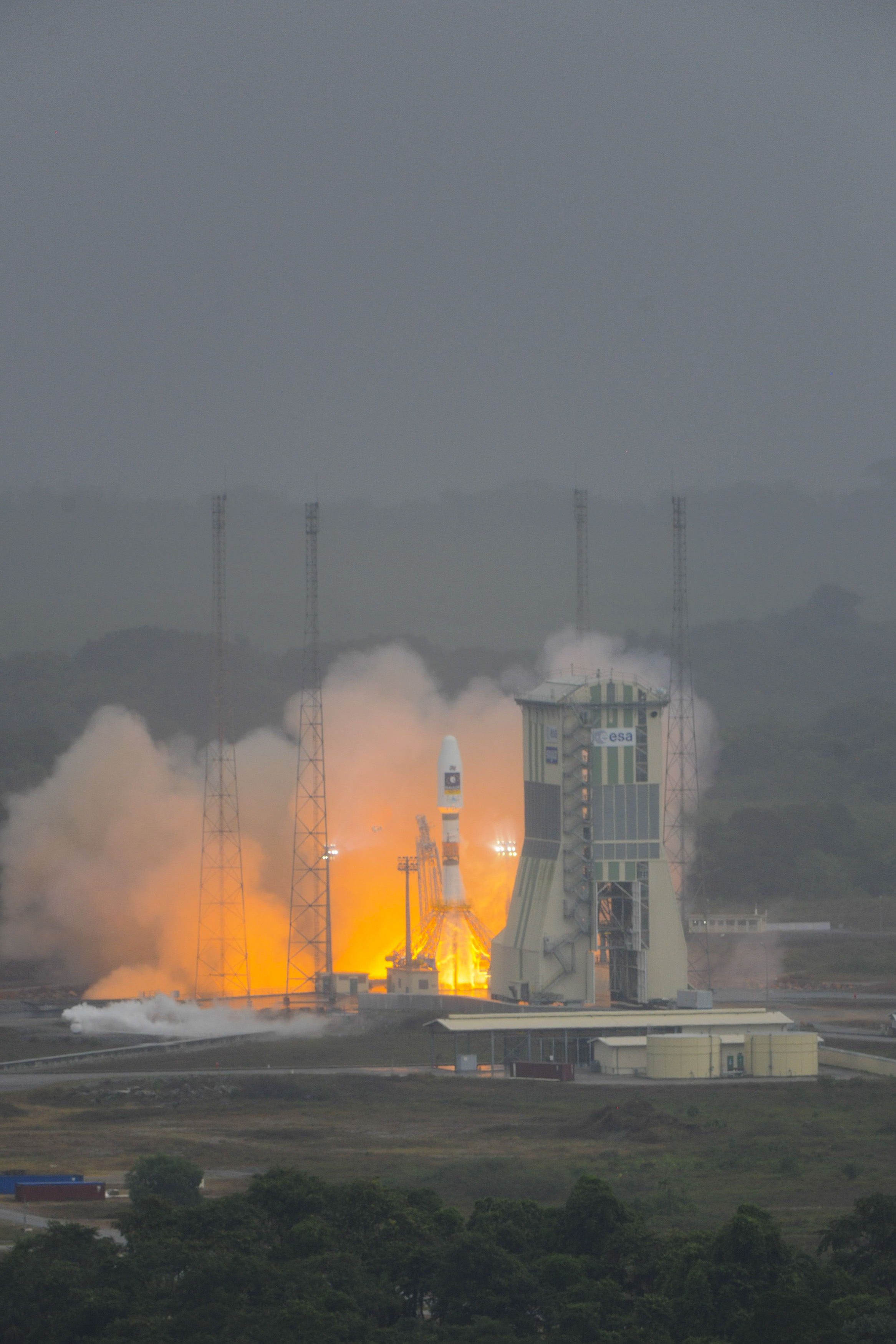
A new era began on 21 October with the successful launch of the first pair of operational spacecraft in Europe’s Galileo global navigation satellite system. The spectacular, fiery lift-off was also a landmark occasion for European access to space. It was the first time that a Russian-built Soyuz rocket had blasted off from the new, specially built launch site at Kourou in French Guiana.
Until now, all Soyuz rockets have been launched from Baikonur in Kazakhstan or Plesetsk in Russia. However, by launching it from Europe’s spaceport, close to the equator, the European Soyuz can carry up to 3 tonnes into ‘geostationary transfer orbit’. This compares with only 1.7 tonnes for launches from Baikonur. The improved performance is made possible by the boost in speed provided by Earth’s rapid rotation at the equator.

The Soyuz VS01 flight, operated by Arianespace, started at 10:30 GMT (12:30 CEST) and all of the Soyuz stages performed perfectly. The Fregat-MT upper stage released the Galileo In-Orbit Validation (IOV) satellites into their target orbits at 23,222 km altitude, 3 hours 49 minutes after lift off.
During the early phase of the mission, the Galileo IOV satellites are being controlled from Toulouse, France, by a joint team from ESA and the French Space Agency (CNES). They will eventually be handed over to SpaceOpal, a joint company of the German Aerospace Centre (DLR) and Italy’s Telespazio, for 90 days of testing. Next year, they will be joined by a second pair of IOV satellites. When the constellation is completed, it will consist of 30 satellites circling in three different orbits.