|  | ExoMars rover | | Combined Raman spectrometer/Laser-induced breakdown spectrometer
This activity was approved by the Aurora Board of Participants within the Work Plan 2005-2006 and should be initiated by the end of 2005.
The ExoMars mission will be the next European mission to Mars. It consists of a rover of 100 kg class with a dedicated payload within the range 8-14 kg to be confirmed aimed at detecting possible signs of past/present life forms on Mars as well as improving our knowledge of the most hospitable neighbour planet.
This payload will bring together of a set of instruments (besides the drilling system), among which some developments are required in order to be ready for launch. Therefore, a number of technology activities were approved to achieve the suitable level of development. This instrument is regarded as a fundamental, next-generation instrument for the mineralogical and elemental (atomic) characterisation of Martian samples. It is planned to locate this instrument inside the rover’s analytical laboratory, and its objective will be to analyse the samples collected from underground and from within surface rocks or boulders with high accuracy.
Additionally, this instrument will provide a second optical fibre link to the rover’s small robotic arm. This second fibre will be used for ‘contact science’, when instruments at the end of the small robotic arm will be brought into contact with surface rocks.
In comparison with the current spectro-chemical instruments, which require several hours to perform a measurement sequence, this advanced technique can perform better measurements in a few seconds. Europe has a very important lead in this area of planetary instrumentation - the instruments on the MER rovers performing spectral analysis are European-built (Germany). It would be very interesting to maintain this capability by promptly developing the next-generation Raman/LIBS instrumentation.
Although this instrument has a very high priority within the scientific community, and has been the subject of two ESA TRP studies, its present level of development is not mature enough to commence its industrial development. To ensure the timely definition of the Raman/LIBS system for a 2011 launch, an immediate - and important - effort is required.
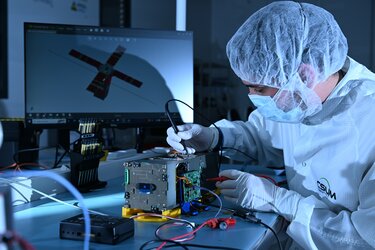
The main objective is to develop and build an advanced laboratory breadboard/engineering model, able to verify the instrument’s end-to-end functionality. This prototype is intended to become the basis for realising the instrument’s flight version. Additionally, the activity will encompass a first initiative to build spectral libraries for combined Raman/LIBS instrument.
The goals of the project will be:
- Definition of final user requirements
- Design and construction of a fully-operational, integrated laboratory breadboard/engineering model with commercial components
- Laboratory testing with reference and natural samples
- Construction of required spectral libraries
- Recommendations to further reduce the overall size, weight and power consumption of flight instrument (target mass < 2 kg)
- Recommendations to improve robustness, radiation hardness, reliability and ease of assembly
| Start | Expected or actual duration | Status | Prime contractor | | Jan '06 | 18 months | On-going | TNO Science and Industry |
| Last update: 17 May 2006 |