Life on Titan?
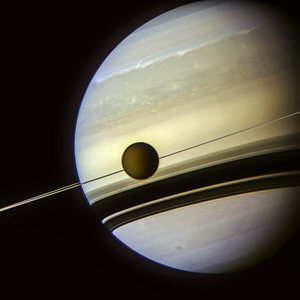
Titan, Saturn's largest moon, is a mysterious place. Its thick atmosphere is rich in organic compounds. Some of them would be signs of life if they were on our planet.
How do they form on Titan? Will they help us to discover how life began on Earth?
Titan's atmosphere is mostly nitrogen but there are also methane and many other organic compounds. Organic compounds form when sunlight destroys methane. If sunlight is continuously destroying methane, how is methane getting into the atmosphere?

On Earth today, it is life itself that refreshes the methane supply. Methane is a by-product of the metabolism of many organisms. On Earth, the simplest biological sources, such as those associated with peat bogs, rice fields and ruminant animals, continuously supply fresh gas to replace that destroyed by oxidation. Could this mean there is life on Titan?
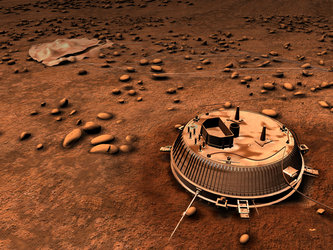
Titan is not a pleasant place for life. It is far too cold for liquid water to exist, and all known forms of life need liquid water. Titan's surface is -180°C. According to one exotic theory, long ago, the impact of a meteorite, for example, might have provided enough heat to liquify water for perhaps a few hundred or thousand years.
However, it is unlikely that Titan is a site for life today. But scientists are still currently puzzled by the amount of methane that persists in Titan's atmosphere. Could there be oceans of methane on or under the surface?