Meet the teams: Physics Addicted (2009)


New PDLC materials obtained from dispersion of liquid crystal under microgravity conditions
| University | Faculdade de Ciências da Universidade do Porto (FCUP) |
| Endorsing professor |
Carla Carmelo Rosa Physics Department, FCUP |
| ELGRA mentor | Thomas Podgorski, LSP, CNRS/UJF Grenoble |
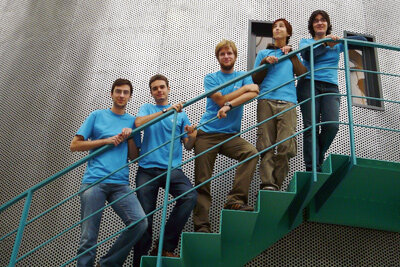
| Team | Marta Matos, Jorge Leitão, Ricardo André, Ricardo Zambujal |
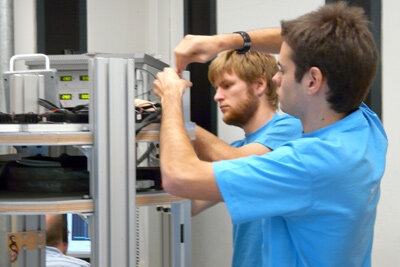
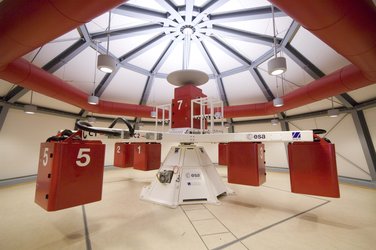
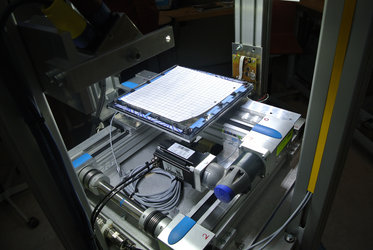
A group of four students from the Physics Department of the Faculty of Sciences at the University of Porto (FCUP) has used the ZARM drop tower in Bremen, Germany, to successfully conduct an experiment to study polymerisation of different types of Polymer Dispersed Liquid Crystals (PDLCs) under microgravity conditions. The polymerisation was achieved by using ultraviolet (UV) illumination.
PDLCs consist of micron-sized droplets of liquid crystal dispersed in a polymer matrix. This mixture combines the mechanical properties of polymers with the electromagnetic properties of liquid crystals, allowing control of the optical anisotropy of the PDLC film through the application of a specific electrical or magnetic field.
The electro-optical properties of PDLCs, such as light scattering, reorientation field, and switching speed, are very important in such applications as liquid crystal displays and electro-optical sensors. The properties are strongly influenced by the morphology of the PDLC film, i.e. the size, shape and distribution of LC droplets, which in turn is affected by the polymerisation conditions, including the level of gravity.
Compared to PDLCs which are polymerised under normal gravity conditions, samples polymerised in microgravity were expected to be less interconnected and more uniformly dispersed, with bigger and more spherical droplets that result in better light scattering and less intense reorientation fields.
For each type of PDLC, the structural and electro-optical properties of samples polymerised in microgravity and under normal gravity conditions were assessed and compared.
This experiment complements the work of Parbhakar et al that was performed at the ZARM drop tower in the 1990s [1], the research at the Physics Department of FCUP, and current research in the field that is targeted at optimising the electro-optical properties of PDLCs.
Among other applications, it might have an impact on maximising the performance of PDLC displays and switchable windows, which is mostly determined by light transmission, reorientation fields and response times.
Read more about this experiment on the ERASMUS Experiment Archive.
[1] K. Parbhakar, J. M. Jin, H. M. Nguyen, and L. H. Dao. Effect of microgravity on the distribution of liquid-crystal droplets dispersed in a polymer matrix. CHEMISTRY OF MATERIALS, 8(6):1210–1216, Jun 1996.