|  |  |  |  |
| |  | |  | |
 |
| Europe goes to Mars About Mars Express About Mars Meet the team Multimedia VideoTalkMars Express imagesMars Express videosHRSC videosAnimation in 11 languagesDownload wallpapersDownload screensavers3D Flash 'model'Make a modelServices Comments
|  |  |  |  | | | | Article Images |  | Western flank of Olympus Mons 21 April 2004
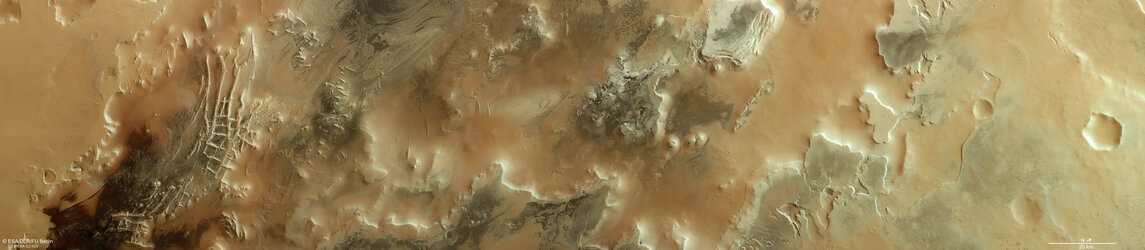
 | | This image was taken by the High Resolution Stereo Camera (HRSC) on ESA's Mars Express during orbit 143 from an altitude of 266 kilometres. This image was taken with a resolution of about 25 metres per pixel and centred at 222° East and 22° North. North is to the right.
The image shows the western flank of the shield volcano Olympus Mons in the Tharsis region of the western Martian hemisphere. The escarpment at lower left rises from the surface level to over 7000 metres.
At the top of the image, part of the extensive plains west of the escarpment are shown, known as the 'aureole' (from the Latin for 'circle of light').
To the north and west of the volcano, these 'aureole' deposits are regions of gigantic ridges and blocks extending some 1000 kilometres from the summit like petals of a flower. The origin of the deposits has challenged planetary scientists for an explanation for decades.
The most persistent explanation, however, has been landslides. Large masses of shield material can be found in the aureole area. Several indications also suggest a development and resurfacing connected to glacial activity.
This colour image has been created from the nadir channel and three colour channels. Image resolution has been decreased to 50%.
Credits: ESA/DLR/FU (G. Neukum) |  |  |  |  |
| | | |  | | This image was taken by the High Resolution Stereo Camera (HRSC) on ESA's Mars Express during orbit 143 from an altitude of 266 kilometres. This image was taken with a resolution of about 25 metres per pixel and centred at 222° East and 22° North. North is to the right.
The image shows the western flank of the shield volcano Olympus Mons in the Tharsis region of the western Martian hemisphere. The escarpment at lower left rises from the surface level to over 7000 metres. At the top of the image, part of the extensive plains west of the escarpment are shown, known as the 'aureole' (from the Latin for 'circle of light').
To the north and west of the volcano, these 'aureole' deposits are regions of gigantic ridges and blocks extending some 1000 kilometres from the summit like petals of a flower. The origin of the deposits has challenged planetary scientists for an explanation for decades.
The most persistent explanation, however, has been landslides. Large masses of shield material can be found in the aureole area. Several indications also suggest a development and resurfacing connected to glacial activity.
This anaglyph (3D) image has been created from the nadir channel (vertical view) and one stereo channel of the HRSC. Image resolution has been decreased to 50%.
Credits: ESA/DLR/FU (G. Neukum) |  |  |  |  |
| | | | | | | |  | | This image was taken by the High Resolution Stereo Camera (HRSC) on ESA's Mars Express during orbit 143 from an altitude of 266 kilometres. This image was taken with a resolution of about 25 metres per pixel and centred at 222° East and 22° North. North is to the left.
The perspective view shows the western flank of the shield volcano Olympus Mons in the Tharsis region of the western Martian hemisphere. The escarpment rises from the surface level to over 7000 metres. The lower part of the image shows the start of the extensive plains west of the escarpment, known as the 'aureole' (from the Latin for 'circle of light').
To the north and west of the volcano, these 'aureole' deposits are regions of gigantic ridges and blocks extending some 1000 kilometres from the summit like petals of a flower. The origin of the deposits has challenged planetary scientists for an explanation for decades.
The most persistent explanation, however, has been landslides. Large masses of shield material can be found in the aureole area. Several indications also suggest a development and resurfacing connected to glacial activity.
The anaglyph (3D) image has been created from the nadir channel (vertical view) and one stereo channel of the HRSC. The
colour image has been created from the nadir and three colour channels. Image resolution has been decreased to 50%.
Credits: ESA/DLR/FU (G. Neukum) |  |  |  |  |
| | | |  | | This image was taken by the High Resolution Stereo Camera (HRSC) on ESA's Mars Express during orbit 143 from an altitude of 266 kilometres. This image was taken with a resolution of about 25 metres per pixel and centred at 222° East and 22° North. North is to the left.
This is close-up perspective view of the western flank of the shield volcano Olympus Mons in the Tharsis region of the western Martian hemisphere. This escarpment rises from the surface level to over 7000 metres.
To the north and west of the volcano, 'aureole' deposits are regions of gigantic ridges and blocks extending some 1000 kilometres from the summit like petals of a flower. The origin of the deposits has challenged planetary scientists for an explanation for decades.
The most persistent explanation, however, has been landslides. Large masses of shield material can be found in the aureole area. Several indications also suggest a development and resurfacing connected to glacial activity.
The anaglyph (3D) image has been created from the nadir channel (vertical view) and one stereo channel of the HRSC. The
colour image has been created from the nadir and three colour channels. Image resolution has been decreased to 50%.
Credits: ESA/DLR/FU (G. Neukum) |  |  |  |  |
| |
|  | Looking at Mars Mars Express image browser Recent images View of deposits in Melas Chasma on MarsFractured crater near Valles Marineris'Yardangs' on MarsNorthern rim of Hellas basinMelas Chasma, in Valles MarinerisEvidence of flooding at Mangala VallesArsia Mons volcano in 3DDeep faults and disrupted crater at Acheron FossaeLouros Valles, south of Ius ChasmaClaritas Fossae tectonic region on MarsMore information High Resolution Stereo CameraBehind the lens...
|