| Europe goes to Mars About Mars Express About Mars Meet the team Multimedia VideoTalkMars Express imagesMars Express videosHRSC videosAnimation in 11 languagesDownload wallpapersDownload screensavers3D Flash 'model'Make a modelServices Comments
|  |  |  |  | | | | Article Images |  | ESA closes in on the origin of Mars’ larger moon 16 October 2008
| | | |  | | This animation shows the 3D (shape) model of Mars’ moon Phobos, built thanks to the data collected by Mars Express’ High Resolution Stereo Camera (53 images obtained by the Super Resolution Channel, or SRC) and NASA’s Viking (16 images). The model is dressed with a mosaic of the same images. The SRC coverage is about 70% of the moon’s surface. The mean resolution is 12 m/pixel.
During Mars Express’ fly-bys of Phobos, the MaRS radio science experiment on Mars Express detected the gravitational influence of the moon on the trajectory of the spacecraft, so allowing the determination of the moon’s mass with unprecedented accuracy (1.072 1016 kg, or about one billionth the mass of the Earth). The 3D model of the body built thanks to HRSC data, combined with the mass measurement, is key to calculate the mean density of Phobos. In turn, this can tell scientists a lot about the moon’s composition (how much rock or ice may be present, and how porous the structure may be), helping to close in on Phobos’ origin.
Credits: ESA/ DLR (K.Willner)/ FU Berlin (G. Neukum) |  |  |  |  |
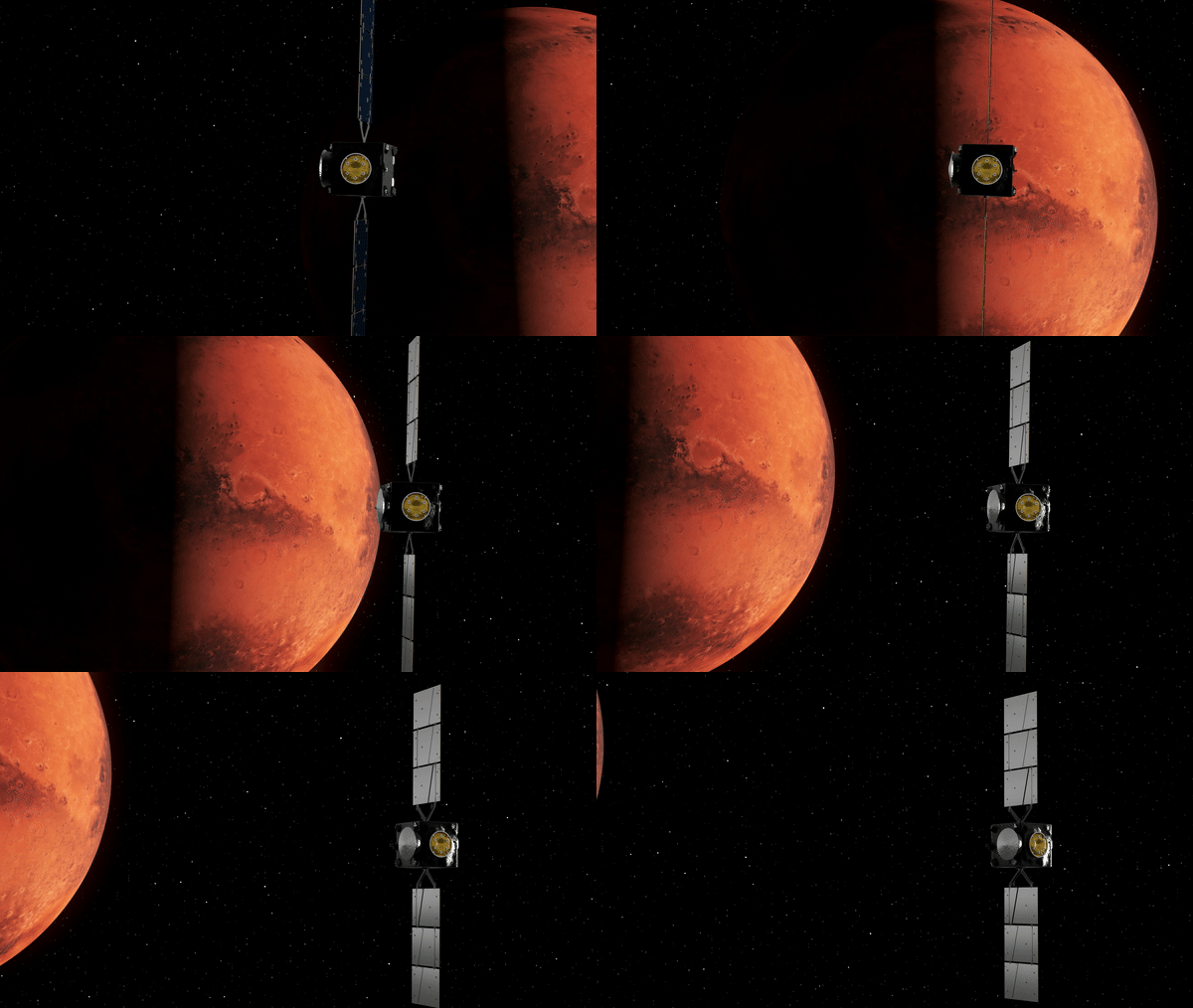
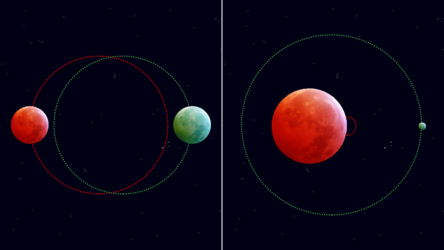
| | | |  | This animation shows how the orbit of Mars Express has been influenced by the gravitational influence of Phobos during the spacecraft’s fly-bys of the moon in Summer 2008. Since the orbital deviation strictly depends on the mass and shape of the moon, scientists could use this very deviation to determine the mass of Phobos with unprecedented accuracy (1.072 1016 kg, or about one billionth the mass of the Earth).
Credits: MaRS team/Observatoire Royal de Belgique |  |  |  |  |
| | | | | | | |  | This mosaic image is composed by 53 pictures obtained by the Super Resolution Channel (or SRC, a part of the High Resolution Stereo Camera experiment) on board ESA’s Mars Express. The SRC images covered 70% of the moon's surface. The remaining area is filled with 16 images previously obtained by NASA’s Viking mission. The mean resolution is 12 m/pixel.
Credits: ESA/ DLR (S. Semm, M. Wählisch, K.Willner)/ FU Berlin (G. Neukum) |  |  |  |  |
| | | | | | | | | | | | Note for editors
 | Geometry of the Phobos fly-by. Phobos and Mars Express are not to scale.
Credits: ESA/ DLR/ FU Berlin (G. Neukum) |  |  |  |  |
| | | |  | This stereo (anaglyph) view of Phobos has been obtained by the High Resolution Stereo Camera (HRSC) on board ESA’s Mars Express on 28 July 2008 (orbit 5870), at a distance of 351 km from the moon’s centre. The image was taken using the camera’s stereo-2 channel, at a resolution of 15 m/pixel.
Credits: ESA/ DLR/ FU Berlin (G. Neukum) |  |  |  |  |
| | | | | |
|  | Looking at Mars Mars Express highlights Phobos minigallery Water on MarsRelated articles Mars Express acquires sharpest images of martian moon PhobosMars Express to rendezvous with Martian moonListen to Phoenix descendMars Express supports Phoenix Mars landingTimeline: Mars Express support to Phoenix landingInterviews: the martian water cycle and climateMars radar opens up a planet’s third dimensionFrom Mars to the Earth: Studying ice beneath the surfaceMars Express reveals the Red Planet’s volcanic pastChoose a language Vollständiger Artikel Vollständiger Artikel Volledig artikel Noticia completa Koko tarina Articolo intero Les hele saken Volledig artikel Artigo completo Hela historien Vollständiger Artikel Articolo intero
|