ESAESA ScienceMars Express
   
Europe goes to Mars
About Mars Express
About Mars
Meet the team
Multimedia
VideoTalkMars Express imagesMars Express videosHRSC videosAnimation in 11 languagesDownload wallpapersDownload screensavers3D Flash 'model'Make a model
Services
Comments


Article Images
Mars Express orbiter instruments
 
 
  High Resolution Stereo Camera (HRSC)
 
The HRSC on board ESA's Mars Express will image the entire planet in full colour, 3D and with a resolution of about 10 metres. Selected areas will be imaged at 2-metre resolution. One of the camera's greatest strengths will be the unprecedented pointing accuracy achieved by combining images at the two different resolutions.

The Camera Head is the light grey unit in the middle and the top rectangular aperture. The Super Resolution Channel (SRC) is the black cylindrical aperture at lower right. The Camera Head and SRC together measure 515 x 300 x 260 mm. The Digital Unit is the black box at the back. The complete HRSC weighs 20.4 kilograms and consumes about 48.7 Watts with both camera and SRC working.

Credits: DLR/FU Berlin/ESA 2003

 
  OMEGA Visible and Infrared Mineralogical Mapping Spectrometer
 
 
  SPICAM Ultraviolet and Infrared Atmospheric Spectrometer
 
SPICAM instrument
Breadboard model of SPICAM undergoing tests during summer, 2000
 
  Planetary Fourier Spectrometer (PFS)
 
 
  ASPERA Energetic Neutral Atoms Analyser
 
 
  Mars Radio Science Experiment (MaRS)
 
MaRS
MaRS (Mars Radio Science Experiment)will use the radio signals that convey data and instructions between the spacecraft and Earth to probe the planet’s ionosphere, atmosphere, surface and even interior. Information on the interior will be gleaned from the planet’s gravity field, which will be calculated from changes in the velocity of the spacecraft relative to Earth. Surface roughness will be deduced from the way in which the radio waves are reflected from the martian surface. "Variations in the gravitational field of Mars will cause slight changes in the speed of the spacecraft relative to the ground station, which can be measured with an accuracy of less than one tenth the speed of a snail at full pace," says Martin Pätzold, MaRS PI from Köln University, Germany.
 
  MARSIS Sub-Surface Sounding Radar Altimeter
 
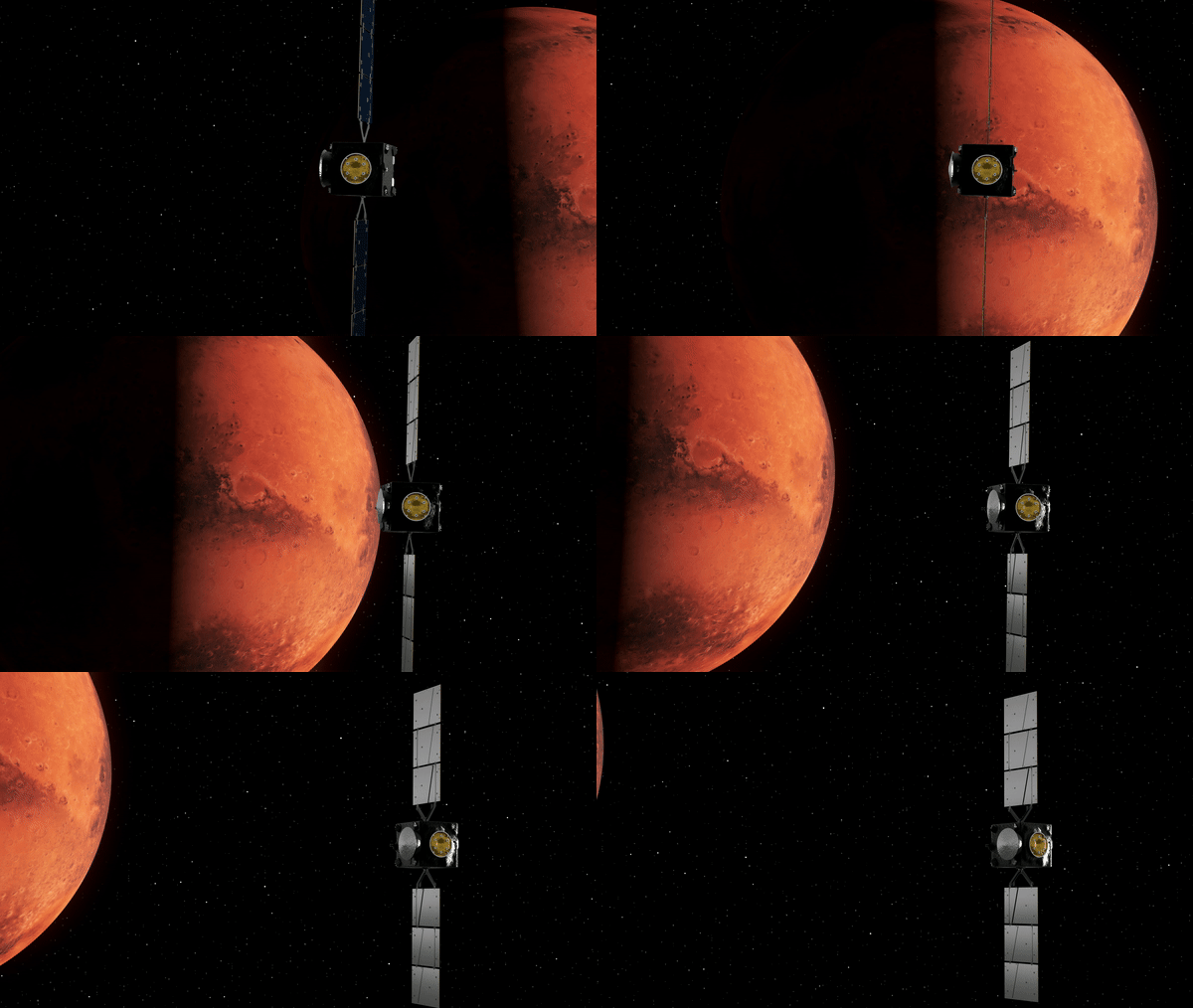
Mars Express with MARSIS antenna unfurled
Download:
 HI RES JPG (Size: 75 Kb)
Mars Express in orbit around Mars with the MARSIS antenna unfurled
 
  Last update: 30 November 2005 


Orbiter instruments
High Resolution Stereo CameraOMEGAPlanetary Fourier SpectrometerASPERAMaRS - Radio Science ExperimentMARSIS
Principal investigators
Freie UniversitaetInstitut d'Astrophysique SpatialeService d'Aeronomie du CNRSCNR-IFSISwedish Institute of Space PhysicsInstitut für Geophysik und MeteorologieUniversita' di Roma
La Sapienza


   Copyright 2000 - 2009 © European Space Agency. All rights reserved.