SOHO data used for real-time space radiation forecasting
Scientists are now testing a new method that uses SOHO data to predict, in real-time, the approach and intensity of hazardous solar particles that would threaten astronauts and technology in space.
The method was developed eight months ago by Dr Arik Posner, Southwest Research Institute (SwRI), USA, with collaborators from the University of Kiel in Germany, NASA’s Goddard Space Flight Center, USA and the University of Turku in Finland. It shows how latest results from basic solar physics research can be used rapidly for operational applications, such as in space exploration.
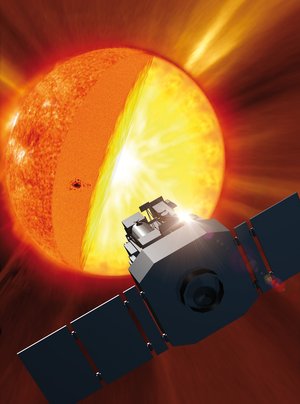
Posner used data from the Comprehensive Suprathermal and Energetic Particle Analyzer (COSTEP) on the ESA/NASA SOHO satellite. “It provides advance warning up to about one hour,” says Posner. “Although it seems relatively short notice, the warning can be mission-critical during extravehicular activities, such as on the lunar surface, but in most cases it will simply reduce astronauts’ total exposure to radiation.”
“COSTEP is currently the only instrument in space which can provide the input for Posner’s forecasting method,” says Professor Bernd Heber from the University of Kiel.
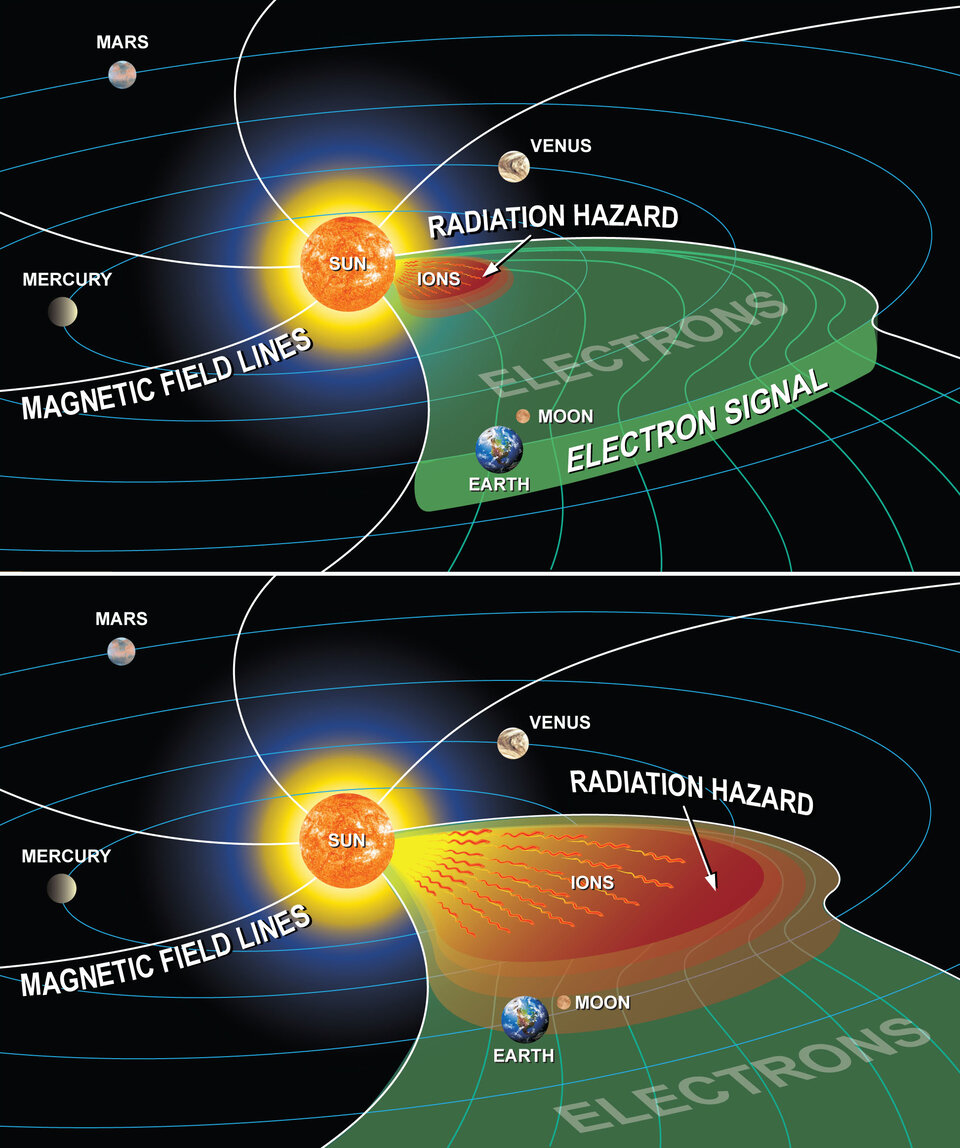
Since SOHO launched in 1995, COSTEP has provided a wealth of data but not in real time. “We were so excited by Posner’s project that we immediately teamed up and developed new software that displays the data and can give a warning three minutes after taking the measurements 1.5 million km away,” explains Oliver Rother from the University of Kiel.
The forecasting method calculates the appearance and intensity of solar ion events by measuring relativistic, near light-speed electrons. These are highly abundant, easy to detect outside of the magnetosphere and detectable ahead of the more dangerous ions that follow. Extreme solar events create the relativistic electrons, the characteristics of which can be exploited to predict the time and intensity of ions arriving later, which are predominantly protons with energies more harmful to humans.
Energetic protons and heavier ions are among the main constituents of solar particle events, and exposure of the human body to such ionising radiation elevates cancer risk. Heavy exposure to these particles can also result in acute radiation syndrome, with symptoms that include nausea, skin burns or disruption of the functioning of the central nervous system.
“Earth’s magnetic field helps prevent exposure to solar particle events,” says Posner, “but as space exploration leads humans out of this protective magnetic cocoon, towards the Moon and into outer space, this and other methods of space weather forecasting will become increasingly important.”
Notes for editors:
SOHO is a project of international cooperation between ESA and NASA.
COSTEP is funded by the German Aerospace Center (DLR). The instrument was developed and built at the University of Kiel (Germany) in collaboration with the Alcala University (Spain).
For more information:
Bernhard Fleck, ESA SOHO Project Scientist
Email: Bfleck @ esa.nascom.nasa.gov