Integral reveals exotic and dusty binary systems
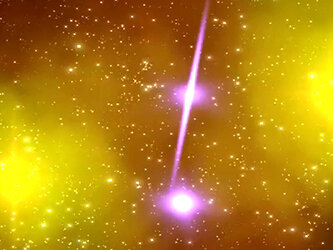
ESA’s orbiting gamma-ray observatory, Integral has revealed a new population of exotic and dusty binary stars which might represent a brief evolutionary period in a binary star’s life. The findings bring to light a gap in our knowledge of the formation and evolution of such binary star systems.
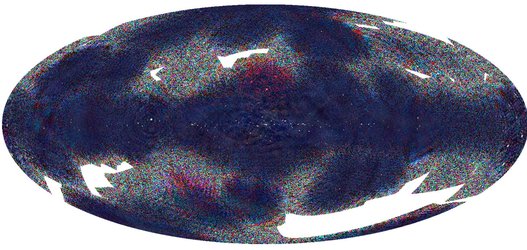
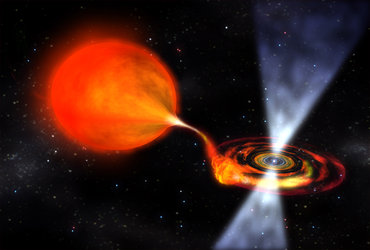
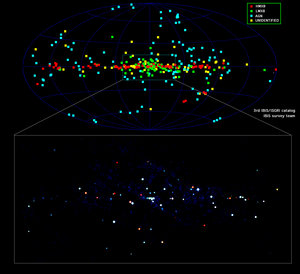
Since 2002, when Integral was launched, the observatory has been surveying the galaxy, looking for sources of the most powerful X-rays and gamma rays. Fifteen of its new discoveries appeared to be so-called supergiant high-mass X-ray binaries (HMXB). These binary systems consist of a neutron star orbiting around a supergiant star. Before Integral, only seven supergiant HMXBs were known.
The supergiant star is at least 20 times larger than the Sun, contains 30 solar masses, with luminosity one million times greater and a temperature of
Sylvain Chaty, University of Paris Diderot and CEA Saclay France, and colleagues have used Integral along with X-ray satellites and telescopes of the European Southern Observatory (ESO) to target the 15 new discoveries and confirm that most are indeed supergiant HMXBs, some of them enshrouded by a cocoon of gas and dust.
The supergiant star is at least 20 times larger than the Sun, contains 30 solar masses, with luminosity one million times greater and a temperature of
20 000 K .
“They are so deeply embedded that only Integral has the sensitivity to see them,” says Chaty. In each case, the neutron star is orbiting within the outer atmosphere of its supergiant companion.
This may be a precursor of what astronomers refer to as the common envelope phase, a short-lived period of a binary star’s existence that is thought to last for just a few thousand years. If so, it gives astronomers an unprecedented opportunity to study this aspect of stellar evolution. It also presents a problem.
These celestial pairings must once have been two supergiant stars in orbit around one another. According to our computer models of how stars form and evolve, such a supergiant pairing should be more scarce than Integral is showing it to be.
“There must be many more of them than we thought you could have,” says Chaty, “So we don’t quite know what is going on, yet.”

High-mass X-ray binary stars offer a snapshot of star formation, but delayed by about 10 million years. This is because the neutron star forms about 10 million years after the original system is formed, when the more massive of the two stars has lived its life and collapsed.
Eventually, such a system will evolve further with the death of the remaining supergiant star. At this point, a neutron star pair, or even a neutron star-black hole pair, is formed. As these tiny stellar remnants orbit one another, calculations show that they should lose energy and spiral together. At the point of collision they may release a giant Gamma Ray Burst.
A potential future ESA mission, currently undergoing technological development, hopes to detect nearby neutron star pairs. Laser Interferometer Space Antenna (LISA) will find them by spotting the gravitational waves they radiate as they spiral together.
In the meantime, Integral has plenty of work to look for more supergiant HMXBs and study the known ones further.
Notes for editors:
The following papers have been published today in the online issue of Astronomy & Astrophyiscs:
‘Multi-wavelength observations of Galactic hard X-ray sources discovered by Integral.’
I. The nature of the companion star by S. Chaty, F. Rahoui, C. Foellmi, J.A. Tomsick, J. Rodriguez, Walter
II. The environment of the companion star by F. Rahoui, S. Chaty, P.-O. Lagage, E. Pantin
For more information:
Sylvain Chaty, University of Paris Diderot, France
Email: Chaty @ cea.fr
Christoph Winkler, ESA Integral Project Scientist
Email: Christoph.Winkler @ esa.int