Mir FAQs - About the re-entry
What is going to happen at re-entry?
MIR has reached the end of its useful life (15 years, i.e. over three times its planned lifetime) and needs to be disposed of safely and in a controlled manner. The Russian Aviation and Space Agency has announced that the re-entry of the station will take place in March 2001. A fuelled Progress vehicle (M1-5) was launched on 24 January and docked onto the space station on 27 January. The engines of the Progress vehicle will be fired several times at regular intervals in order to bring MIR down into the Earth’s atmosphere (in other words, the Progress engines will be fired to "brake" and slow down MIR by acting in the direction opposite to that of the station's motion).
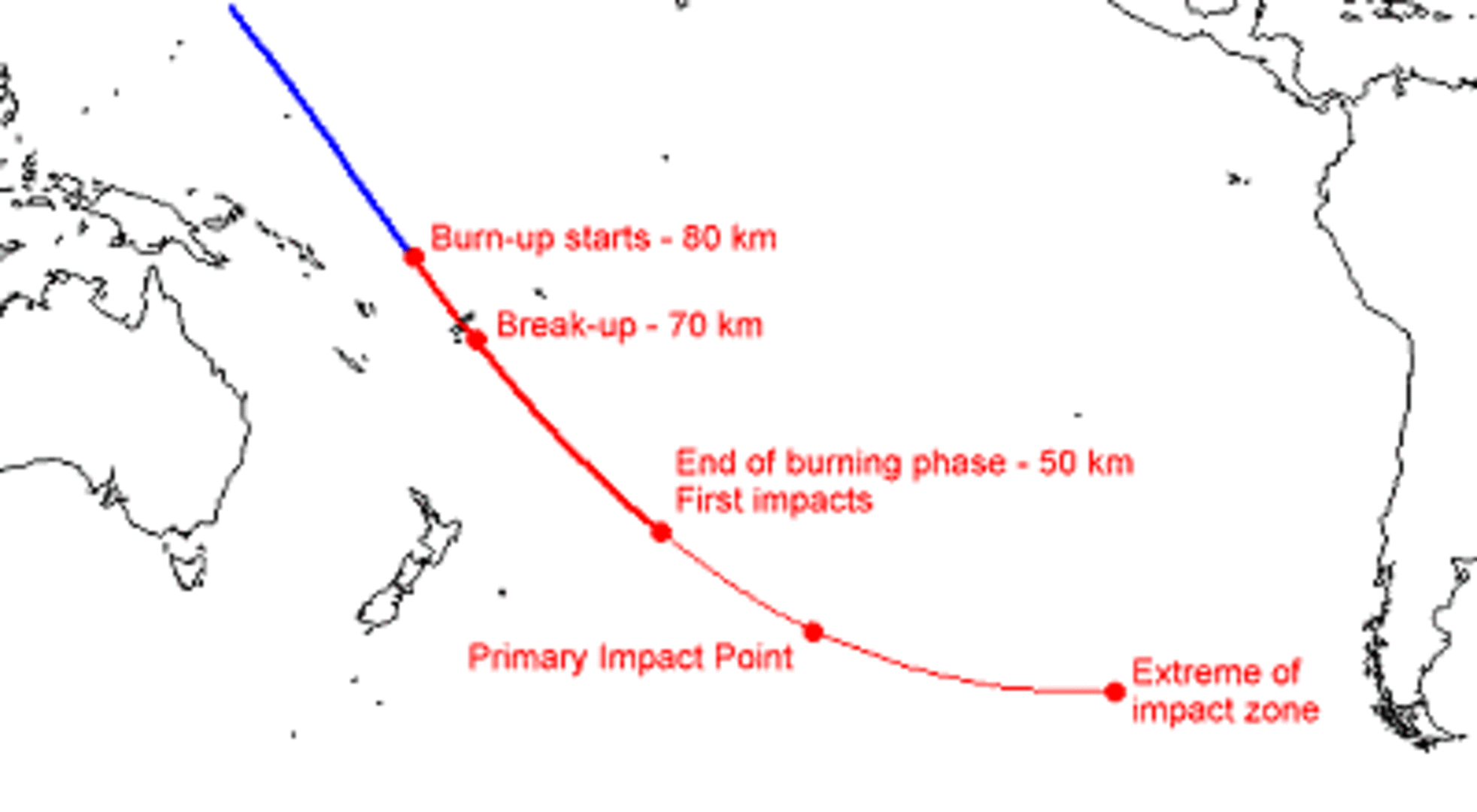
Re-entry is expected to take place over an uninhabited remote area, the southern Pacific Ocean (some 1500-2000 km southeast of Australia - the same area that was used for previous controlled re-entries of Progress vehicles).
Most of MIR will burn up in the atmosphere, as normally occurs with re-entering space objects that have to be disposed of. However, some pieces will impact on the ocean surface, creating an effect similar to the crash landing of one or two small aircraft.
How will the de-orbit be carried out?
On 20 March, Rosaviakosmos informed ESA that the final Mir de-orbit and re-entry phase is revised as follows:
The station’s altitude will be allowed to decay naturally to ~ 220km, which is currently expected to be reached early on Friday 23 March. When this altitude is reached, the attitude control system of Progress M1-5 will be activated and the station will be manoeuvred into its final de-orbit attitude and orientation (i.e. Progress M1-5 ahead).
Under this scenario, the first 3 impulses will bring the station down to an orbit altitude of approximately 217 x 158 km, and the final impulse will drive the orbit perigee down to approximately 82 km.
- In the nominal case, the final impulse (lasting approximately 800 sec) will be initiated in the area of Africa and will be completed over Russia, with a predicted impact point (to be reached approximately 45 min later) to the southeast of Australia at approximately 47 degrees South/140 degrees West.
Who is responsible for the re-entry operations?
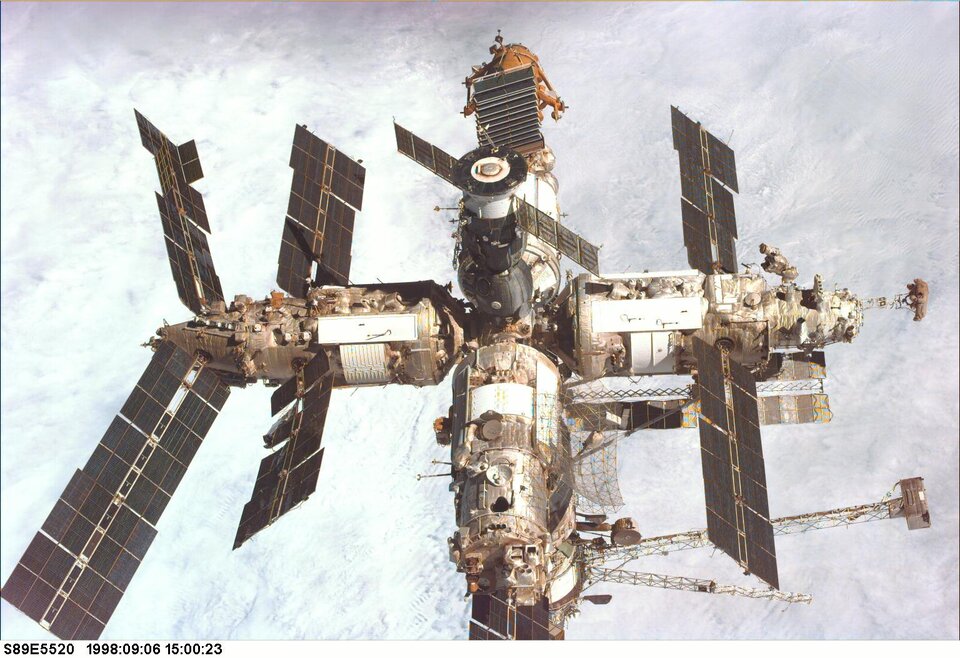
The Russian Aviation and Space Agency, Rosaviakosmos, has been charged by the Russian Government with the overall responsibility for all re-entry operations. RSC Energia, as the operator of the station and Rosaviakosmos’ TsUP Mission Control Centre in Korolev, near Moscow, are in charge of carrying out the de-orbiting. TsUP also oversees several tracking, telemetry and control stations spread all over the Russian territory.
What is the role of ESA?
ESA, together with other European partners, will monitor the progress of the MIR re-entry. A Mir De-Orbit Monitoring group was set up at the end of December 2000 within the Agency with the task of acquiring, screening and distributing information to Member States (and the media) during the preparation, de-orbit and re-entry phases of this critical operation. An official request from the Russian Aviation and Space Agency was made to ESA in mid-January to support re-entry activities with data coming from the FGAN radar of the German Ministry of Defence. Data will be relayed to Rosaviakosmos' TsUP Mission Control Centre in Korolev (near Moscow) through ESOC, ESA’s Control Centre in Darmstadt, Germany.
Why can’t MIR be dismantled in space?
In principle MIR could be dismantled in space. But then each module would require a separate de-orbiting with its own rocket engines and attitude control. The simplest solution is the de-orbiting of the whole station as one unit.
Why can't MIR's altitude be raised?
Raising the altitude would only postpone the problem to a later stage. The atmospheric drag would cause MIR to loose altitude and to re-enter sooner or later into the Earth's atmosphere. The safest procedure is to perform a controlled de-orbit and re-entry over an unpopulated area.
Why can’t the Shuttle retrieve MIR and bring it back in its cargo bay?

Most of the elements of MIR are too large to fit into the payload bay of the Shuttle. In addition, there are very stringent constraints placed on objects to be carried in the payload bay (e.g. mass limits and balance criteria).
Why do satellites return to Earth, is it gravity?
Not exactly, it is the combination of gravity and air drag. Satellites return to Earth because they rub against atoms of the highly rarefied atmosphere that extends for hundreds of kilometres above the surface of the Earth. The Russian Aviation and Space Agency will use rocket engines placed on the Progress vehicle to start the re-entry process in order to dispose of MIR safely.
More Mir FAQs
Last update: 21 March 2001